
Gallup: 27% of US Workers Fear AI Job Loss in 2026
Serge Bulaev
Gallup reports that 27% of U.S. workers now worry that technology may make their jobs obsolete, and this fear appears to be increasing. Experts suggest that this anxiety could harm workplace morale and retention if not addressed. Clear communication about how AI might affect specific roles and offering reskilling opportunities may help calm workers' fears. Piloting AI changes in a small way first, and measuring employee concerns, might make transitions smoother. Employers are advised to start with transparent information, support managers, and focus on both people and technical outcomes.

A recent Gallup poll reveals a significant rise in workplace anxiety: 27% of U.S. workers fear AI job loss, a seven-point increase in just one year More U.S. Workers Fear Losing Their Jobs to Technology. Workplace analysts warn that if left unaddressed, this growing concern can severely undermine morale, engagement, and employee retention. This playbook offers a strategic response for leaders.
Proactive and Transparent Communication
To counter rising automation anxiety, organizations must communicate early and transparently about how AI will impact specific roles. This includes clarifying which tasks will change and which will remain human-led. By providing clear information and upskilling managers, employers can build trust and reduce uncertainty.
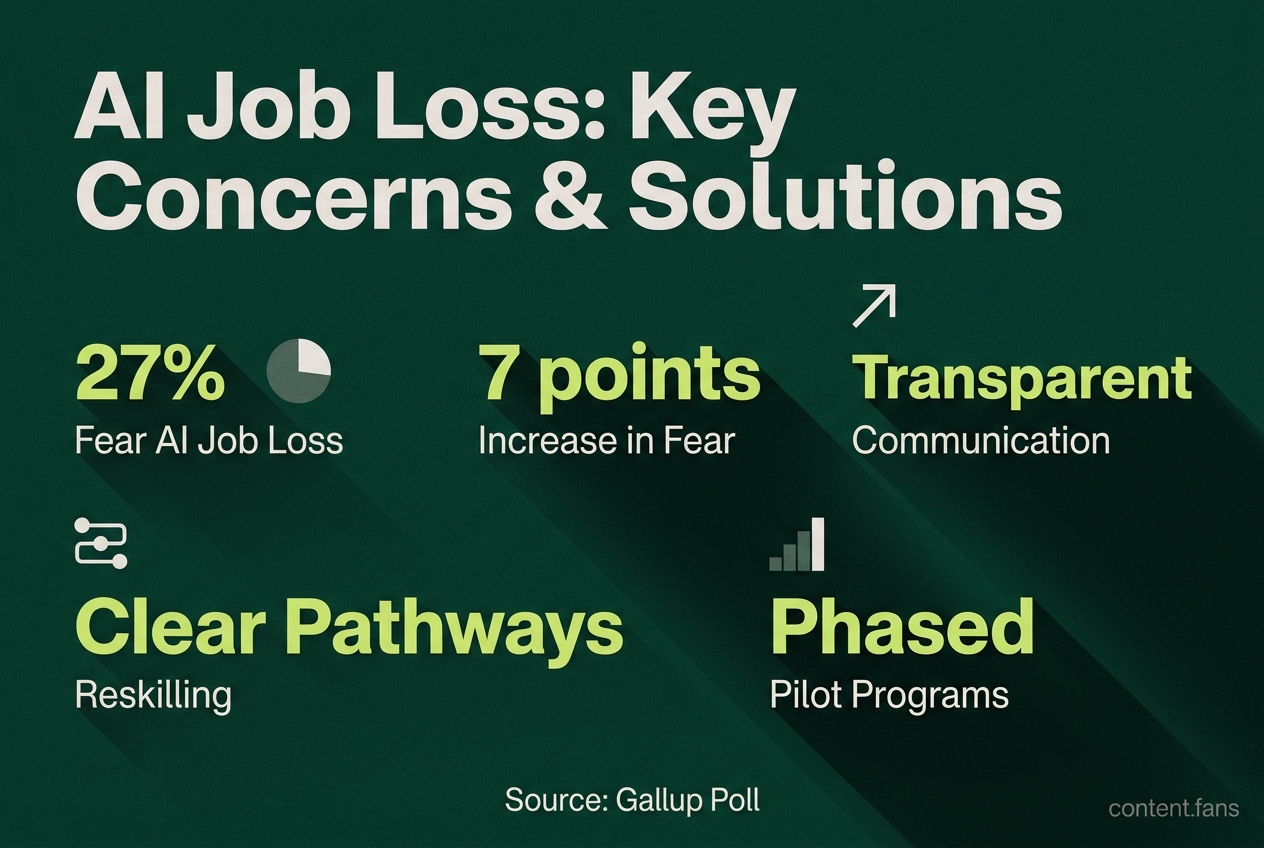
To prevent rumors and manage expectations, leadership must communicate early and transparently throughout any AI implementation How to Address AI Anxiety in Your Workplace (2026 Edition). HR departments should create role-specific impact statements detailing which tasks will evolve and which remain human-centric. Establishing a central FAQ hub and equipping managers with talking points are crucial first steps. Since supportive managers can mitigate displacement fears, upskilling supervisors in empathetic communication is a top priority.
Build Confidence with Clear Reskilling Pathways
While AI adoption often boosts productivity, it can also increase quit intent among heavy users, according to McKinsey. This suggests employees need to see a clear future for themselves within the company. Following recommendations from Mercer's 2026 talent trends, organizations should build visible and achievable reskilling pathways. Partnering with educational institutions can align training with future skill demands, while offering micro-credentials tied to internal job boards translates learning directly into career mobility.
Pilot, Measure, and Adjust Your AI Strategy
Anxiety often spikes when multiple new tools are launched at once. To manage this, implement a phased pilot program with a single job family. This allows HR to test adoption, collect feedback, and refine support materials before a company-wide rollout. Link sentiment surveys directly to action plans to demonstrate that employee feedback leads to real change. Key quarterly indicators to track include:
- percentage of employees reporting fear of automation
- internal mobility rate by skill tier
- manager comfort score on AI questions
- productivity self-rating among pilot participants
- turnover intention among heavy AI users
Listening sessions are crucial for pinpointing which roles feel most vulnerable and understanding the specific concerns behind the sentiment.
An Employer's Playbook: Key Deliverables and Budget
To move from awareness to execution, equip your teams with a practical starter kit. Key deliverables should include:
• Town-hall slide deck with current worker anxiety statistics as context
• Manager scripts for first-line Q&A
• Workforce-impact assessment template in spreadsheet form
• Sample six-month upskilling pathway for an at-risk role
• KPI dashboard outline linking sentiment, retention and productivity
For budgeting, industry reports suggest organizations should plan for a meaningful first-year investment in addressing AI anxiety. Research indicates that investing in comprehensive support programs correlates directly with lower quit intent among high-value staff. In essence: start with transparent facts, support managers, map out skill journeys, pilot carefully, and measure human outcomes alongside technical ROI.
What does Gallup's latest research reveal about worker anxiety over technology?
According to Gallup's August 2026 survey, 27% of U.S. workers now say technology could soon make their jobs obsolete - a 7-point increase from the previous year and roughly double the 13% recorded when Gallup first asked this question in 2017. This marks a new high in worker anxiety about technological displacement. Notably, concern has risen among both college graduates (25%) and non-college graduates (29%), and it is now the top job worry among workers under 45.
Why should employers take this anxiety seriously?
Employee fear of automation can directly harm morale, productivity, and retention. Research from 2025-2026 shows that while AI often boosts individual task efficiency, broader engagement has not improved in step - global employee engagement fell to 20% in 2025, the lowest since 2020. Additionally, McKinsey found that heavy AI users were 7-10 percentage points more likely to plan to quit in the next 3-6 months compared to light or non-users. Unchecked anxiety creates a cycle where workers disengage, productivity suffers, and talent walks out the door.
What immediate steps can HR leaders take to address technology-driven job fears?
HR leaders should focus on three parallel tracks: transparent communication, concrete reskilling pathways, and psychological safety supports. Best practices for 2026 emphasize communicating early and repeatedly about what technology will and will not change, creating a single source of truth for policies, and being explicit about role-specific impacts. TalentPredix research confirms that silence amplifies anxiety - leaders must address job security fears directly rather than hoping they fade.
How can organizations move from fear to opportunity through reskilling?
Targeted reskilling and redeployment transform anxiety into engagement when employees see visible, achievable career paths. Mercer's 2026 talent trends highlight upskilling as a strategic priority, with learning "within the flow of work" proving most effective. Organizations should develop sample upskilling pathways by job family, establish training partnerships, and redesign roles around augmented workflows rather than elimination. When employees understand how technology changes their work rather than replacing them, fear converts to confidence.
What metrics should organizations track to measure progress?
HR leaders should establish KPIs that capture sentiment and behavioral change: employee fear levels (tracked through pulse surveys), engagement scores, retention rates, and internal mobility rates. Gallup's research shows that supportive managers can reduce displacement worries even when AI use increases - making manager effectiveness a critical leading indicator. Growing worker anxiety about technology serves as a powerful executive-summary hook to secure leadership buy-in for these measurement and intervention investments, with progress benchmarked against current baseline levels in future survey cycles.