
AI Transforms Marketing: Marketers Adopt New AI, Discovery, and Hybrid Roles
Serge Bulaev
AI is changing marketing by making routine tasks faster and pushing marketers to focus more on strategy and oversight. Research suggests that AI automation and new discovery-driven platforms are leading to roles that mix data, creativity, and ethics. Social media may now act like a search engine for many people, especially Gen Z, which suggests marketers should optimize content for search within these platforms. Skills like using AI tools, analyzing data, and understanding privacy are becoming more important. Experts say that engagement and search visibility metrics may matter more than follower counts for measuring success.

The ongoing AI transformation in marketing is fundamentally reshaping daily workflows, reducing marketers' manual tasks and elevating their strategic responsibilities. As powerful AI tools rewrite campaign development and content discovery, a new paradigm is emerging. Recent research indicates that AI automation and discovery-driven platforms are merging, creating demand for hybrid marketing roles that require a blend of data analysis, creative insight, and ethical governance.
Marketer Roles Shift From Execution to Strategic Oversight
Artificial intelligence automates routine marketing activities like copywriting, data analysis, and campaign optimization, freeing professionals to focus on higher-level strategy, creative direction, and oversight. This shift moves the marketer's role from task execution to strategic guidance, ensuring AI tools align with brand goals and ethical standards.
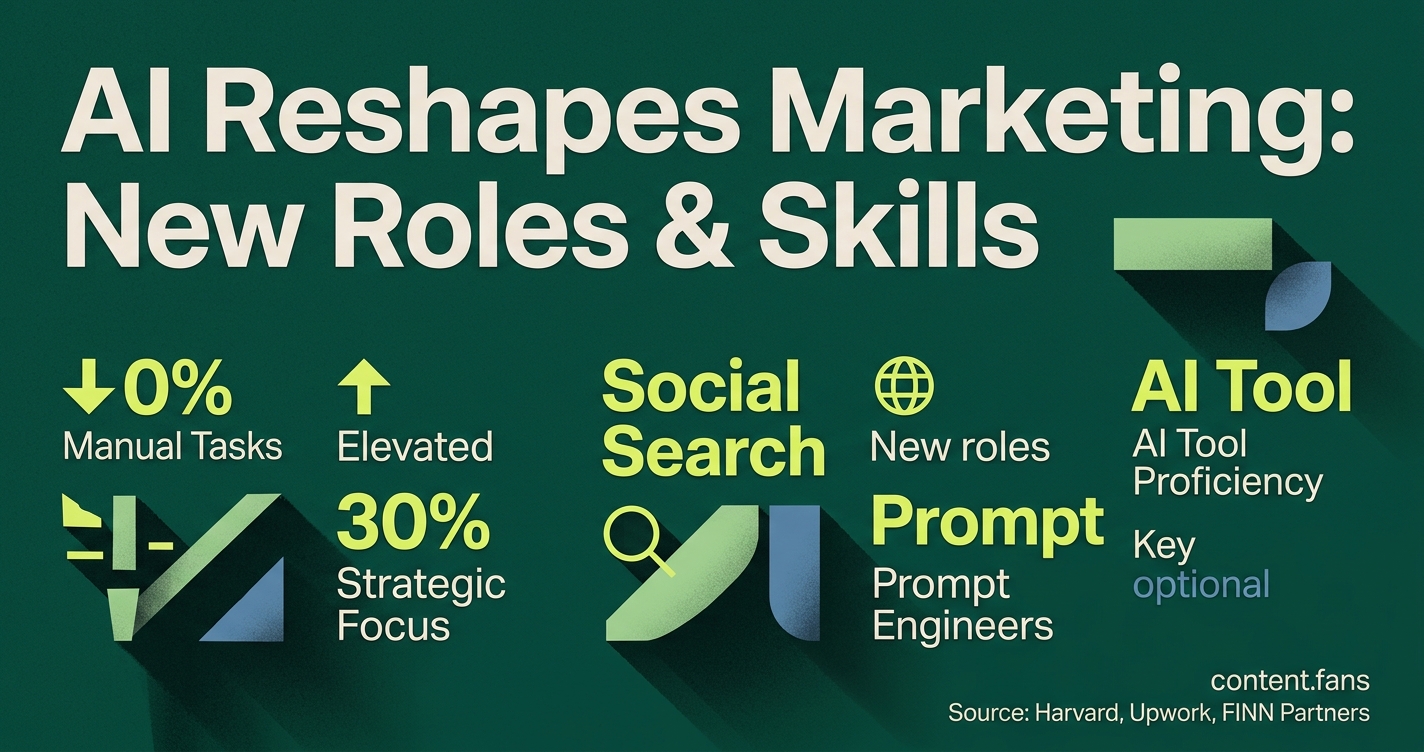
Industry analysis confirms this evolution. Harvard's Division of Continuing Education notes that tasks once requiring hours, such as data mining and copy drafting, are now completed in minutes. Concurrently, AI platforms are automating a wide range of functions from copywriting to campaign optimization, which shifts human focus toward strategic direction and critical judgment, according to Upwork Resources. As strategy becomes paramount - because AI "supports decisions... not define[s] them" - companies are adding specialized positions like prompt engineers and data scientists, while traditional production roles face mounting pressure.
Social Media Evolves into a Primary Search Engine
The rise of social search is fundamentally altering how audiences discover brands. For Gen Z, social networks have become an increasingly important discovery tool, with industry reports indicating a significant portion prefer using TikTok or Instagram for certain searches over Google. This trend extends beyond younger demographics, as platforms like Facebook are reorienting toward discovery feeds based on behavioral signals, not just social connections, per FINN Partners insight.
AI-powered search on these platforms now delivers concise, summarized answers directly within the user interface. To capitalize on this, marketers must adopt a "social SEO" mindset, treating every post as a searchable asset by embedding relevant keywords in captions, on-screen text, and image alt text to improve visibility in intent-driven feeds.
Essential Marketing Skills for the AI Era
To succeed, marketers must cultivate a blend of analytical fluency and creative discipline. Recruiters and industry sources consistently highlight the following essential capabilities:
- AI Tool Proficiency: Mastery of prompt engineering, output iteration, and quality assurance.
- Data Interpretation: The ability to translate analytics dashboards into actionable business decisions.
- Creative & Brand Stewardship: Guiding brand voice and developing narratives that AI cannot replicate.
- Ethical Governance: Applying judgment to privacy-aware targeting and the responsible use of consumer data.
- Cross-Channel Strategy: Coordinating campaigns informed by platform-specific analytics.
The value of these new skills is clear. As the Boston Institute of Analytics notes, "Even something like writing better prompts is turning into a skill people get paid for." This demand is creating new roles for creative technologists, AI-first performance marketers, and product marketers who can effectively leverage AI models.
Case Studies: AI-Powered Discovery and Engagement
Leading brands are already demonstrating the power of AI-driven marketing and discovery:
* Unilever's Dove: Utilized Nvidia Omniverse to build digital twins for influencer campaigns, achieving 3.5 billion social impressions and attracting a 52% majority of first-time buyers.
* Netflix's Stranger Things: Deployed a Messenger chatbot ("El Bot") across multiple countries that achieved high user retention rates, successfully extending the narrative universe through conversational AI.
* Nutella: Used generative algorithms to create seven million unique jar labels, transforming its packaging into a collectible experience and driving engagement at the shelf.
* BMW: Implemented AI-powered billboards that recognized vehicle models and displayed personalized messages, showcasing real-time personalization in an offline channel.
Widespread adoption confirms this trend. Industry reports show that a significant majority of marketers intend to integrate AI into their content creation, with many already using it for media production. These figures highlight a definitive industry-wide shift.
Redefining Success in the Discovery Era
In an algorithm-driven discovery era, traditional metrics like follower counts are becoming less important than engagement signals tied to search visibility. Experts advise marketers to prioritize KPIs that reflect genuine interest and intent, such as:
* Content saves
* Search impressions
* Profile visits from discovery surfaces
* Map clicks for local content
According to FINN Partners, authenticity and creator-led storytelling are key levers for boosting algorithmic relevance. Success is now measured by tracking how effectively creator collaborations drive these new discovery-focused KPIs, rather than just audience size.
How is AI changing day-to-day marketing work?
Routine tasks like copy drafting, keyword research, and basic reporting are now automated in minutes. Harvard DCE notes that work that once took hours is finished in minutes with AI, while Upwork adds the technology handles "everything from copywriting to campaign optimization." The human shift is from operator to strategist, editor, and ethical overseer.
Which skills matter most for marketers in the coming years?
- AI tool fluency - knowing how to prompt, iterate, and quality-check output
- Data interpretation - turning dashboards into decisions, not just collecting numbers
- Creative strategy - shaping brand voice and narrative that AI cannot invent
- Experimentation mindset - A/B testing, lift analysis, and causal reasoning
- Ethics & privacy judgment - governing how consumer data are used
Boston Institute of Analytics sums it up: "Marketers don't need to build AI, but they must know how to use it properly."
What new hybrid roles are appearing?
Job boards now list titles such as:
- AI-first performance marketer
- Creative technologist
- Prompt strategist
- Marketing analyst / data storyteller
- AI governance lead
Forbes reports businesses are hiring prompt engineers and data scientists to support these hybrid teams.
Is follower growth still the main goal on social platforms?
No. Industry reports indicate that discovery-driven algorithms are increasingly prioritizing content relevance over follower counts on TikTok, Instagram, and YouTube. Many Gen Z users now prefer TikTok and Instagram over Google for certain searches, while FINN Partners says Facebook's feed is becoming "a content discovery hub" driven by intent signals, not friend lists.
How should brands optimize for discovery-first platforms?
- Social SEO: write keyword-rich captions, add alt-text, and answer conversational queries
- Native search features: use location tags, TikTok keywords, YouTube chapters, and Instagram Map Search
- Creator-led authenticity: partner with relatable voices instead of polished brand-only content
- Social commerce: enable in-app checkout so discovery collapses into purchase in one session