
AI Transforms Digital Marketing in 2026: Social Becomes Search
Serge Bulaev
Artificial intelligence may soon become the core of digital marketing, helping brands connect with consumers through automation and personalized experiences. Social platforms like TikTok and Instagram appear to be acting more like search engines, so brands might need to focus on making their content easily found and relevant in these spaces. New job roles could emerge, but key skills still include strategy, understanding data, and using AI tools. Agencies and marketers may need to adapt by using more automation and focusing on authentic, proof-driven content instead of just follower numbers. While AI can handle routine tasks, human insight seems to remain important for setting goals and keeping brand trust.

Artificial intelligence is transforming digital marketing, profoundly reshaping workflows as social platforms evolve into primary search engines. Marketers who harness these dual trends can unlock significant brand discovery and growth, proving that AI enhances - rather than replaces - human strategic insight.
AI Moves From Add-On to Operating Core
Artificial intelligence is shifting digital marketing from manual campaign execution to strategic system oversight. AI now powers predictive analytics, real-time personalization, and automated ad bidding, allowing specialists to focus on guiding algorithms, filling content gaps, and improving user experience rather than managing routine tasks.
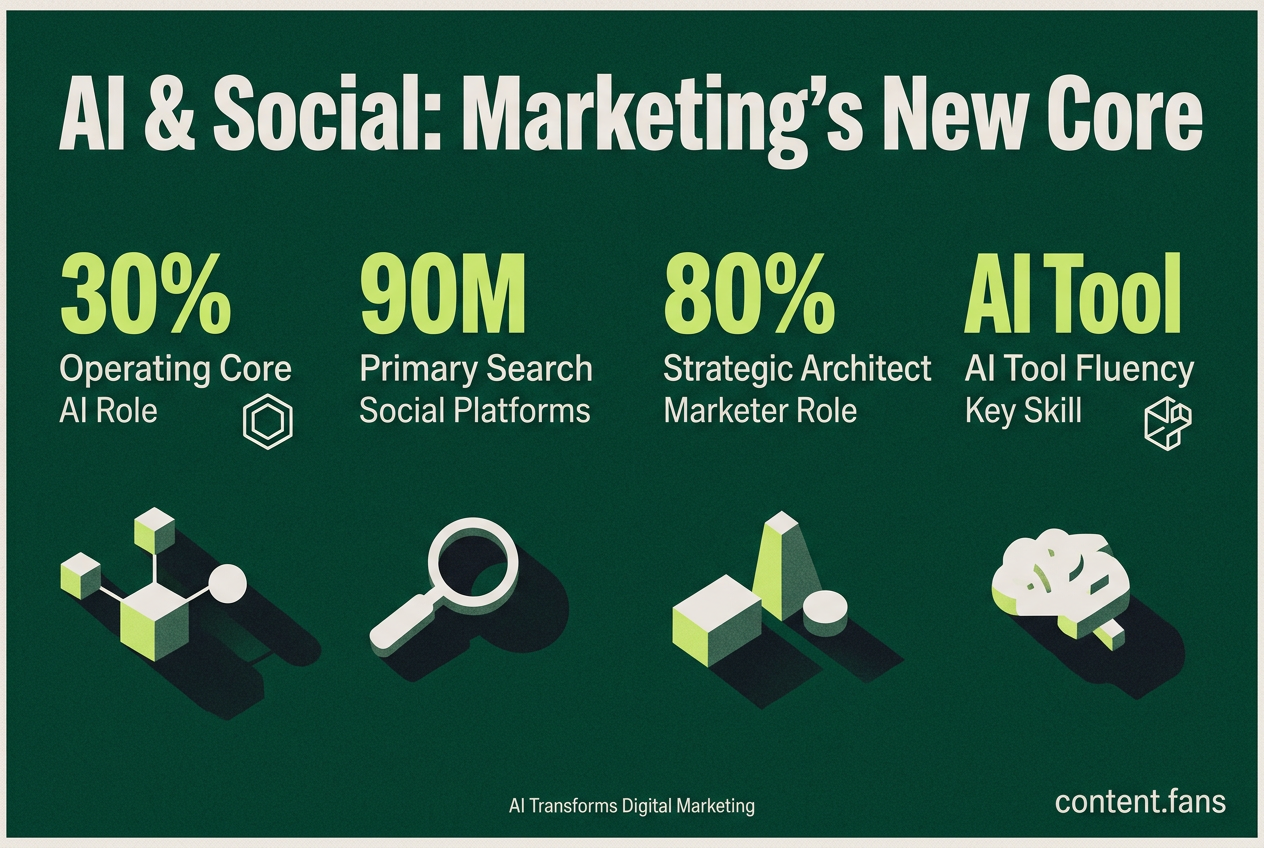
AI is revolutionizing how brands connect with consumers by enabling predictive analytics, real-time personalization, and automated campaigns, with a significant portion of marketers viewing automation as essential according to industry reports (IIDE). In parallel, search engines are increasingly prioritizing topical authority and user experience over keyword density, shifting the SEO focus to guiding algorithms and enhancing page experience (Refonte Learning). Paid media follows this trend, as AI-driven platforms adjust bids in real time, freeing marketers to supervise strategy while machines handle tactical optimization.
Discovery-Driven Social Replaces Follower Math
The concept of "search" is expanding into visual and conversational discovery on platforms like TikTok and Instagram (Sociallyin). These social networks are increasingly driving product discovery, with many consumers turning to social platforms for first-touch searches (Sprout Social). As a result, platform algorithms increasingly reward relevance, short-form video, and creator-led storytelling over raw follower counts. To succeed, brands must optimize captions, on-screen text, and spoken keywords for in-platform search, delivering immediate proof of value through unfiltered reviews, comparisons, and behind-the-scenes content.
Job Roles and Required Skills
The modern marketer's role is evolving from campaign operator to strategic architect, focusing on setting goals and training AI on business outcomes. While new titles like AI Marketing Strategist and Marketing Automation Architect are emerging, the foundational requirement remains strategic thinking rooted in clear objectives. Familiarity with automated platforms and analytics is now a baseline expectation.
Essential skill clusters include:
- AI tool fluency and prompt design
- Data interpretation and predictive analytics
- Semantic SEO and social search optimization
- Workflow automation design
- Privacy-aware first-party data strategy
Practical Adjustments for the Next 12 Months
To adapt over the next 12 months, marketers can focus on three high-impact areas:
- Audit content for topical authority and user intent alignment, prioritizing quality over volume.
- Repackage top-performing assets into short, searchable social videos with keyword-rich captions.
- Map campaign success to discovery signals like saves, shares, profile visits, and assisted conversions.
These actions align with major shifts in consumer behavior and platform engineering, positioning brands for future success.
Agencies Evolve Into System Orchestrators
Agency service models are evolving in parallel. Advanced analytics tools can surface insights and suggest strategic pivots more quickly than traditional methods (ALM Corp). AI-powered video tools are dramatically lowering production costs for tutorials and product explainers (Risex Ventures). Furthermore, privacy changes and the end of third-party cookies make first-party data combined with AI automation the new cornerstone of retention programs. Agencies reliant on manual tasks will face price pressure, while those building proprietary, AI-driven workflows with human oversight are positioned to offer superior consultative value.
Key Takeaway for Planning
The key is to leverage AI for routine optimization while empowering human teams to define strategy, supervise outputs, and safeguard brand trust. Discovery-first social platforms reward authenticity and proof over polish, making creator collaborations and unfiltered demonstrations essential. Ultimately, adaptable marketers who are supported by data, clear governance, and a commitment to continuous learning will thrive amidst these accelerating changes.