
Agentic AI Shoppers Could Drive $5T E-commerce by 2030
Serge Bulaev
AI shopping agents, also called agentic shoppers, may drive $190B - $385B in U.S. online sales and $3T - $5T globally by 2030, according to forecasts. These agents could handle up to one in five e-commerce dollars in the U.S. by the end of the decade. Agentic commerce means AI systems find, check, and buy products for consumers, which appears to make data quality more important than website design. Retailers might need to update product data and APIs so AI agents can easily find and pick their products. The exact growth of agentic shopping before 2030 is still uncertain, depending on factors like consumer trust and regulations.

AI-powered agentic shoppers are poised to reshape the digital marketplace, potentially driving $3 - $5 trillion in global e-commerce by 2030. This seismic shift requires retailers to move beyond website design and focus on structured product data to capture a share of this autonomous commerce wave, where AI agents - not humans - make purchasing decisions.
The Multi-Trillion-Dollar Opportunity in Agentic Commerce
Leading financial analysts forecast a monumental shift in online retail. Morgan Stanley projects that agentic shoppers could account for $190 billion to $385 billion in U.S. online sales by 2030, representing 10-20% of the market, as detailed in a recent NielsenIQ report. On a global scale, McKinsey's agentic commerce analysis estimates the opportunity at $3 trillion to $5 trillion, with up to $1 trillion in the U.S. B2C sector alone. These AI systems autonomously discover, evaluate, and purchase products, collapsing the traditional sales funnel.
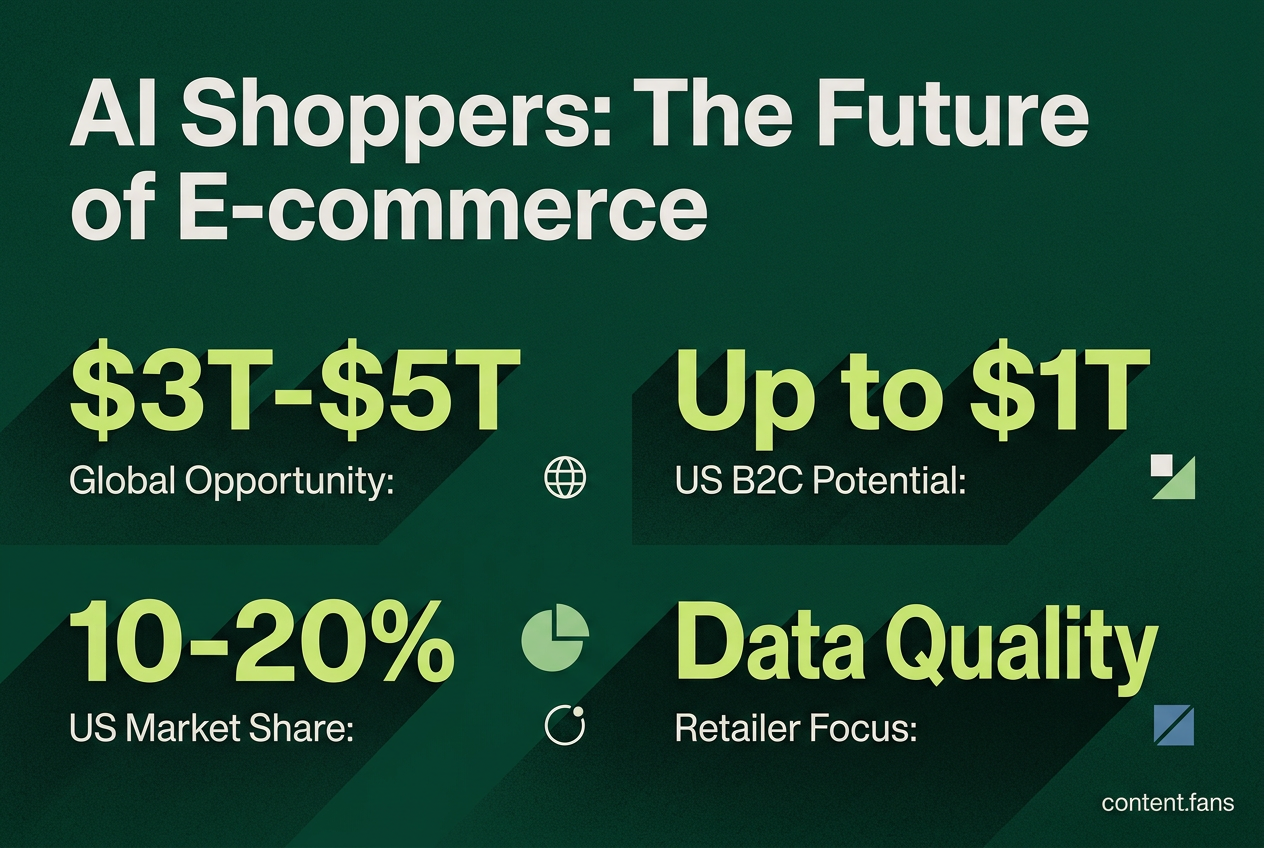
Agentic commerce is a new retail paradigm where AI systems autonomously manage the shopping journey on behalf of a consumer. These agents prioritize structured, machine-readable data - such as price, stock levels, and product attributes - over visual design or marketing copy, fundamentally changing how brands must compete for online visibility.
From Persuasion to APIs: A New Discovery Model
The rise of agentic shoppers marks a pivot from persuasive marketing copy to structured data feeds. AI agents process factual information like price, availability, user reviews, and technical specifications in milliseconds to create a curated shortlist. Consequently, brand visibility now hinges on data quality and API accessibility, not front-end web design. Industry analysis indicates that product pages without accurate schema markup for Product and Offer details risk being completely invisible to these automated systems.
The Retailer's Playbook for an Agentic Future
To prepare for this shift, retailers are adopting a new operational playbook focused on data governance over web design. Key strategic actions include:
- Implement comprehensive schema: Add or validate
Product,Offer, andReviewschema markup to make price, inventory, and specifications machine-readable. - Sync data in real-time: Use live data feeds for stock levels and pricing to prevent AI agents from discarding offers based on outdated information.
- Standardize product attributes: Create a consistent vocabulary for product details (e.g., size, material, compatibility) across all channels to eliminate ambiguity.
- Expose catalogs via APIs: Ensure product catalogs are accessible through APIs, not just human-readable web pages, for seamless machine integration.
- Prioritize facts over fluff: Structure product pages to place factual specifications above narrative marketing copy, aligning with how agents rank information.
Global Trends and the Road to 2030
The adoption of agentic commerce is a global trend, with analysts noting a convergence between Eastern social commerce models and Western retail media ecosystems. While this fusion is expected to accelerate AI agent adoption, the exact timeline remains fluid. The wide forecast ranges from Morgan Stanley and McKinsey reflect variables like consumer trust, evolving regulations, and the pace of technical standardization. However, the consensus points to a multi-trillion-dollar agent-driven market, defining the core strategic challenge for retailers today.
What exactly is an "agentic shopper"?
An agentic shopper is an AI system that can discover, compare, and buy products without human clicks. Instead of browsing pages, the agent reads structured feeds, checks real-time inventory, and places the order. NielsenIQ says these agents are already "collapsing the traditional funnel", so the winner is whichever brand gives the clearest, freshest data.
How big could agentic commerce become by 2030?
Two Wall Street benchmarks appear in NielsenIQ's The Commerce Revolution:
- Morgan Stanley: $190 B - $385 B in U.S. e-commerce, roughly 10-20 % of all online retail
- McKinsey: $3 T - $5 T global opportunity, with up to $1 T inside U.S. B2C retail alone
Why does product data need to change for AI agents?
Agents do not read glossy copy; they scan schema markup, pricing APIs, and attribute tables. If a feed lacks SKU-level clarity, availability pings, or normalized specs, the agent skips the item and the sale evaporates. Retailers are therefore rebuilding catalogs so "good agents prefer them".
Which restructuring steps matter most for retailers?
- Add Product, Offer, and Review schema so every price, variant, and rating is machine-readable
- Replace static pages with live inventory & pricing feeds
- Standardize fields (size, material, compatibility, shipping, returns) across every channel
- Expose the catalog through APIs and interoperable feeds, not just HTML
- Move factual specs above marketing copy on product pages
How soon could agentic shoppers own a significant share of U.S. online retail?
Morgan Stanley's scenario places the 10-20 % threshold by 2030, only five years away. Because agents accelerate routine purchases, commodity categories (groceries, drugstore, household staples) may cross into significant market share first, while luxury or experiential goods trail slightly.