
Agentic AI shifts enterprises from SaaS seats to workflow platforms
Serge Bulaev
Enterprises moving from seat-based SaaS to workflow platforms may face technical and organizational challenges. Agentic AI appears to work best in workflow systems that track and manage entire processes, which may explain why this shift is happening. Experts suggest starting with small, focused projects and measuring real business results early on. Good governance, careful integration planning, and clear communication with teams are recommended to avoid problems and support adoption. Studies suggest most agentic AI projects have not yet scaled fully, often due to gaps in process redesign and team alignment.

Enterprises are rapidly adopting agentic AI, a shift that is moving them from seat-based SaaS to workflow platforms. This transition introduces both technical and organizational challenges, driven by the growing recognition that AI agents perform best in systems that manage end-to-end processes. This guide provides a strategic roadmap for IT, procurement, and business leaders to navigate this evolution from pilot to enterprise scale.
Why Workflows Beat Seats for Agentic AI
Agentic AI delivers maximum value by orchestrating complete business processes, not just isolated user tasks. Unlike standalone SaaS tools, workflow platforms offer the native logging, policy enforcement, and exception handling required for automation at scale. These platforms act as control planes for coordinating AI agents, integrating with core systems like ERPs, and providing essential enterprise oversight. Ultimately, architectural alignment with workflow systems - not just AI model performance - is the key to unlocking sustained returns.
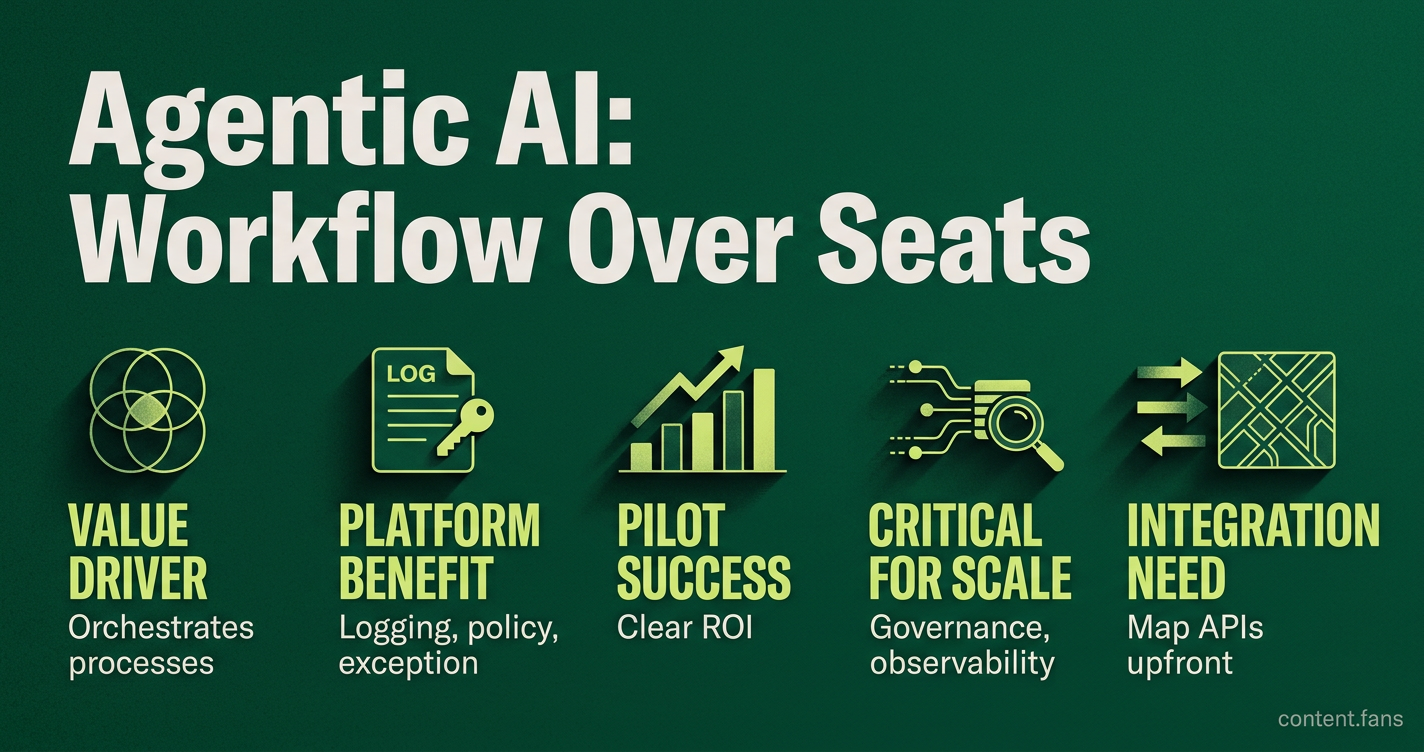
Workflow platforms are superior for agentic AI because they are designed to manage, track, and audit entire multi-step processes. This structure provides the necessary control, observability, and integration points for AI agents to execute tasks autonomously and securely, which isolated, seat-based SaaS applications cannot offer.
Start Small and Measure Real Outcomes
Successful agentic AI adoption begins with narrow, high-volume pilot projects that establish a clear ROI. For example, according to industry reports, Klarna achieved significant cost savings by automating customer service chats with an AI agent. Similarly, major financial institutions have deployed numerous AI use cases, with some reporting meaningful improvements in legal review processes. Successful pilots consistently leverage existing data and track key business metrics like cost, latency, or handle time from day one.
Governance and Observability First
Many agentic AI projects fail when governance is an afterthought. To ensure success, embed robust controls from the beginning, including role-based access (RBAC), confidence-based thresholds for human review, and immutable audit logs. Full-stack observability is equally critical; instrument every agent decision, feedback loop, and API call to detect and resolve issues rapidly before scaling.
Sequence Integrations Before Scaling
Before selecting a platform, meticulously map all required integrations, including ERP, CRM, identity providers, and document repositories. Pilot environments may use clean data and loose controls, but production systems demand robust connectivity. Defining critical APIs and authentication requirements upfront prevents costly re-architecture and delays during enterprise-wide scaling.
Five Criteria for Vendor Shortlists
When creating a vendor shortlist, evaluate platforms against these five essential criteria:
- Industry & Use-Case Specificity: Proven success in your specific industry and workflow type.
- Autonomy & Human-in-the-Loop Controls: Flexible options for configuring human oversight and approval gates.
- Integration & API Depth: A rich library of pre-built connectors combined with a robust, open API.
- Security & Auditability: Verifiable security certifications (e.g., SOC 2), clear data policies, and comprehensive audit trails.
- Observability & Performance Metrics: Dashboards tracking key metrics like latency, cost per transaction, and success rates.
Change Management and Adoption Gaps
A significant adoption gap exists, with many agentic AI initiatives failing to scale across the enterprise, often due to poor process redesign and stakeholder misalignment. Overcome this by developing a clear change management strategy. Proactively communicate with finance, compliance, and business teams about the boundaries of AI autonomy and the role of human oversight. Comprehensive training, clear escalation procedures, and regular value reporting are essential for building trust and ensuring successful adoption.