
Z.ai's GLM-5.2 challenges GPT-5.5 with lower cost, higher coding performance
Serge Bulaev
Z.ai's GLM-5.2 may challenge GPT-5.5 because it appears to cost much less and may perform better on some coding tasks. Reports suggest GLM-5.2 offers similar or higher scores on coding benchmarks and could save companies money, especially for heavy code-generation work. New government and security rules might delay or limit model access for some users, meaning companies have to check more carefully before choosing AI tools. Most organizations seem to use more than one AI model, possibly to keep their options open and deal with changing costs and rules. This suggests that, in 2026, the best approach may be using a mix of models instead of only one.

The announcement that Z.ai's GLM-5.2 challenges GPT-5.5 signals a market shift where factors like pricing and policy are becoming as critical as raw model performance. For enterprises, securing affordable and reliable AI access is paramount. This is highlighted by the pricing gap: GLM-5.2 is listed at $1.40 per million input tokens and $4.40 per million output tokens in the provided sources; GPT-5.5 pricing is not verified by the supplied sources. According to industry reports, this cost difference can be substantial when factoring in output tokens.
Edge in AI access economics
Z.ai's GLM-5.2 presents a significant challenge to GPT-5.5 by reportedly delivering better performance on advanced coding benchmarks like SWE-bench Pro and Terminal-Bench. This performance advantage is coupled with a substantially lower operating cost, making it a highly attractive alternative for enterprises focused on budget-efficient AI development.
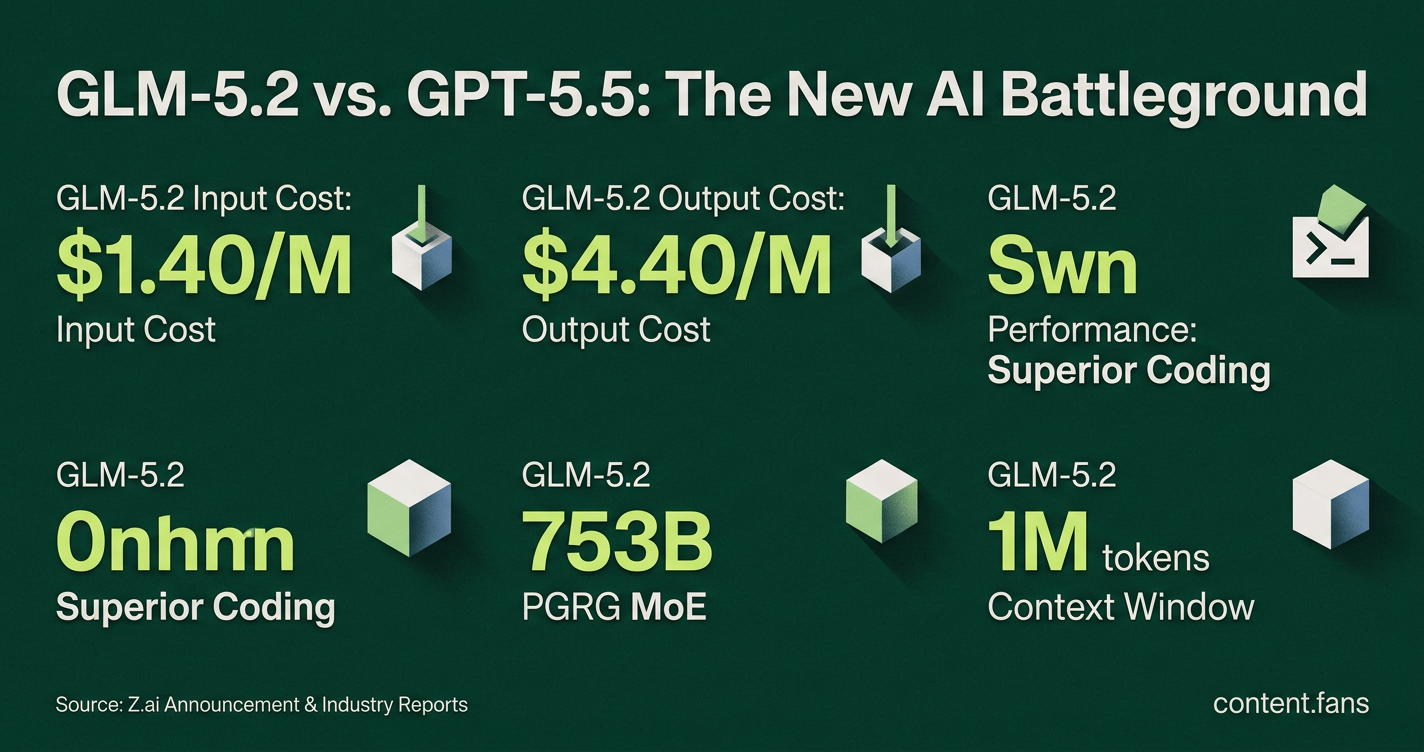
According to industry reports, GLM-5.2 outperforms GPT-5.5 on complex, long-horizon coding tasks. The 753-billion-parameter Mixture-of-Experts (MoE) model reportedly achieved superior scores on SWE-bench Pro and Terminal-Bench compared to GPT-5.5. Achieving superior performance at what can amount to a significant fraction of the total operating cost forces a re-evaluation of paying premiums for closed-source APIs.
Z.ai further enhances its value proposition with an enterprise plan that reportedly includes a one-million-token context window. This plan features the IndexShare sparsity method, which according to industry reports reduces compute requirements significantly at full context. For teams managing heavy code-generation workloads, this translates directly to significant infrastructure savings.
Policy restrictions reshape procurement
The decision is not purely financial. Regulatory and policy constraints are increasingly shaping AI procurement. For instance, the June 2026 White House executive order creates a voluntary framework in which frontier-model developers may provide the federal government early access for up to 30 days before release to other trusted partners, which could cause rollout delays for government contractors and critical infrastructure sectors. Furthermore, reports of providers restricting access for foreign nationals based on security directives introduce a new layer of complexity. As these policies become more common, multinational corporations must conduct extensive due diligence to ensure uninterrupted tool access for their global teams, adding to procurement overhead.
Hybrid stacks become the safe default
In response to these economic and regulatory pressures, a hybrid AI strategy is emerging as the industry standard. Industry reports indicate that a significant majority of organizations already utilize two or more LLM providers. The growing adoption of open-weight models is further confirmed by reports that a substantial portion of Fortune 500 companies have verified accounts on platforms like Hugging Face. This trend shows enterprises are using open-weight models for cost-sensitive tasks while reserving closed, proprietary models for high-stakes reasoning.
A typical hybrid stack now involves:
- Closed Frontier APIs: For safety-critical reasoning and tasks requiring maximum vendor support.
- Open-Weight Models: Deployed on private infrastructure for coding, automation, and data retrieval to optimize cost and control.
- Orchestration Layers: To dynamically switch between models based on real-time cost, latency, or policy requirements.
This diversified approach suggests that the most resilient procurement strategy is building a flexible portfolio of AI tools rather than relying on a single flagship model.
What makes GLM-5.2 cheaper to run than GPT-5.5?
GLM-5.2 costs significantly less than GPT-5.5 for real-world workloads according to industry reports.
- Input tokens: $1.40 per million (GLM-5.2 verified pricing)
- Output tokens: $4.40 per million (GLM-5.2 verified pricing)
The open-weight MIT license also removes per-seat or audit fees that closed models often hide.
Which coding tasks does GLM-5.2 actually win on?
According to industry reports on long-horizon benchmarks:
- SWE-bench Pro: GLM-5.2 reportedly outperforms GPT-5.5
- Terminal-Bench: GLM-5.2 shows superior performance
- FrontierSWE: GLM-5.2 demonstrates competitive results
These are real-world, multi-file engineering tasks, not toy puzzles.
Can I host GLM-5.2 inside my own cloud or on-prem?
Yes. The 753-billion-parameter MoE is downloadable and runs on standard 8×A100 or 8×H100 nodes. Z.ai's IndexShare layer reportedly cuts peak-memory use significantly, so a 1-million-token context fits in standard GPU configurations.
Will U.S. policy restrictions affect my access to GPT-5.5?
Potentially. The June 2026 White House order creates a voluntary framework in which frontier-model developers may provide the federal government early access for up to 30 days before release to other trusted partners, and reports suggest some providers have implemented access restrictions for foreign nationals on certain models. If your team includes non-U.S. citizens, you may face delays or segmenting with closed models.
How are enterprises mixing open and closed models?
Industry reports indicate that a significant majority of organizations now use two or more LLM providers. Typical split:
- Open-weight for internal coding, batch jobs, long docs (cost, control, self-host)
- Closed frontier for highest-stakes reasoning where vendor support is required
This hybrid portfolio is becoming a common procurement pattern.