
Companies Measure AI ROI, Turn Data Into Revenue Streams
Serge Bulaev
Companies are trying to better measure how useful AI really is by using new ways to track its value. Simple usage numbers may not show true results, so teams are starting to track things like saved time, fewer mistakes, and real financial impact. Some companies may also make money by selling their well-organized data once it has helped them internally. Experts suggest testing the AI carefully, comparing it to old methods, and reviewing results often. What counts as 'good' AI is still being defined, and companies might change their tools as they learn what works best.

To effectively measure AI ROI and turn data into revenue streams, companies must move beyond simplistic usage metrics. As leaders see token consumption climb without clear business value and finance teams scrutinize GPU costs, a robust measurement strategy is critical. This guide outlines how to use multidimensional ROI frameworks, baseline experiments, and data licensing to define and capture the true economic impact of AI.
From Usage Logs to Economic Primitives
Move from vanity metrics like user queries to tangible business outcomes. The Three-Pillar framework advises tracking financial, operational, and strategic gains. Leading teams now measure "economic primitives" - task complexity, autonomy, and success rates - to see if AI is tackling complex problems or just simple tasks. Establishing a pre-AI baseline is essential. By timing current workflows and recording error rates, companies can use 30-day A/B tests to isolate the AI's true impact. Quarterly reviews can then translate these performance deltas into clear ROI figures and calculate the Levelized Cost of AI for each valuable result.
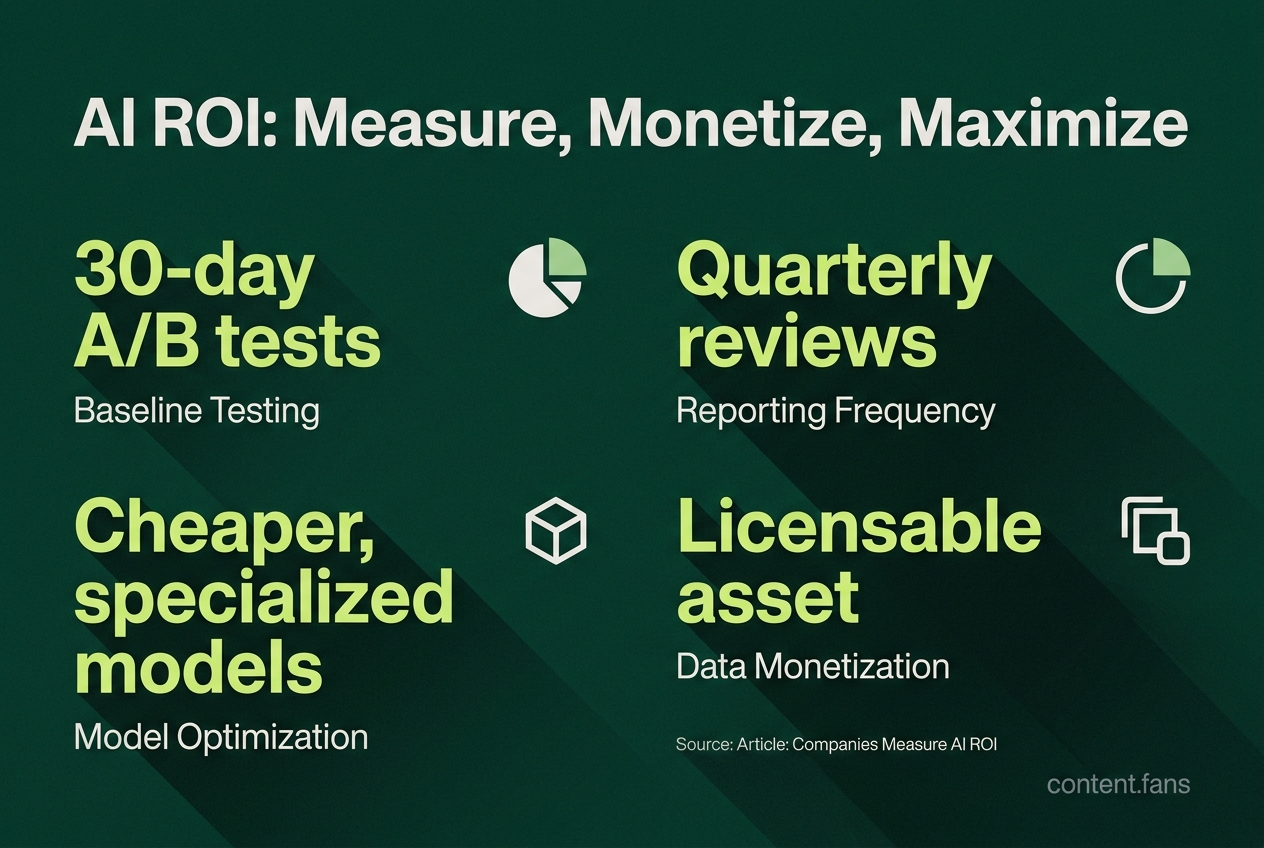
To accurately measure AI ROI, establish a performance baseline before deployment by recording task times and error rates. Then, track "economic primitives" like task complexity and success rate instead of simple usage. This isolates the AI's direct impact on efficiency, cost reduction, and strategic goals.
Defining and Measuring 'Good' Inside Benchmarks
A benchmark serves as a scorecard connecting AI predictions to meaningful business outcomes. For example, an AI agent can be graded on its ability to improve customer retention or accelerate bug fixes. Clear benchmarks reveal two key benefits: first, cheaper, specialized models often outperform large, general-purpose LLMs for specific tasks; second, each graded AI interaction generates valuable labeled data that can be licensed to other companies. This approach simultaneously cuts costs and opens new revenue opportunities.
- Establish Baselines: Quantify time, errors, and revenue of existing processes.
- Select Key Metrics: Choose indicators that directly link to profit or risk mitigation.
- Run Controlled Pilots: Use 30-day tests with attribution controls to isolate AI impact.
- Report Quarterly: Integrate AI performance into standard business reviews.
- Re-evaluate Models: Continuously assess if a different model can achieve goals more efficiently.
Turning Benchmarked Output into a Revenue Asset
Once a dataset's internal value is proven, it can be transformed into a licensable asset. Healthcare and media companies are leading this trend. For instance, according to industry reports, AstraZeneca has entered into significant partnerships for oncology data, as detailed in recent deal studies. Similarly, major platforms are generating substantial revenue by licensing their content to AI companies. With the growing AI training data market, well-documented datasets offer a dual return: first from operational improvements, then from direct sales. To capitalize, strategic legal planning around data rights, exclusivity, and privacy is essential to avoid devaluing the asset during M&A.
Selecting Models After the Metrics Speak
When clear, quarterly ROI data becomes available, organizations can optimize their AI model portfolio. For example, structured-data analysis can be shifted to more cost-effective relational foundation models. High-stakes tasks like compliance benefit from models engineered to reduce hallucinations, while security-sensitive operations may require on-premise solutions. This creates a powerful feedback loop: precise metrics justify using more efficient models, and the data generated from these interactions enriches a proprietary dataset that can be monetized or used for further model refinement. This virtuous cycle of optimization and value creation begins with a solid measurement framework.
What is the fastest way to prove AI is creating real value, not just hype?
Start with a pre-AI baseline and measure economic primitives - task complexity, autonomy level, and success rate - instead of vanity metrics like "logins." Enterprises that do this see significantly better performance on business-specific tasks and can shift from expensive general models to cheaper specialized ones. A quarterly cadence that feeds CFO-grade payback models into standard business reviews keeps the story credible to finance and the board.
How do companies keep attribution clean when many factors move at once?
They run 30-day structured pilots with A/B cells and isolate the AI impact with attribution modeling. Gartner's dual metric set - Return on Employee (ROE) and Return on Future (ROF) - is becoming the default way to separate what the model did from what the market or a new process did.
Which industries are already turning their data into cash by selling it to AI labs?
Healthcare and media lead the charge. Pharma players like AstraZeneca have entered into substantial partnerships with companies like Tempus for access to multimodal oncology datasets, while major content platforms are generating significant annual revenue from AI labs licensing forum and news content. The AI training data market continues to grow rapidly, so niche operators with exclusive, compliant datasets are finding ready buyers.
Why are many CEOs still reporting zero ROI from AI?
Most skipped the baseline step and chose the wrong payback model for the use case - a trap called the payback paradox. Without a counterfactual, even strong results look like noise, and finance teams default to zero. Companies that treat AI as a balanced portfolio of bets - each with its own economic identity - are among the minority that already profit.
When does it make sense to swap a frontier LLM for a smaller, specialized model?
As soon as well-defined goals show the task is narrow and the data is domain-specific. Relational foundation models trained only on tabular ERP or supply-chain data routinely outperform giant LLMs on forecasting, cut latency, and significantly reduce cost per query.