
VAST pivots to 'AI operating system' with $1B Series F funding at $30B valuation
Serge Bulaev
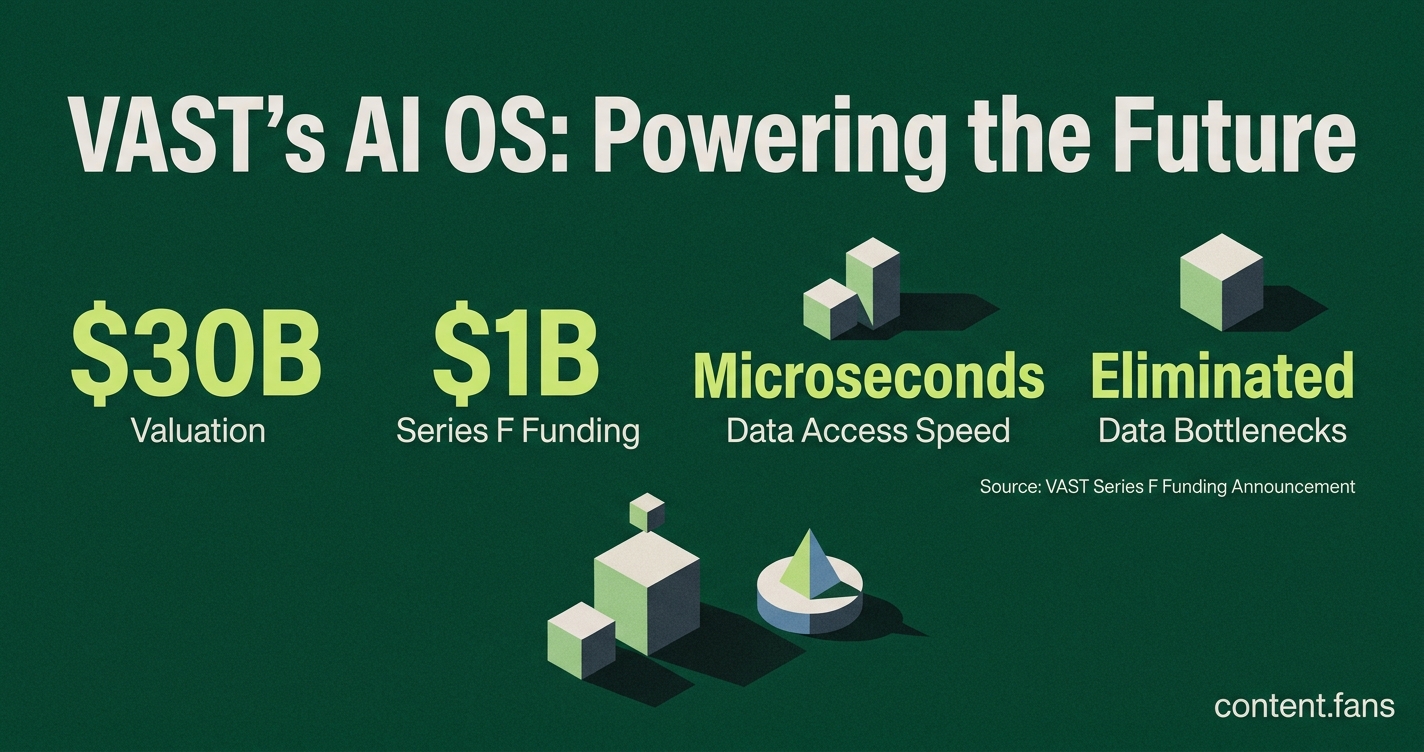
VAST is shifting to become an 'AI operating system' that joins storage, database, vector search, and execution in one platform. The company says this may help make data processing faster and easier for AI applications. VAST recently raised about $1 billion at a $30 billion valuation, which suggests investors see potential in this new direction. Analysts note that the move appears to answer the needs of AI systems that require quick access to organized data. It is unclear if this new type of platform will become a standard in the market, as it depends on how competitors respond.

VAST pivots to an 'AI operating system' with a strategic move that unifies storage, database, vector search, and execution into a single, integrated platform. This approach is designed to eliminate critical data bottlenecks between GPUs and applications, positioning VAST in the middle of the modern AI stack. Industry analysts see the pivot as a direct response to AI workloads that require extremely fast data processing and preparation.
What lives inside the AI operating system
VAST's AI operating system is a unified data platform combining exabyte-scale storage, a distributed database, native vector search, and a CUDA-enabled execution engine. It processes and indexes data as it's ingested, allowing AI applications to query new files in seconds without moving data between separate systems.
The platform integrates four core services into a single control plane:
- Exabyte-scale flash storage using its DASE (Disaggregated Shared Everything) architecture
- A distributed database for both structured and semi-structured data tables
- Native vector search that stores embeddings alongside the raw data objects
- An execution engine that triggers CUDA tasks directly as new files arrive
According to VAST, this consolidated design simplifies operations by processing data in place, which avoids the complexity of external message brokers or redundant data copies.
Fresh capital to fund the pivot
This strategic pivot is backed by significant new capital. VAST recently secured substantial Series F financing, with the round led by Drive Capital and co-led by Access Industries, signaling strong investor confidence in the company's "AI OS" strategy. The company has reported strong growth in cumulative bookings.
Competitive signals
The "AI OS" positions VAST in a competitive landscape against both data platform giants like Databricks and Snowflake and high-performance storage specialists such as WEKA and Dell PowerScale. To minimize latency, VAST clusters can run directly on GPU-accelerated servers, a strategy noted by Supercomputing.news. However, competitors are highlighting hardware trade-offs. Dell claims its PowerScale storage array uses 72% less energy and 80% less rack space than competitors to run the same Nvidia technology. VAST counters by emphasizing its microsecond data access speeds, enabled by NVIDIA BlueField-4 DPUs.
Why integrated processing matters
The push for integrated platforms addresses a major industry pain point: data readiness. According to industry reports, a significant portion of AI projects fail or stall because data is not properly prepared. VAST's platform automates critical preparation steps like chunking and embedding directly within its execution engine. This convergence of storage and data processing may signal a market shift away from chained, single-purpose products. Underscoring this trend, AI cloud provider CoreWeave, VAST's largest customer, has adopted the platform as the foundational data layer for its services. All customers also receive the Polaris software at no extra cost to manage VAST clusters across hybrid environments.
Road ahead
While major analysts do not yet track market share for the "AI operating system" category, VAST's reported financial growth points to strong market demand for unified data infrastructure. The future of this emerging category will depend on whether competitors can match VAST's integrated database, vector search, and execution features without compromising raw training throughput.