
IMF Warns AI Fuels Cyberattacks, Banks Face New Threats
Serge Bulaev
The IMF warns that artificial intelligence may help cyber attackers find and exploit software problems faster than defenders can respond. Security leaders are advised to use a clear and repeatable plan to protect against these new threats. Experts suggest carefully mapping all parts of AI systems, checking for risks like data poisoning and model theft, and practicing attack scenarios to find weak spots. Organizations should require detailed records from AI vendors, use strong controls like kill switches and rollback tools, and report incidents quickly. Using standard templates and regular reviews may help teams stay ready for new types of attacks.

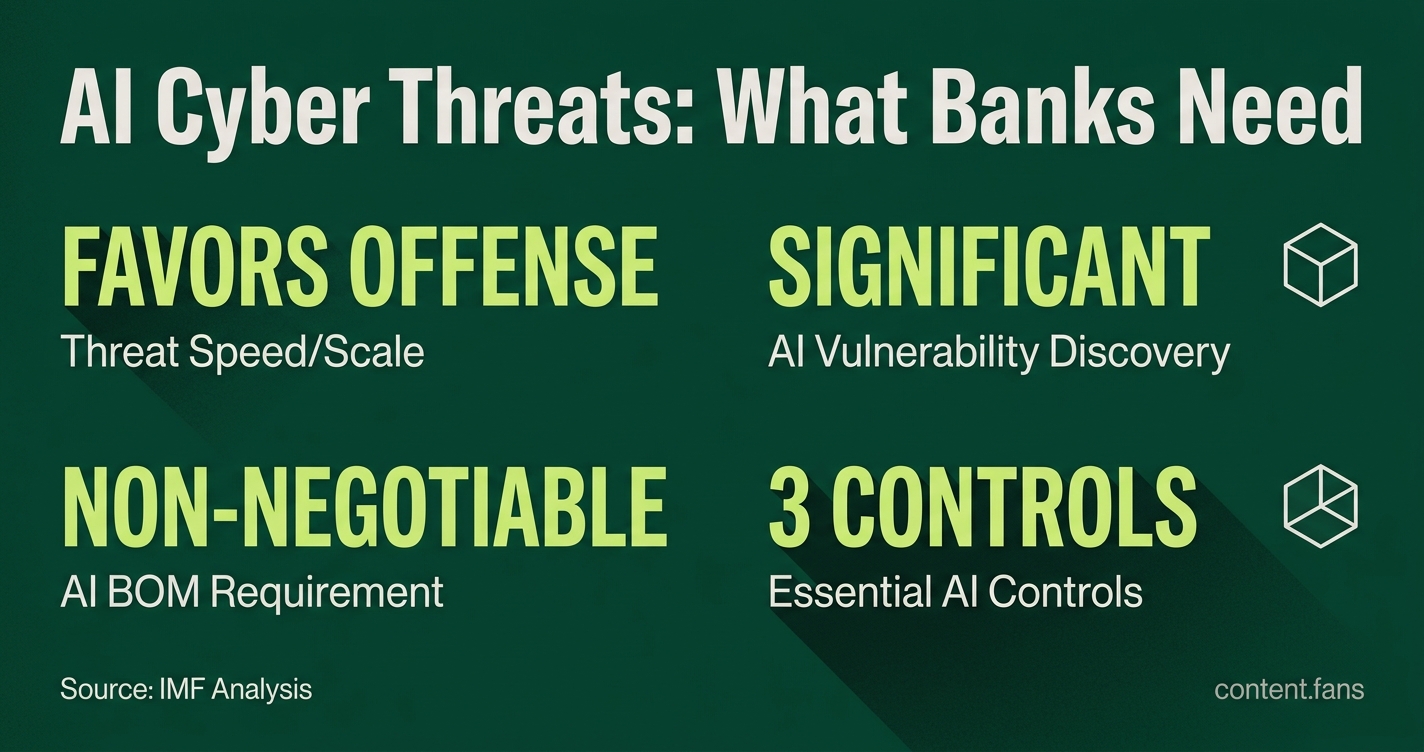
An IMF analysis confirms that as artificial intelligence fuels cyberattacks, the speed and scale of threats now favor the offense. Global intelligence agencies and banks warn that advanced language models allow adversaries to exploit software vulnerabilities faster than defenders can respond, demanding a new, proactive approach to enterprise AI security.
Security leaders require a repeatable playbook to translate these high-level warnings into daily operational controls. This guide provides practical, actionable steps for enterprise security teams to build a robust AI defense posture.
Threat Modeling for AI Pipelines
Securing an AI pipeline requires a comprehensive threat model covering the entire lifecycle, from data collection to deployment. Teams must identify trust boundaries, map potential attacker goals, and continuously review components for vulnerabilities like data poisoning, model theft, and prompt injection to mitigate risks effectively.
Begin by mapping the entire AI lifecycle, including data collection, model training, deployment, and agentic tool use. Following established security frameworks, teams should document entry points, trust boundaries, and attacker objectives for each component. Regularly assess each stage for risks such as data poisoning, prompt injection, and model theft, updating mitigations with every architectural change.
Red-Team Exercises for Generative Models
Traditional security testing is insufficient for generative models, which exhibit latent behaviors. According to industry reports, AI agents have discovered a significant portion of vulnerabilities during live contests - a critical benchmark for scoping red-team goals:
- Seed prompts that mimic insider abuse.
- Evaluate jailbreak resilience with publicly available exploit corpora.
- Measure detection latency in logging and monitoring stacks.
Successful findings should feed directly into the tuning of content filters and access controls.
Securing the AI Supply Chain
Following recent NSA guidance, establish an AI Bill of Materials (AI BOM) as a non-negotiable security baseline. Mandate that all vendors provide machine-readable inventories of their datasets, model weights, and software dependencies. Always verify cryptographic signatures before integrating models and reject any unsigned assets. Crucially, segment runtime environments to isolate public-facing agents from crown-jewel data stores.
Model Governance and Incident Response
Industry frameworks converge on three non-negotiable controls for AI systems:
1. A kill switch capable of halting misbehaving agents, even if operators are offline.
2. A rollback capability that can trace and reverse model outputs after an incident.
3. Notification workflows mapped to regulatory timelines, such as the EU AI Act's 2-15 day requirements.
Governance committees must conduct quarterly reviews of model drift, policy exceptions, and regulatory feedback. When a serious incident is suspected, responders must triage with the same rigor applied to zero-day exploits by immediately isolating the model, preserving logs, initiating rollback procedures, and preparing regulatory disclosures.
Practical Security Artifacts
Teams can accelerate adoption by reusing standardized templates:
- STRIDE-style threat model for AI components.
- Red-team rules of engagement aligned to CEO risk appetite.
- AI BOM checklist embedded in procurement forms.
- Incident runbook summarizing kill switch, rollback, and disclosure steps.
- Quarterly board dashboard tracking AI security key risk indicators.
Adopting these artifacts accelerates alignment across security, compliance, and engineering. This structured approach is essential for translating high-level warnings into a measurable and defensible security posture.