
Nvidia, Palantir restrict Anthropic AI use over data fears
Serge Bulaev
Nvidia, Palantir, and Booz Allen Hamilton have reduced their use of Anthropic's most advanced AI models because of worries about how their private data might be exposed. These companies are now using the models only for tasks with lower sensitivity. This change may hurt Anthropic's income from high-value clients and may help competitors who offer stronger data controls. Anthropic has added new security features, but some customers still seem cautious and are trying out other providers. The situation suggests that managing data privacy is now just as important as how well the AI models work when companies decide which tools to use.

Concerns over data security have prompted Nvidia, Palantir, and Booz Allen Hamilton to restrict their use of Anthropic's advanced AI models, highlighting a major shift in enterprise AI adoption. These industry leaders have reportedly limited the deployment of Anthropic's top-tier models after raising questions about the potential exposure of proprietary and classified data. This move underscores a new reality for enterprise buyers, where data governance and stringent contractual safeguards are now as critical as the underlying model's performance.
Major customers restrict use of Anthropic's most advanced models over data fears
The restrictions are driven by concerns about data privacy, audit capabilities, and uncertainty over whether customer data might be used for future model training. For companies handling sensitive or classified information, these data governance issues have become critical factors influencing their choice of AI provider.
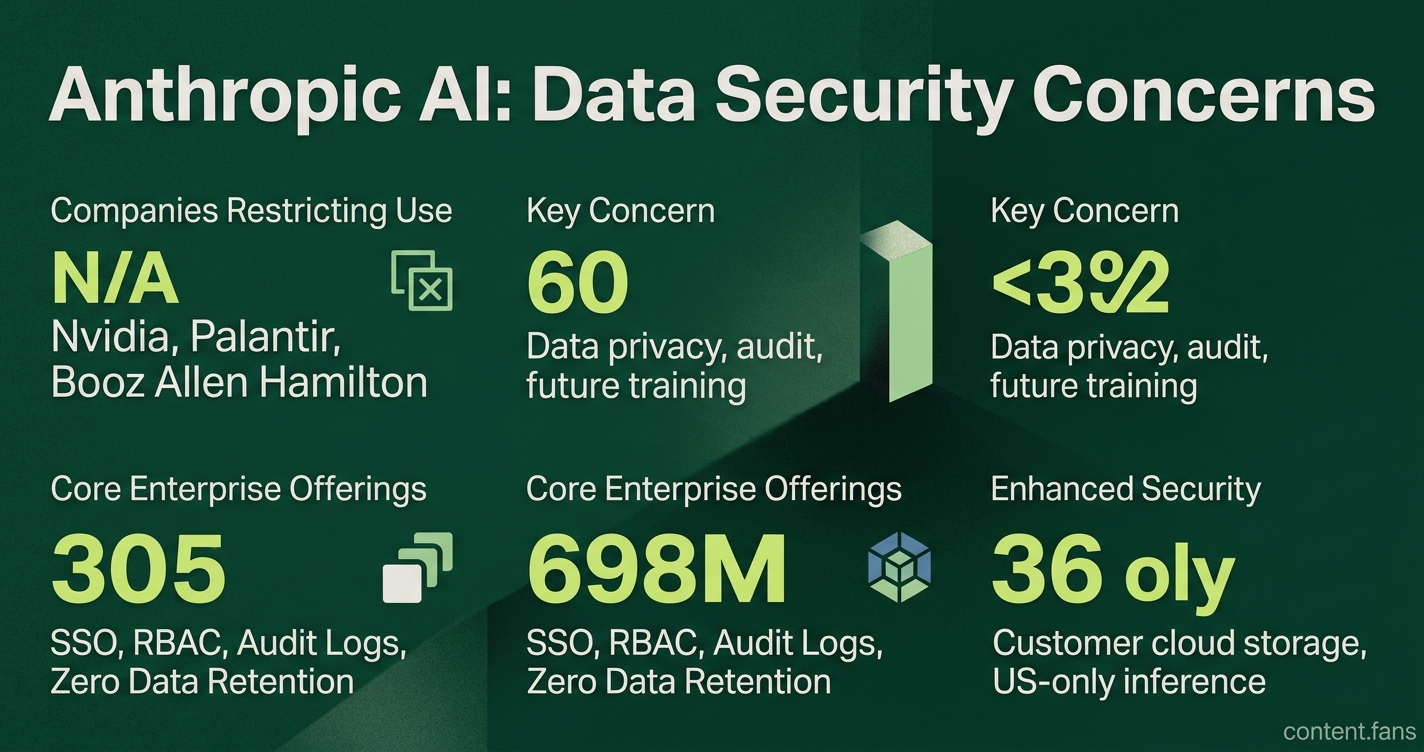
According to reports, Nvidia, Palantir, and Booz Allen Hamilton have relegated Anthropic's most powerful Claude models to less sensitive applications. The decision stems from concerns over data privacy, adherence to audit requirements, and ambiguity about how customer data might be used for future model training. This pullback directly impacts Anthropic's potential revenue from high-value, secure workloads and opens the door for competitors that offer more robust data control and privacy guarantees.
How Anthropic is trying to regain trust
In response to these enterprise concerns, Anthropic is bolstering its security and privacy features. The company's core enterprise offering includes single sign-on (SSO), SCIM for user management, role-based access controls (RBAC), comprehensive audit logs, and customer-managed encryption keys. A key feature is Zero Data Retention, which ensures prompts and outputs are immediately deleted.
Anthropic has introduced enhanced security measures including enterprise safeguards that allow customer data to reside in their own cloud storage. An automated system monitors for misuse, but alerts are sent directly to the customer's security team, not Anthropic, to preserve confidentiality.
Key controls now offered to enterprise tenants:
- Custom data-retention windows, including immediate deletion
- Customer-managed encryption keys and IP allow-listing
- US-only inference regions for regulated workloads
- Connector governance so admins can approve or block tool integrations
- A Compliance API that feeds logs to existing SIEM or DLP systems
Competitor playbooks for cautious buyers
Competitors are capitalizing on this demand for stronger data governance. A clear pattern is emerging for secure AI adoption. Cautious enterprises are deploying AI gateways to centralize control, redact sensitive information, and enforce strict access policies. Cloud providers like Azure OpenAI and AWS Bedrock are gaining traction by offering private, VPC-isolated deployments that guarantee data sovereignty.
Analysts observe that vendors who cannot provide clear, confident answers to five key questions are frequently eliminated from consideration by enterprise buyers:
1. Will our enterprise data be used to train your public models?
2. Where is our data stored and processed geographically?
3. Who has access to our usage logs and data?
4. What are our data retention and deletion options?
5. How do you demonstrate compliance with regulations like the EU AI Act or the NIST AI RMF?
Data governance now shapes procurement cycles
This shift signifies that data governance is no longer a secondary concern but a primary driver in AI procurement. Industry surveys show that governance documentation - such as model cards, audit logs, and data lineage reports - now acts as a critical gatekeeper in contract negotiations. Sales cycles are significantly extended when AI vendors cannot provide clear policies on data usage for training or on cross-border data transfers.
Consequently, raw model performance is no longer sufficient to secure major enterprise contracts; verifiable, responsible data stewardship is equally important. While Anthropic's enhanced security controls are a step forward, the continued exploration of rival models in private cloud environments by major clients suggests a move toward permanent, multi-vendor AI strategies based on data-centric risk assessments.
Which companies have restricted use of Anthropic's advanced AI models?
Nvidia, Palantir, and Booz Allen Hamilton have all placed restrictions on their use of Anthropic's most advanced AI models. These three named customers handle particularly sensitive workloads - ranging from classified government contracts to proprietary semiconductor research - and their decisions reflect growing enterprise caution about data exposure in frontier AI systems.
What specific concerns are driving these restrictions?
The restrictions stem from worries about how sensitive data might be exposed or handled when processed through Anthropic's advanced models. Enterprise procurement teams are increasingly scrutinizing where data is stored, whether it is used for model training, who can access prompts and outputs, and how retention and lineage are controlled. For organizations handling classified or highly proprietary information, these data governance questions have become active purchase criteria that can override raw model capability in procurement decisions.
How is Anthropic responding to these enterprise data concerns?
Anthropic has introduced several measures to address enterprise security requirements, including Enterprise Frontier Safeguards that combine zero data retention with customer-controlled cloud infrastructure - meaning enterprise data is stored in environments the customer owns rather than on Anthropic's systems. Other key features include:
- Customer-managed encryption keys and US-only inference options
- SSO, SCIM, and role-based access controls for identity governance
- Audit logs and Compliance API for integration with existing security tools
- Automated misuse detection where flags go to the customer's review team rather than Anthropic staff
These features are available across Claude Enterprise, Claude Platform, Amazon Bedrock, and other deployment channels.
What opportunities does this create for Anthropic's competitors?
The customer pullback creates immediate market openings for rivals offering different privacy guarantees or deployment models. Competitors are actively positioning to capture these cautious customers through several strategies:
- AI gateway layers that centralize policy enforcement, logging, and observability
- Private or VPC deployments where sensitive data never leaves customer-controlled infrastructure
- Cloud-platform LLM services like Azure OpenAI and AWS Bedrock, which many enterprises now prefer for production workloads needing enterprise-grade controls
- Stricter contractual terms including explicit no-training clauses and deletion SLAs
Research indicates that enterprises are converging on a layered security model combining identity controls, data minimization, runtime prompt filtering, and continuous monitoring - with vendors that can demonstrate these capabilities gaining advantage in sensitive sectors.
Why does this matter for the broader enterprise AI market?
These restrictions signal a structural shift in how enterprises evaluate and procure large language models. Data governance has evolved from a compliance checkbox to a gatekeeper for purchase approval and a determinant of vendor shortlist eligibility. Organizations are increasingly asking prospective vendors:
- Will customer data be used to train models?
- Where is data processed and stored?
- What subprocessors are involved?
- Can you provide model cards, evaluation results, and audit trails?
This trend is pushing enterprise buyers toward managed private deployments for sensitive use cases, vendor contracts with strict data-use clauses, or selective adoption where only low-risk workflows are permitted on shared LLM services. For Anthropic specifically, these customer restrictions reduce addressable enterprise usage for high-sensitivity workloads and may constrain commercial growth in the most lucrative segments of the enterprise market.