
New research expands AI prompting from hacks to cognitive skill
Serge Bulaev
New research suggests that prompting AI is a thinking skill that comes from clear mental models, not just using tricks or hacks. Studies link good prompting to habits like breaking down tasks, predicting responses, and using the right context, which may help manage cognitive load. Early evidence hints that structured prompting training could make professionals faster and their AI outputs more useful, though more data is needed. Researchers also propose that treating prompting as a step-by-step dialogue, instead of a single question, may help people learn and use AI tools better.

New research reframes AI prompting from a collection of hacks to a core cognitive skill, rooted in clear thinking and mental models. Cognitive psychologists argue that effective prompting is a craft belonging to learning science, not software shortcuts, linking success to habits that manage cognitive load (Five Educational-Psychology Lenses). This article explores how this perspective is reshaping training for professionals seeking reliable AI results.
Why users still wrestle with chatbots
Effective AI prompting is a cognitive skill because it requires translating complex intent into structured, unambiguous instructions. This process involves predicting AI behavior, providing relevant context, and iteratively refining inputs - mental tasks that go far beyond applying simple tricks and demand disciplined, systematic thinking to achieve reliable outcomes.
Most prompt failures in the workplace stem from users neglecting key cognitive steps: predicting the AI's response, providing specific domain context, and planning for iteration. Recent analysis links these failures to cognitive overload and framing bias (The Cognitive Turn). Vague, multi-part prompts overwhelm the model, leading to guesswork, while ambiguous framing can cause users to accept plausible but incorrect outputs.
Core cognitive principles to teach
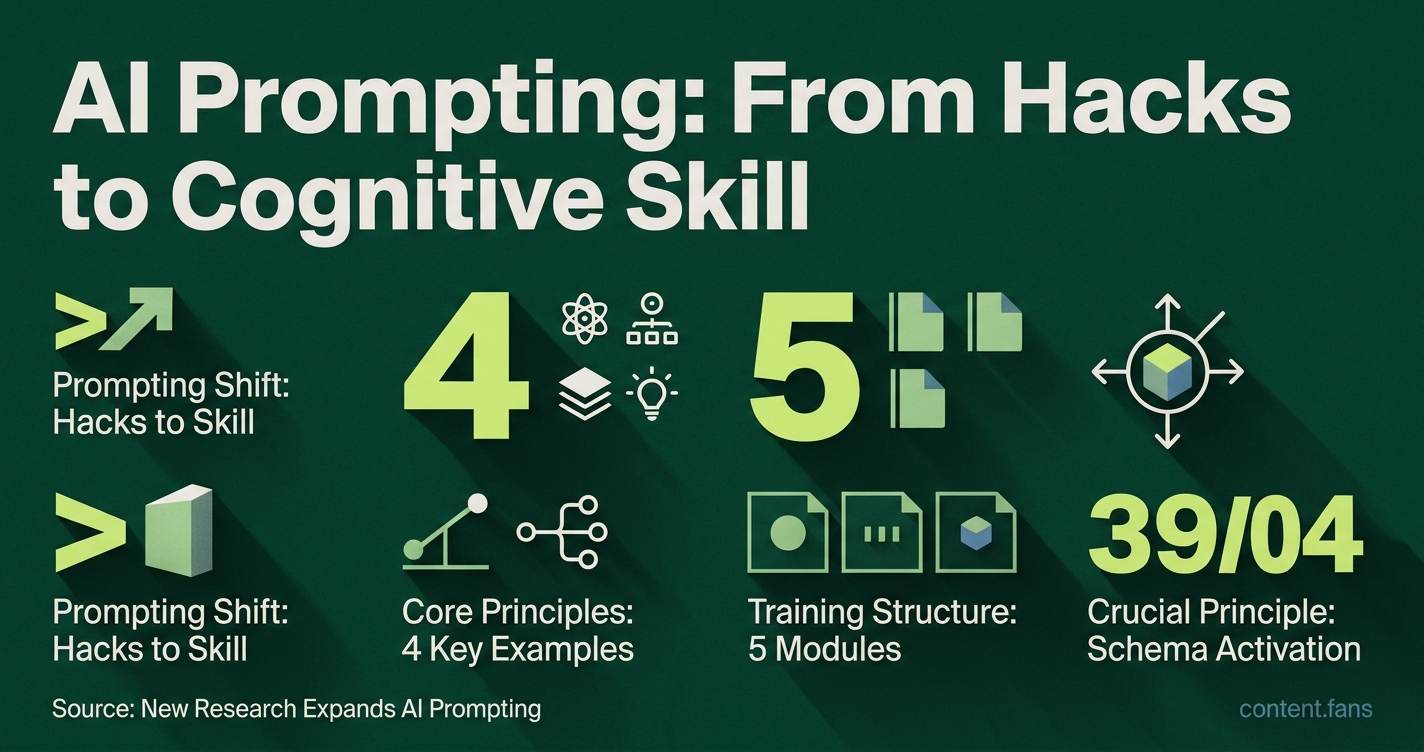
Researchers have identified several core principles that translate directly to effective workplace prompting. The table below outlines four key examples.
| Principle | Prompting habit |
|---|---|
| Cognitive load | Split complex tasks into sub-prompts |
| Mental models | Predict output before sending |
| Scaffolding | Start with templates, then fade support |
| Schema activation | Use role, audience, and domain cues |
Among these, experts highlight schema activation as particularly crucial for non-technical users. For instance, prompting a model to act as a "junior financial analyst" activates the correct vocabulary and format for the task.
Building a short course for busy professionals
Based on research from organizations like Microsoft Foundry, effective training for non-technical professionals often follows a five-module micro-learning structure:
- Prompt basics: task, context, constraints
- Prompt patterns: role, example, step-by-step
- Output control: tone, length, structure
- Iteration: compare variants, revise, re-run
- Safety checks: fact review and bias scan
To ensure genuine skill acquisition, each module should conclude with an exercise where support templates are removed. This practice, known as scaffold-fading, tests for true competence rather than reliance on aids, which can mask fragile understanding.
Reported productivity payoffs
While comprehensive evidence is still emerging, early data suggests significant productivity gains. One summary noted that consultants at Harvard and BCG completed tasks faster with structured prompting guidance. Similarly, other trials reported that output usefulness increased when employees used established prompt patterns. Although based on secondary reporting, these findings suggest that cognitive-based training translates directly into improved workplace efficiency and quality.
Beyond hacks: treating prompting as dialogue
Shifting the perspective further, research positions prompting as a dynamic dialogue, not a single command. A paper from the University of Hawai'i, "Prompt Engineering as a Cognitive Interface," frames the process in four phases: mental modeling, semantic projection, dialogic feedback, and intent refinement. Training users to recognize these phases transforms a simple query into a reflective conversation, which may explain why training programs emphasizing prediction and revision lead to stronger skill retention.
Structured FAQ: New Research Expands AI Prompting from Hacks to Cognitive Skill
Why is prompt engineering now considered a cognitive skill rather than just a technical hack?
The shift reflects a deeper understanding of what effective prompting actually requires. Prompting is fundamentally about translating human intent into instructions that an AI can execute - a process that demands clear thinking, mental modeling, and iterative refinement. Research frames prompting as a bridge where humans externalize mental models, intentions, and iterative hypotheses into structured instructions. This cognitive interface perspective, outlined in academic work on prompt engineering as a cognitive skill, distinguishes true competence from mere template-following. The strongest training programs now evaluate learners through scaffold-fading tests - removing supports to verify whether someone has developed genuine skill or simply depends on hidden aids.
What cognitive psychology principles make prompt engineering training effective?
Several evidence-backed principles shape modern training design:
| Principle | How It Applies to Prompting |
|---|---|
| Cognitive load management | Breaking complex requests into simpler subprompts so working memory isn't overwhelmed |
| Mental model building | Teaching learners to predict AI responses before prompting, then comparing expectations to actual outputs |
| Scaffolding and fading | Starting with templates and examples, then gradually removing support until learners prompt independently |
| Schema activation | Using role framing and context priming to trigger relevant knowledge structures |
| Feedback loops | Building iterative cycles of draft, output, critique, and revision |
Training that incorporates these elements - as described in educational psychology research on AI training design - produces durable competence rather than superficial familiarity.
How does reframing prompting as a thinking skill benefit non-technical professionals?
This reframing dramatically expands accessibility. When prompting is taught as natural language programming rather than coding, professionals in marketing, HR, finance, and operations can engage without technical intimidation. Non-technical learners perform best when courses begin with business outcomes and everyday tasks rather than model architecture. Effective programs use no-code interfaces, role-based examples, and reusable templates that transfer directly to daily work. The practical impact appears substantial: trained employees reportedly save significant time versus untrained counterparts, according to current workforce training data. Perhaps more importantly, framing prompting as cognitive skill reduces situations where users spend excessive time coaxing AI rather than completing tasks manually.
What does effective prompt engineering training look like in practice?
A well-designed curriculum follows a structured progression:
- Mental model foundation - Understanding what AI can and cannot infer
- Low-load patterns - Clear instructions, context, and constraints before complex workflows
- Explicit scaffolding - Templates and worked examples that fade over time
- Framing and schema training - Testing how role, audience, and wording change outputs
- Iterative critique practice - Draft-output-revision cycles rather than one-shot habits
- Evaluation under fading conditions - Testing independent performance without supports
- Bias detection - Exercises revealing authority bias, anchoring, and confirmation tendencies
Courses like Emory's executive education offering emphasize highly interactive, non-technical workshops with hands-on labs and personalized prompt playbooks. The focus is on verification before adoption - ensuring learners check outputs for accuracy and relevance.
What measurable productivity gains come from investing in prompt engineering training?
While controlled trials specifically isolating prompt training remain limited, directional evidence shows meaningful impact:
- Harvard and BCG research with consultants found generative AI access improved output quality and task completion speed - though this measures AI access broadly rather than training specifically, as noted in business-focused prompting guidance
- Workers with structured prompting skills reportedly produce outputs significantly more useful than those without guidance
- Proper prompting skills correlate with faster throughput on realistic daily tasks
However, emerging commentary suggests nuance: workflow design and domain expertise may ultimately matter more than prompting skill alone for maximizing value, as explored in analysis of AI skill prioritization. The most defensible investment combines solid prompting fundamentals with broader process redesign - ensuring that improved instruction-giving translates into genuinely faster, more reliable results rather than simply more sophisticated frustration.