
White House unveils plan to vet AI models before public release
Serge Bulaev
The White House has proposed a plan that may require companies to let the government check advanced AI models before they are released to the public. This review process appears to be advisory and might include checks on safety, cybersecurity, and use of data, but does not guarantee automatic approval. Teams could be asked to provide documents showing how the AI works, how safe it is, and how they protect secrets and data. The process also suggests ways to keep trade secrets safe while showing enough information for safety checks. Companies that prepare early may have less delay and risk when launching their AI models.

The White House has unveiled a plan to vet advanced AI models before their public release, a move that requires AI companies to prepare for government safety reviews. This advisory process will likely examine model safety, cybersecurity protocols, and data usage, demanding comprehensive documentation from developers. Companies that proactively establish a compliance workflow may significantly reduce launch delays and regulatory risks.
Preparing for government pre-release reviews of AI models is now a critical engineering task, not just a boardroom discussion. Following recent briefings with major AI labs like Anthropic, Google, and OpenAI, the federal government is formalizing a proposal to vet advanced models before launch, as reported by The New York Times. While the process is described as advisory, its scope, which may include cybersecurity audits and security controls detailed by Politico, suggests a more rigorous review than previous voluntary efforts. AI developers must now create repeatable compliance workflows to prove safety while protecting trade secrets.
What Will Federal AI Model Reviews Require?
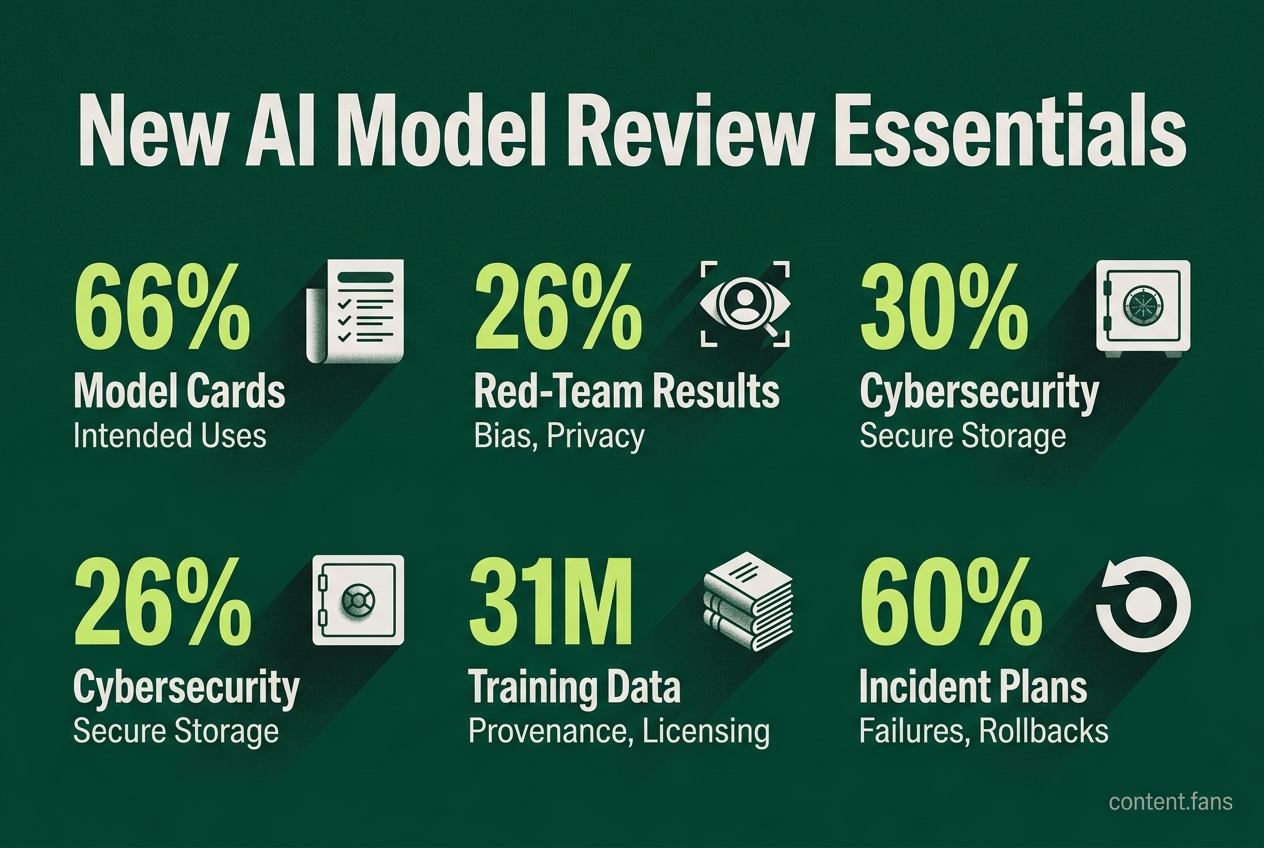
Federal reviewers will likely request detailed model cards describing intended uses, results from red-team security exercises, cybersecurity attestations, summaries of training data provenance, and documentation of incident response plans. These artifacts must prove model safety and compliance without exposing proprietary information like model weights or prompts.
The framework recommends avoiding a new federal AI regulator and relying on existing regulatory bodies for sector-specific oversight, but it does not itself establish a model-review program. Based on early drafts and briefings, review teams are expected to request a comprehensive submission package that includes:
- Model Cards: Detailed descriptions of the model's intended and prohibited uses.
- Red-Team Results: Findings from exercises targeting policy evasion, privacy vulnerabilities, and algorithmic bias.
- Cybersecurity Attestations: Proof of secure model weight storage, supply-chain risk management, and insider threat controls.
- Training Data Summaries: Information on data sources, provenance, and licensing.
- Incident Response Plans: Formal procedures for addressing model failures and executing rollbacks.
How to Build a Compliant AI Submission Package
AI developers should integrate compliance into their development lifecycle, treating documentation and red-teaming as continuous processes rather than last-minute hurdles. By embedding structured, machine-readable documentation into CI/CD pipelines and maintaining data lineage records, teams can streamline the review process. A robust submission package should include the following core artifacts:
- System Overview: Defines the model's purpose, scope, and operational boundaries.
- Data Inventory: Catalogs all data sources, licenses, and preprocessing steps.
- Evaluation Dossier: Presents results for accuracy, bias, robustness, and adversarial testing.
- Governance Log: Records all risk assessments, human oversight checkpoints, and model changes.
- Monitoring Evidence: Includes metrics on model drift, incident reports, and retraining triggers.
It is crucial to link red-team findings directly to implemented mitigations within a searchable repository. Furthermore, continuous monitoring should track performance, bias, and security risks like prompt injection, ensuring evidence remains current as regulations evolve.
Protecting Intellectual Property During Government Reviews
Sharing detailed artifacts with government reviewers raises valid concerns about protecting trade secrets and intellectual property. According to industry reports, agencies are seeking greater vendor knowledge transfers, making proactive IP protection essential. To safeguard sensitive information, developers can negotiate strict confidentiality clauses, use sealed evaluation environments, and clearly mark submissions as trade secrets to prevent disclosure under Freedom of Information Act (FOIA) requests. The use of secure enclaves and privacy-enhancing technologies allows regulators to verify safety claims without accessing core IP, such as model weights, outside of a controlled environment.
Ultimately, a proactive compliance strategy is becoming a key competitive differentiator. Teams that integrate artifact generation into their development process can significantly reduce review delays, minimize regulatory risk, and accelerate their time to market.
What exactly will the White House require companies to submit before an AI model goes public?
Under the National Policy Framework for Artificial Intelligence released in March 2026, there is no single mandated submission format yet. However, recent briefings with Anthropic, Google, and OpenAI indicate that reviewers will expect a package that at minimum contains:
- A model card that explains intended and prohibited use cases
- Evidence of adversarial red-team exercises and any harms found
- Documentation of training data provenance, including licensing and any copyrighted material
- Safety-test results that show how the system performs on cybersecurity, bias, and misuse benchmarks
The proposed framework is modeled on the UK's multi-agency safety review. According to industry reports, draft proposals could give agencies access to model weights or secure read-only environments when national-security risks are flagged. Crucially for developers, the review is advisory, not an automatic block, but failing to supply the requested artifacts will almost certainly delay a launch.
How can teams turn compliance paperwork into a competitive advantage?
Proactive teams are packaging the same material needed for regulators into customer-facing trust assets:
- A continuously updated AI-BOM (bill of materials) that doubles as marketing collateral for enterprise buyers who need vendor transparency.
- Red-team reports that are anonymized and published as third-party verified safety badges, with industry reports suggesting these can significantly accelerate procurement cycles when present.
- Structured, machine-readable model cards that plug directly into customer audit dashboards, cutting onboarding time.
By integrating documentation into CI/CD pipelines, teams also shorten the path between code freeze and regulatory sign-off, with many organizations reporting substantial reductions in average release delays.
What concrete steps should legal and engineering teams take right now?
- Establish an Evidence Pipeline: List every artifact reviewers might request (e.g., training logs, evaluation protocols, rollback scripts) and assign an owner in a project management tool like Jira or Linear.
- Implement Secure Enclaves: Set up sandboxed instances where regulators can interact with the model without accessing proprietary weights. AWS Nitro Enclaves and Azure Confidential VMs are among the common patterns being tested in industry pilots.
- Use Confidentiality Declarations: Mark every document containing trade secrets or third-party licensed data with appropriate confidentiality protections to reduce later FOIA exposure, following established government information handling guidelines.
- Retain a Third-Party Auditor: Contract an outside lab (e.g., MITRE, PwC AI Assurance) to run an independent red-team. The resulting report is typically accepted by multiple agencies, cutting duplicate investigations.
How do you protect intellectual property during a government deep dive?
Federal AI policies emphasize the importance of maintaining respect for individual rights and ensuring civil liberties, privacy, and confidentiality protections. In practice, companies are negotiating tiered access models:
- Tier 1: Public model card.
- Tier 2: Technical appendices under non-disclosure agreements with a 10-year confidentiality term.
- Tier 3: Weights and raw datasets stored in air-gapped government labs with strict chain-of-custody logs.
Legal teams are also embedding public-records exemptions into review contracts. California's Frontier AI Transparency Act already recognizes these clauses, reducing the likelihood that sensitive artifacts become public through Freedom of Information requests.
What are the biggest risks of waiting until an executive order is final?
The primary risk is costly delays. According to industry reports, venture investors estimate significant market-cap penalties for each month a frontier model is held back. More broadly, because the White House framework asks Congress to preempt state AI laws, early compliance investments map directly to national market access. Teams that wait risk being forced into retroactive evaluations after launch, which can trigger model rollbacks or retraining - events that industry reports suggest have negatively impacted launch-week valuations for multiple large-model providers.