
Slack AI integrates with Salesforce, Google Workspace to automate workflows
Serge Bulaev
Slack AI now connects with Salesforce, Microsoft Dynamics, and Google Workspace to help teams automate their work in one place. The platform has added about 30 new features, such as channel summaries, email drafting, and file summaries, that might help employees save time, with some reports suggesting up to 40% less meeting follow-up work. These tools allow users to get quick updates, find decisions, and translate messages instantly, although their availability depends on the user's subscription plan. Analysts say these features may lead to large productivity gains and simpler security compared to other tools. However, not all features are available on free plans, and some benefits are based on early estimates and may vary.
Slack AI integrates with Salesforce (basic features on Free/Pro plans; advanced features on Business+ and Enterprise+ plans). No integration with Google Workspace or Microsoft Dynamics is documented. This allows teams to consolidate actions on customer data, files, and calendars into a single, unified hub. With significant new features rolled out, Slack AI is positioned to reduce administrative overhead and streamline daily operations.
How Slack AI Fits Into Daily Workflows
Slack's AI-powered agent, Slackbot, streamlines daily work by summarizing channels, drafting messages, and building approval flows from simple, plain-language prompts. Users can instantly find key information by asking questions like, "What was the final decision on the Q3 launch?" and get answers with linked source messages for full context.
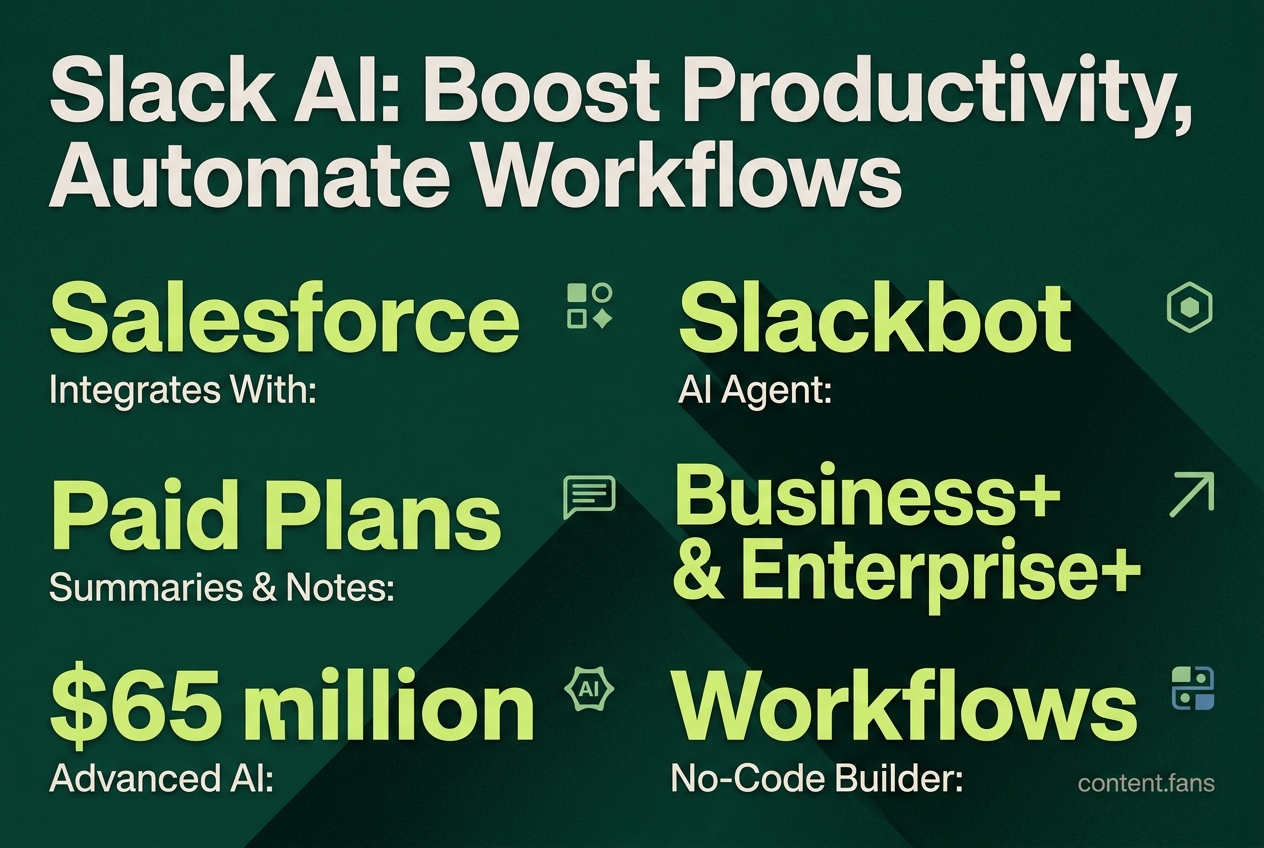
Slack AI transforms team productivity by embedding automation directly into conversations. It uses natural language to summarize channels, draft messages, and answer questions, leveraging source messages for context. This integration eliminates app-switching, centralizing tasks like approvals and updates within the Slack interface.
The official Slack AI features page lists capabilities such as automatic Huddle transcripts, document summaries, and instant message translations, empowering global teams to operate more efficiently.
Key Capabilities at a Glance
- Automated Summaries: Get up to speed quickly with AI-generated summaries of channels and conversations, delivered on your schedule.
- Intelligent Huddle Notes: Automatically capture action items and key takeaways from audio meetings without manual note-taking.
- No-Code Workflow Builder: Turn plain-text descriptions into powerful, multi-step automations that connect across your tools.
- Document Summarization: Instantly generate summaries for PDFs, spreadsheets, and presentations.
- Real-Time Translation: Break down language barriers with instant message translations, fostering seamless global collaboration.
Productivity Data and Availability
According to industry reports, teams using AI-driven tools can significantly reduce meeting follow-up tasks, a time-saving that Slack AI aims to deliver through its automated recaps and searchable decision logs. Broader enterprise adoption of AI agents is linked to substantial productivity gains by shortening coordination cycles.
Access to these features varies by subscription. According to the official guide to AI features, conversation and thread summaries and huddle notes are available to all customers on paid plans (Free and Pro do not have them, but Pro and higher do). Advanced AI features are in Business+ and Enterprise+.
From a security standpoint, Slack AI operates within your existing workspace boundaries, ensuring that data used for prompts is not exported to third-party services. This integrated approach simplifies governance and provides administrators with granular control over feature access.
Slack announced major AI and pricing changes in June 2025, introducing the new Business+ and Enterprise+ plans. The Slack AI add-on is no longer available for new purchase. The platform's integration with Salesforce and other enterprise tools positions it uniquely in a competitive landscape where AI workspace tools are projected to drive significant organization-wide productivity gains.
FAQ
What platforms does Slack AI integrate with?
Slack AI connects natively to Salesforce, OneDrive, and over 1,000 applications through its Model Context Protocol (MCP) client. This integration allows Slackbot to route work and prompt questions autonomously across your existing tech stack, creating a central searchable hub for all company knowledge without requiring teams to leave Slack.
How does Slack AI reduce meeting follow-up time?
The platform's Huddle Notes feature automatically transcribes and summarizes Slack Huddles, capturing meeting insights without manual note-taking. According to industry reports, AI meeting assistants can significantly reduce post-meeting cleanup time. Additionally, action item completion rates show substantial improvement when AI handles follow-up documentation.
What is Slackbot and what can it do?
Slackbot is Slack's personalized AI agent that summarizes conversations, drafts content in your voice, automates workflows, and connects to external tools. Key capabilities include:
- Generating daily recaps of selected channels
- Answering contextual questions like "What decision was made last week?"
- Creating workflows from plain-language descriptions without coding
- Translating messages in real time for global teams
- Summarizing PDFs, documents, and spreadsheets instantly
How does Slack AI compare to competitors?
While platforms like Asana focus on predictive project management and Zapier offers flexible workflow orchestration, Slack differentiates through agentic automation embedded directly in team communication. Unlike tools that require context-switching, Slack AI operates where conversations already happen. The platform's reusable AI skills and enterprise search (exclusive to Enterprise+ plans) create tailored automation that applies across scenarios without generic responses.
What productivity gains can teams expect?
Verified stats include: 66% average throughput increase (NN/G), up to 74% faster task completion (Microsoft), and 77% faster task completion (Hubstaff). For Slack specifically, teams report significant time savings on meeting follow-up through real-time summarization and tone customization. With a growing number of enterprises expected to deploy AI meeting assistants, early adopters gain competitive advantage through faster decision-to-action cycles and reduced administrative burden.