
Guideflow Lists 8 Manufacturing ERPs for 2026
Serge Bulaev
Guideflow's report lists eight manufacturing ERP systems for 2026 that may help factories connect maintenance inventories with real-time production data. Software spending in manufacturing is expected to grow, possibly driven by new AI features, and plant managers seem willing to invest in systems that unify production, inventory, and maintenance. The shortlisted ERPs reportedly focus on real-time tracking, easy configuration, and strong data integration, but the selection criteria are not fully detailed. Quality management and inventory tracking are described as essential, and real-time machine connections might let maintenance teams see parts usage sooner. The report suggests results can vary depending on data quality and how carefully systems are used.

Guideflow has listed top manufacturing ERPs for 2026, reflecting a growing industry need to connect maintenance inventories with real-time production data. These ERP systems promise unified control over production planning, scheduling, and shop floor operations. This report breaks down the key market drivers, Guideflow's selection criteria, and the essential functions plant managers must consider.
Why manufacturers keep topping software budget charts
Manufacturers lead software spending due to intense operational demands and the pursuit of efficiency. They require sophisticated platforms to manage complex production schedules, intricate supply chains, and real-time shop floor data, justifying significant investment in unified systems that integrate planning, inventory, and maintenance for a competitive advantage.
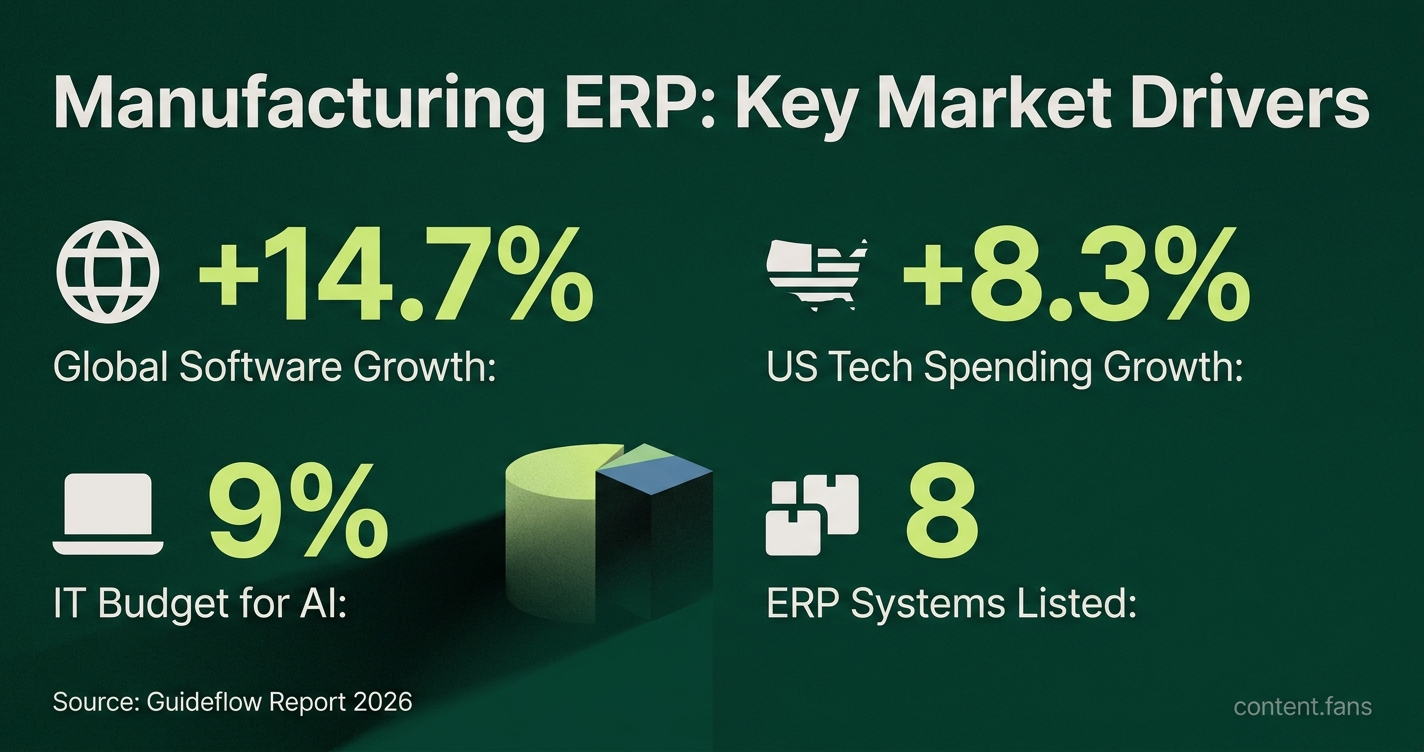
Global software spending is set to climb by 14.7% in 2026, hitting $1.43 trillion, per Gartner data shared on LinkedIn Pulse global software spending. A significant portion of this growth is attributed to generative AI, with 9% of IT budget set aside for software price increases per SaaStr/CIO reports. Forrester forecasts US tech spending to grow 8.3% in 2026 to $2.9T US technology spending. This spending reflects a strategic shift by plant executives to invest in unified platforms that eliminate data silos between production, inventory, and maintenance.
Inside Guideflow's eight-tool shortlist
Guideflow's shortlist includes DELMIAWorks, Epicor Kinetic, SAP S/4HANA Cloud, MIE Trak Pro, Microsoft Dynamics 365, IFS Cloud, and two other regional systems. While the report lacks a formal scoring methodology, it appears to weigh criteria common in the industry:
- AI-Powered Operations: Real-time tracking and automated job scheduling are increasingly considered essential according to industry reports.
- Unified Data: A single data architecture is preferred over simple API integrations to reduce data reconciliation.
- Low-Code Configurability: Tools that allow for easy customization to control long-term ownership costs.
- Embedded Quality: In-platform quality management is a must-have over separate bolt-on modules.
- Complete Traceability: Full lot and serial tracking for comprehensive forward and backward genealogy.
- Financial Integration: Seamless cost flow into financial systems without manual data entry.
The report categorizes its recommendations based on three key factors: production complexity, deployment model (cloud, hybrid, or on-premise), and the level of native integration with industrial equipment. This approach aims to align ERP capabilities with the specific needs of discrete, process, or project-based manufacturers.
Core operations modern ERPs must support
A modern manufacturing ERP must master several core operational areas to be effective.
Advanced Planning and Execution
Advanced Planning and Scheduling (APS) is a broader software category performing finite scheduling and synchronizing it with demand, material availability, and multi-stage routings, as detailed by Symestic and PlanetTogether. SAP S/4HANA integrates with PLCs via middleware but does not automatically calculate OEE without additional modules. This direct machine connection can significantly reduce lead times and boost on-time delivery when properly implemented.
Integrated Quality and Inventory
Quality management is no longer optional. Modern buyers demand built-in inspection planning, non-conformance/corrective action (NC-CAPA) workflows, and unchangeable audit logs directly within the ERP. Likewise, inventory management must include complete lot and serial tracking to produce genealogy reports for compliance or recalls instantly.
Impact on MRO Inventory Management Software workflows
The evolution of ERP systems directly enhances Maintenance, Repair, and Operations (MRO) inventory workflows. Real-time machine connectivity gives maintenance teams unprecedented visibility into spare part usage, while predictive analytics can flag potential equipment failures before they cause downtime, triggering just-in-time parts orders. This creates a highly efficient loop that can lower MRO stock levels without compromising plant service levels. However, success hinges on accurate equipment data and consistent usage tracking.
When evaluating the ERPs on Guideflow's list, procurement leaders should use the six criteria mentioned earlier as a baseline. Insist on scripted demos using your company's actual bills of material and run proof-of-value trials for critical MRO processes to verify that the promised integration delivers under real-world conditions.
What makes manufacturing the largest buyer of enterprise software?
Manufacturing's dominance in enterprise software spending stems from operational complexity and the need for integrated production management. According to industry analysis, high-tech manufacturing ranks among sectors seeing significant potential gains from generative AI adoption [4]. The sector's software investment is accelerating due to three converging pressures: production-scale automation requirements, supply chain visibility demands, and regulatory compliance complexity. Manufacturing ERPs must coordinate multi-level BOM management, finite capacity scheduling, and real-time shop floor control - capabilities that require sophisticated, often expensive, software infrastructure [2][6].
How do modern manufacturing ERPs differ from legacy systems?
Modern manufacturing ERPs represent a fundamental architectural shift from integration to unification. Where legacy systems connected separate data silos through APIs, current platforms prioritize single-source-of-truth data architecture that eliminates information fragmentation [1][5]. Key differentiators include AI-powered predictive scheduling that automatically adjusts production plans when constraints change, direct PLC/IoT integration that reads machine cycles without manual data entry, and composable architecture enabling seamless module expansion [2][4]. No-code configuration has replaced heavy customization, reducing implementation costs and maintenance burden [2][5].
What selection criteria matter most for manufacturing ERP decisions?
Modern selection methodology emphasizes business outcomes over feature checklists. Organizations should anchor decisions in measurable targets: throughput improvement, quality metrics, lead time reduction, and inventory turn optimization [6]. Critical evaluation steps include scripted demos with real production data (not generic scenarios), proof-of-value trials running 2-4 weeks in parallel with existing systems, and reference site visits to validate implementation claims [2][4][6]. Security and compliance capabilities - including e-signatures, revision control, and immutable audit trails - are now baseline requirements rather than differentiators [6].
Which specific innovations are transforming production planning and scheduling?
The three converging forces reshaping manufacturing ERP are: Autonomous 'agentic' operations, composable and headless architectures, and the rise of the sustainability ledger [6]. APS systems handle thousands of work centers simultaneously, adjusting schedules dynamically when demand or machine availability shifts [2][4]. Advanced platforms like Epicor Kinetic parse CNC programs directly to eliminate manual time estimation errors [2][9]. Predictive analytics now flag equipment anomalies before downtime occurs, with lead times potentially slashed by up to 95% through synchronized workflows [1].
What should manufacturers know about total cost of ownership?
TCO calculations for ERP implementations must extend far beyond licensing fees. Implementation services typically cost 2-5x the license price, with additional significant investments in data migration, testing, and change management [5]. The shift to cloud and AI-enhanced platforms introduces ongoing cost considerations for organizations evaluating vendors like PlanetTogether and Siemens Opcenter [5]. Manufacturers should budget for comprehensive training programs and evaluate vendors on support reliability as critical success factors [7]. Organizations prioritizing configuration over customization consistently achieve lower long-term ownership costs [2][5].