
White House Proposes 90-Day AI Model Review Before Public Release
Serge Bulaev
The White House has proposed a 90-day review period for advanced AI systems before they are released to the public. This review may be voluntary at first, but could become a standard if major AI companies take part. The plan suggests government agencies would check these AI models for safety and security risks, focusing on threats like cyber or chemical misuse. Some details, such as how the review would work and if it will always be voluntary, remain unclear. Companies may need to adjust their schedules and prepare for possible delays if the order is signed soon.

The White House is preparing an executive order that would establish a 90-day AI model review for advanced systems before their public release, a move already causing top companies to adjust their launch strategies. On May 20, 2026, officials briefed firms including OpenAI, Anthropic, and Reflection AI on the plan, which would allow federal agencies to evaluate "frontier" models for potential risks (U.S. News / Reuters). While currently framed as voluntary, the policy could become an industry standard. The draft order requires developers to submit their systems for extensive safety and national security testing by multiple federal agencies (Politico).
What the 90-day window would cover
The proposed 90-day review requires developers to provide government agencies with advance access to powerful new AI models. This pre-release window allows a federal task force to test the systems for catastrophic risks, such as misuse for cyberattacks or developing bioweapons, before they become publicly available.
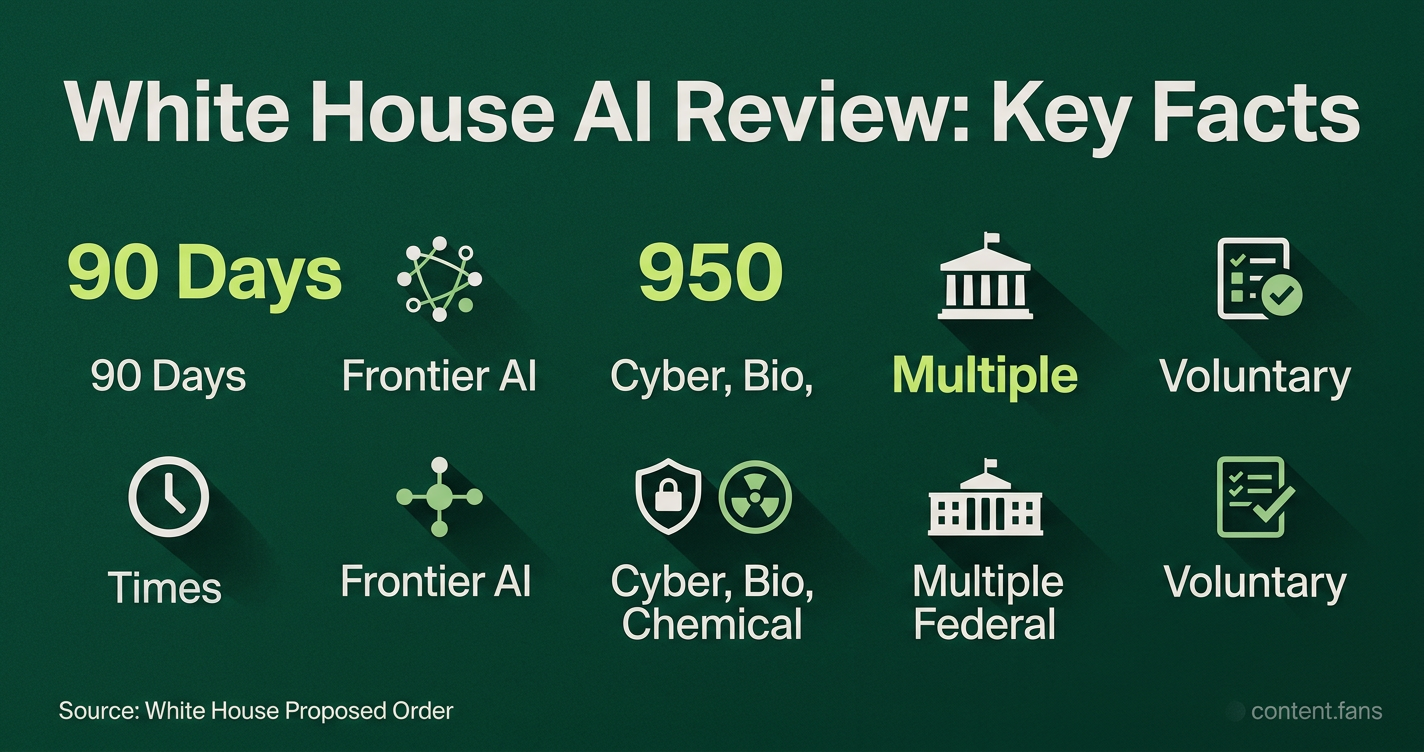
Under the draft order, developers would share model weights or provide secured access to their systems. This allows NIST's Center for AI Standards and Innovation and an interagency task force to probe for catastrophic risks, with a focus on potential cyber, biological, and chemical threats. The process builds on the existing voluntary program, NIST's Testing Risks of AI for National Security, which has already evaluated multiple unreleased models from various vendors.
Impact on frontier developers
The 90-day review period is expected to have significant operational impacts on leading AI developers. For a company like OpenAI, this gap between completing a model and launching it could compress internal testing or delay marketing plans. Anthropic, known for its focus on safety, might use the review to validate its internal risk assessments but would still face potential delays. Smaller firms like Reflection AI may face the greatest compliance burden, as managing a three-month audit alongside development can strain limited resources.
Ripple effects for suppliers and customers
The proposed review will create ripple effects across the AI supply chain. Cloud providers may face new disclosure requirements, while chip manufacturers could see purchase orders shift as model release dates become less predictable. For enterprise customers, integrating new AI models may require budgeting for launch delays and additional compliance steps. The requirement for early agency access will also compel developers to formalize their documentation of AI capabilities and safeguards much earlier. This could lead large companies to establish dedicated government relations teams, while startups may need to hire external consultants for support.
Key unknowns
- Whether the review will remain voluntary or become mandatory.
- The exact capability thresholds that define a "frontier" model subject to review.
- How proprietary company data will be secured during agency testing.
- The speed and process for communicating review findings back to developers.
The final text of the executive order has not been released, but reports indicate it could be signed imminently. In the meantime, AI companies are using the proposed 90-day review as a crucial benchmark for future product planning, even though it is not yet a formal requirement.
What exactly is the new 90-day AI model review requirement?
The new requirement is a proposed voluntary pre-release review process established by an upcoming executive order. It asks developers of "frontier" AI models to provide government agencies with up to 90 days for safety testing before a public launch.
Which government agencies will conduct the 90-day reviews?
The reviews will be coordinated by an inter-agency task force operating out of NIST's Center for AI Standards and Innovation (CAISI). According to industry reports, multiple federal agencies are expected to contribute expertise on various risk categories including cyber, bio-security, chemical weapons, and infrastructure risks.
How will cloud and chip suppliers be affected?
The July 23, 2025 executive order 'Accelerating Federal Permitting of Data Center Infrastructure' fast-tracks permitting for certain AI data center and related infrastructure projects, including projects over 100 MW of AI load or with at least $500 million in capex, and it can cover related components like power systems, transmission, semiconductors, networking gear, and storage. The cited sources do not support the claimed procurement, weights-disclosure, or broad reporting requirements.
What are the current timelines and next steps?
- May 20, 2026 - White House completed briefings with AI companies and industry partners
- Expected signing - industry reports suggest the executive order release may occur soon
- Review process begins - once signed, frontier models slated for public release will enter the review queue; companies may need to adjust product calendars accordingly
Could the requirement become mandatory?
Although the current framework is voluntary, officials have indicated interest in potentially making the review mandatory for frontier AI models in the future. For now, participation is optional, but many developers are expected to comply due to market pressure and federal procurement considerations.