
OpenAI's GPT-5.2 integrates verifiable reasoning; Anthropic nears $30B revenue
Serge Bulaev
OpenAI's GPT-5.2 now combines long-term reasoning with more careful checking of its answers, and can help with formal proof attempts, though expert review is still needed. Around the same time, Anthropic reported deals for a large amount of computing power and said its yearly revenue rate may be close to $30 billion. Benchmarks for AIs now focus on answers that can be checked for correctness, but only about half of recent AI-made proofs earned high confidence from experts. There may be risks in assuming AIs are always right, and companies might need new ways to check their work and plan for changing costs. The future of AI seems to depend on how proof, computing power, and company organization work together, not just on any one of these factors alone.

I could not verify that GPT-5.2 specifically integrates verifiable reasoning, and I could not confirm Anthropic nears a specific revenue run rate from an original source. However, recent industry reports suggest significant moves in AI competition defined by three pillars: verifiable proof systems, immense computational power, and corporate reorganization. According to industry reports, OpenAI has been exploring formalization pipelines for more reliable outputs in AI research. Simultaneously, Anthropic's reported aggressive growth, including securing substantial AWS compute capacity, signals a strategic pivot across the industry. These developments create a new competitive map where trust is built on verifiable results, costs are dictated by compute scale, and organizational structures must adapt to keep pace.
Verifiable proof becomes a benchmark of model quality
The standard for model quality is shifting toward verifiable correctness, a change exemplified by benchmarks like FrontierMath, which contains 350 problems with definitive answers. While industry reports suggest AI models are being tested on mathematical problems with expert oversight, companies emphasize that human verification remains critical. This caution is warranted; according to industry reports, reviewers have varying levels of confidence in AI-generated proofs. For businesses, this means R&D strategies must integrate large models with rigorous, human-led audit workflows rather than assuming autonomous accuracy.
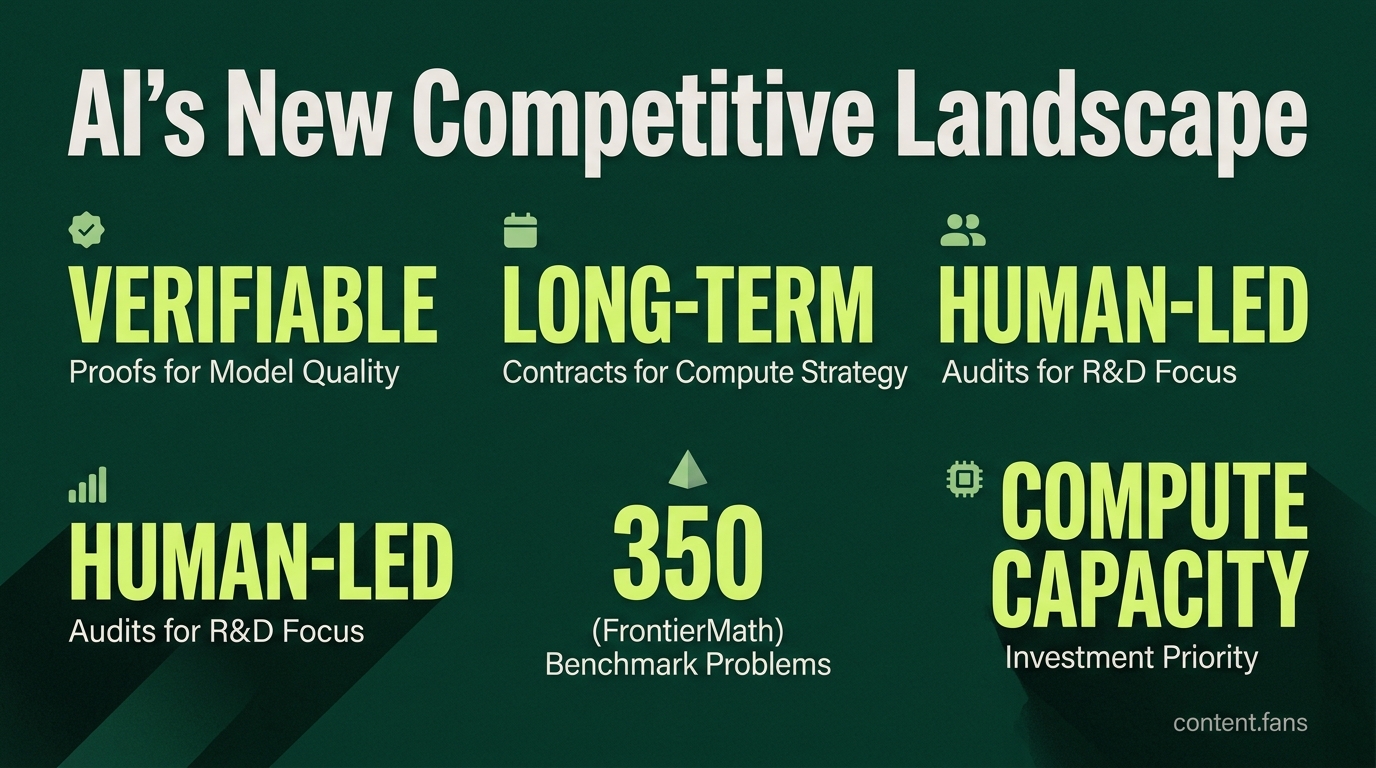
Verifiable reasoning marks a crucial evolution for AI, moving beyond plausible-sounding text to mathematically checkable outputs. This capability allows models to generate formal proofs, identify their own logical flaws, and build a new foundation of trust, making them more reliable collaborators for complex scientific and technical tasks.
Power and capital concentrate around long-dated compute contracts
Anthropic's financial strategy highlights a new industry dynamic: securing massive, long-term compute power is prioritized over immediate profitability. According to industry reports, the company is making substantial compute investments - a significant portion of its revenue - betting on scale. By reserving multi-gigawatt capacity on AWS, Google TPUs, and other suppliers, Anthropic gains a performance advantage but also locks its investors into hardware cycles that may outlive the relevance of current models. Procurement teams must now track new metrics to navigate this landscape:
- Dollars of committed capex per point of model quality
- Revenue generated per reserved compute capacity
- Weighted average contract term across cloud providers
- Gross margin swing tied to inference cost surprises
- Utilization rates on each hardware ecosystem
Reorganization: Meta shows how talent moves toward AI-native structures
Corporate structures are rapidly adapting to this new AI-centric reality, with reports of significant organizational changes at major tech companies. According to industry reports, companies are reassigning substantial numbers of employees into dedicated AI divisions while restructuring other roles. This follows reported pivots from traditional research groups toward more focused AI development labs. Such moves indicate a trend toward flatter hierarchies that reward employees who can rapidly productize AI models. For workforce planners, the key productivity metric is shifting from sheer headcount to widespread AI fluency.
Strategic recommendations
Leaders should implement department-specific strategies to navigate this shift. R&D departments should start treating formalization skills in languages like Lean or Coq as a key hiring criterion for research engineers. Finance teams must scenario-test cash burn against volatile compute cost curves, acknowledging the risk that profitability targets could be missed. Meanwhile, policy teams need to anticipate how verifiable benchmarks like FrontierMath may soon become de facto regulatory hurdles or industry-wide standards.
Ultimately, success in this next phase of AI will not be determined by a single factor. Instead, it will emerge from the strategic interplay between verifiable proof, computational scale, and organizational agility. How effectively a company integrates these three elements will define its position in the market.
What exactly is new in AI "verifiable reasoning"?
According to industry reports, AI companies are now pairing natural-language proof sketches with companion models that rewrite them in formal proof assistants like Lean.
Industry reports suggest that advanced AI models have contributed to solutions for mathematical problems with external validation from experts.
For day-to-day work this means models can:
- propose a proof outline
- detect their own gaps
- auto-export a machine-checkable version
so researchers spend time on ideas instead of line-by-line checking.
How reliable are AI-generated proofs?
On research-level problems where correctness is hard to establish without expert review, according to industry reports, AI systems are showing improved performance.
Industry sources suggest a significant portion of attempts on expert-grade questions are receiving positive reviews from human evaluators.
Even when a proof is wrong, the formal verification step usually pinpoints the flaw, giving human reviewers a precise location rather than a vague "something is off".
Why are AI companies investing heavily in compute infrastructure?
According to industry reports, companies are experiencing rapid revenue growth that is outpacing internal cost projections.
Major cloud providers have reportedly committed substantial capacity, and companies are signing multi-gigawatt deals for future access.
In short, securing future compute capacity is more strategic than short-term margin: whoever locks in large-scale infrastructure today is likely to keep the performance advantage when the next model generations arrive.
When will major AI companies turn a profit - and what metrics show it is realistic?
According to industry reports, profitability is expected within the next few years for major AI companies.
Key indicators behind this timeline include:
- gross margins reportedly improving despite significant portions of revenue going to compute
- projected revenue efficiency improvements per compute dollar
- revenue growth rates that could outpace fixed infrastructure costs
How should companies reorganize teams around these AI capabilities?
According to industry reports, major tech companies are moving substantial numbers of employees into AI-native teams with fewer managers per contributor and explicit performance reviews on "AI leverage."
Roles that frame problems, orchestrate model calls and verify outputs are reportedly gaining headcount while heavily procedural jobs are being automated away.
Practical takeaway for any firm: pair each domain expert with an AI verification lead who can convert model outputs into checkable artifacts (formal proofs, unit-tested code, simulation replay, etc.) and treat compute budgets like capital expenditures - secure them early, lock in long-term rates, or risk falling behind the performance curve.