
SAP Explains Business AI Decisions With New Audit Features
Serge Bulaev
SAP has introduced new audit features to make its Business AI more explainable and trustworthy. The company warns that AI, even when it sounds confident, can make mistakes without enough context. The latest updates may allow users to see the reasons behind AI decisions, such as what information was used and how confident the system was. Regulators and leaders appear to be demanding more proof and transparency, with firms expected to keep logs and provide explanations for key decisions. These changes suggest that making AI decisions traceable and understandable is now an important part of business operations and compliance.

SAP is bolstering trust in its Business AI with new audit features designed to make automated decisions fully explainable and compliant. As enterprises adopt AI, leaders are demanding proof that every recommendation is grounded in business data, transparently logged, and recoverable. SAP has warned that AI can sound confident but lead to wrong decisions without proper context (SAP video), making traceability a critical part of modern business operations.
SAP's Answer: Context, Explanation, and Audit
SAP is shifting from opaque AI scores toward traceable logic. Recent release notes for SAP Business AI describe on-demand rationales for features like auto-scheduling and code remediation (SAP News Center). This approach ensures every action logs the inputs, applied logic, and confidence score, creating immutable records that meet compliance standards like SOX and PCI-DSS.
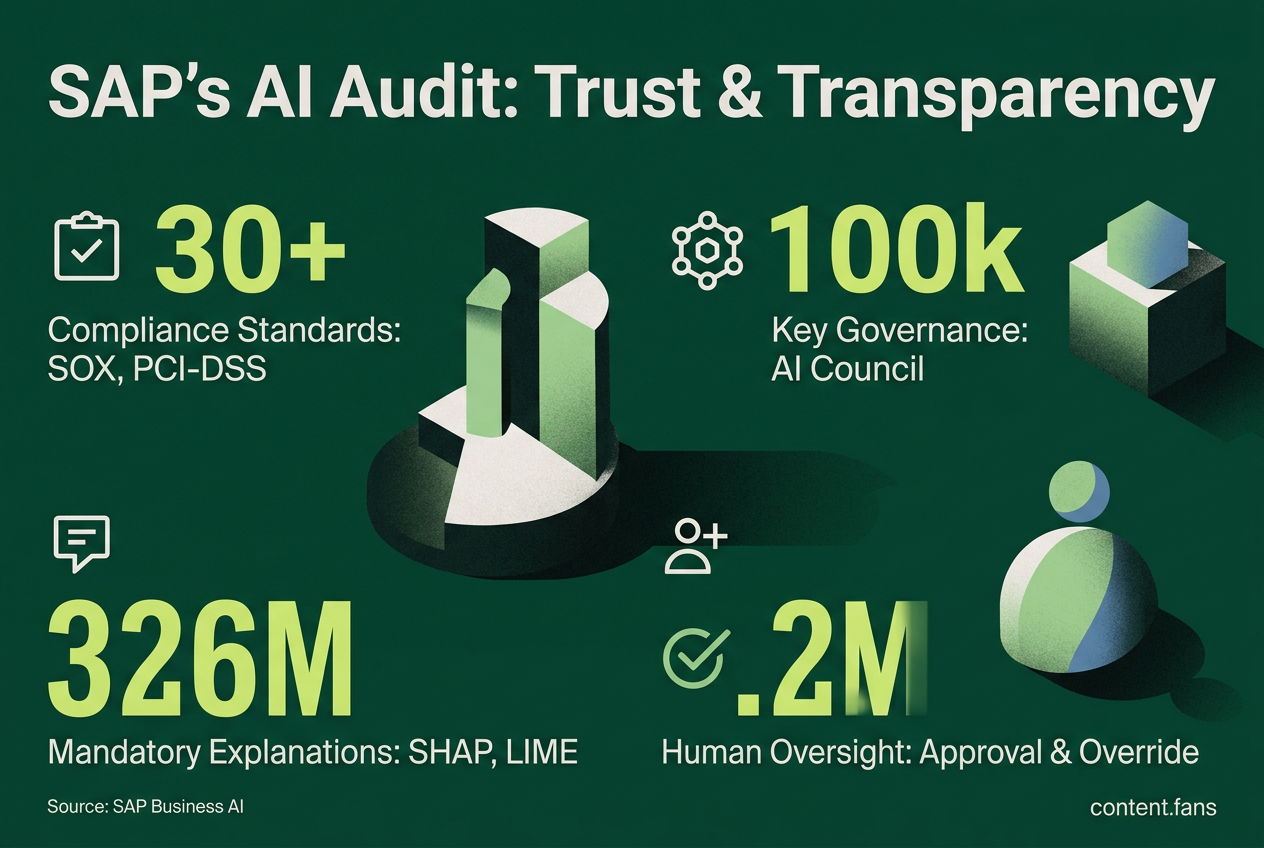
SAP's new audit capabilities provide context and explanations for AI-generated recommendations. The features log the data inputs, logic, and confidence scores behind each decision. This creates a traceable record, enabling businesses to verify automated actions, manage risk, and meet growing regulatory demands for AI transparency.
Key Governance Patterns for AI Operations
To operationalize AI responsibly, industry playbooks recommend several key governance controls. Regulators are increasingly moving from principles to proof, requiring firms to "demonstrate real governance" through auditable logs and supervision. This includes new state laws that mandate notices and opt-outs for automated decisions in lending, hiring, and housing.
Effective control frameworks often include:
- A cross-functional AI council with legal, risk, and business owners.
- A risk-tier registry mapping use cases to required documentation.
- Lifecycle checkpoints for intake, design, testing, and monitoring.
- Mandatory explanation techniques (e.g., SHAP, LIME) for high-impact models.
- Clear human approval and override paths for consequential decisions.
The High Cost of "Almost Right" AI
Consider a scenario where an AI model recommends a sales price based on incomplete contract data, causing a deal to close at a loss. Without explainability, diagnosing the error is a manual, time-consuming process. With a proper audit trail, the root cause - including the input list, feature weights, and confidence score - is discoverable in seconds, preventing revenue loss and regulatory issues.
Essential Metrics for AI Trust and Performance
To build trust and reduce second-guessing, executives should track key performance indicators for their AI systems. Continuous monitoring and establishing baseline performance metrics are crucial for catching model drift early. Key metrics include:
1. Explanation Request Rate: How often users ask "why" before accepting an AI output.
2. Override Rate: The percentage of AI decisions reversed by human reviewers.
3. Time to Trace: The time needed to retrieve a full decision log for an audit.
4. Drift Deltas: Changes in key data distributions since the last validation cycle.
Aligning Performance with Governance Frameworks
Leading organizations connect AI governance directly to business objectives. This can involve tying compensation or OKRs to stability metrics, such as maintaining an override rate below 5% for low-risk automation. Adopting established frameworks like the NIST AI Risk Management Framework (RMF) and seeking ISO 42001 certification provides a pragmatic path to satisfying diverse state and EU regulations, turning explainability into a core part of operational management.
Why is SAP adding audit features to Business AI now?
SAP cites the "almost right" risk: an AI answer that sounds confident but lacks business context can trigger wrong decisions. New Q1 2026 fields-service and code-analysis apps already surface "clear, on-demand explanations" of every auto-schedule or ATC finding, and finance-side partners such as Hyperbots are publishing SOX-ready immutable logs that regulators accept in place of manual sign-offs. The aim is to replace blind trust with evidence continuity before local statutes in California, Colorado and the EU move from guidance to mandatory proof in 2026.
What exactly is recorded in the new audit trail?
Each AI decision stores:
- inputs (master data, sensor feed or user prompt)
- model ID and version
- business rules or policy version applied
- confidence score and threshold
- human reviewer ID (if any)
- final action taken
The entire bundle is timestamped and tamper-proof, matching the same evidentiary bar SAP customers already use for financial journal entries.
Who inside the company is expected to review the explanations?
SAP keeps humans in the loop only for high-risk or regulated choices (credit limit change, candidate short-list, dynamic pricing above a set margin). Dispatchers, HR managers and treasury clerks see a "Why this result?" side-panel; they can accept, override or escalate. The audit log captures each click, so risk officers can quantify override rates and spot model drift without opening a code notebook.
Do the features satisfy upcoming AI regulations?
Early adopters are mapping the log schema to EU AI Act "lifecycle documentation" and the NIST AI RMF control taxonomy. Because every record contains inputs, logic and output, external auditors can re-perform a decision trail without extra reverse engineering - a step regulators call "evidence continuity". SAP partners predict that ISO 42001 certification timelines can be cut by 30-40 % when this level of pre-structured evidence is available.
How should executives roll this out without slowing automation value?
- Start with one consequential workflow (finance accrual, service dispatch or recruitment) and enable explanations in shadow mode.
- Measure override rates, explanation click-through and cycle time for two weeks; tune thresholds until override < 5 %.
- Expand to the next risk tier only after audit samples pass internal compliance.
Following this sequence lets teams harvest speed gains while building the documentary proof that 2026 statutes will demand.