
NanoClaw pivots to enterprise AI, secures agents with Rust gateway
Serge Bulaev
NanoClaw is shifting to focus on enterprise AI by making a secure, open-source tool that helps companies safely use AI agents at work. The system uses containers and a Rust gateway to keep agents isolated and only allows actions after checking company rules, with some actions needing human approval. Reports suggest NanoClaw may fit teams in finance, healthcare, and legal fields that need strong security and clear tracking of agent actions. The platform has gathered about 250,000 downloads and 29,000 GitHub stars, which may show growing interest, though it is not clear how many use it in production. Analysts suggest its strong security approach sets it apart from bigger cloud competitors, but it might face more competition soon.
As NanoClaw pivots to enterprise AI, it is transforming from a side project into a compliance-ready platform for businesses. This move secures AI agents with a Rust gateway and an open-source harness, enabling a managed 'second brain' for employees. A recent VentureBeat report reveals plans for a version that integrates with Slack and Teams, protecting company data from large language models.
The architecture is designed for security teams concerned about autonomous agents accessing code or production systems. By routing every agent action through a central Rust gateway for policy checks before injecting credentials, NanoClaw ensures that all AI operations are auditable, adhere to the principle of least privilege, and are suitable for regulated industries.
Hard isolation instead of best-effort prompts
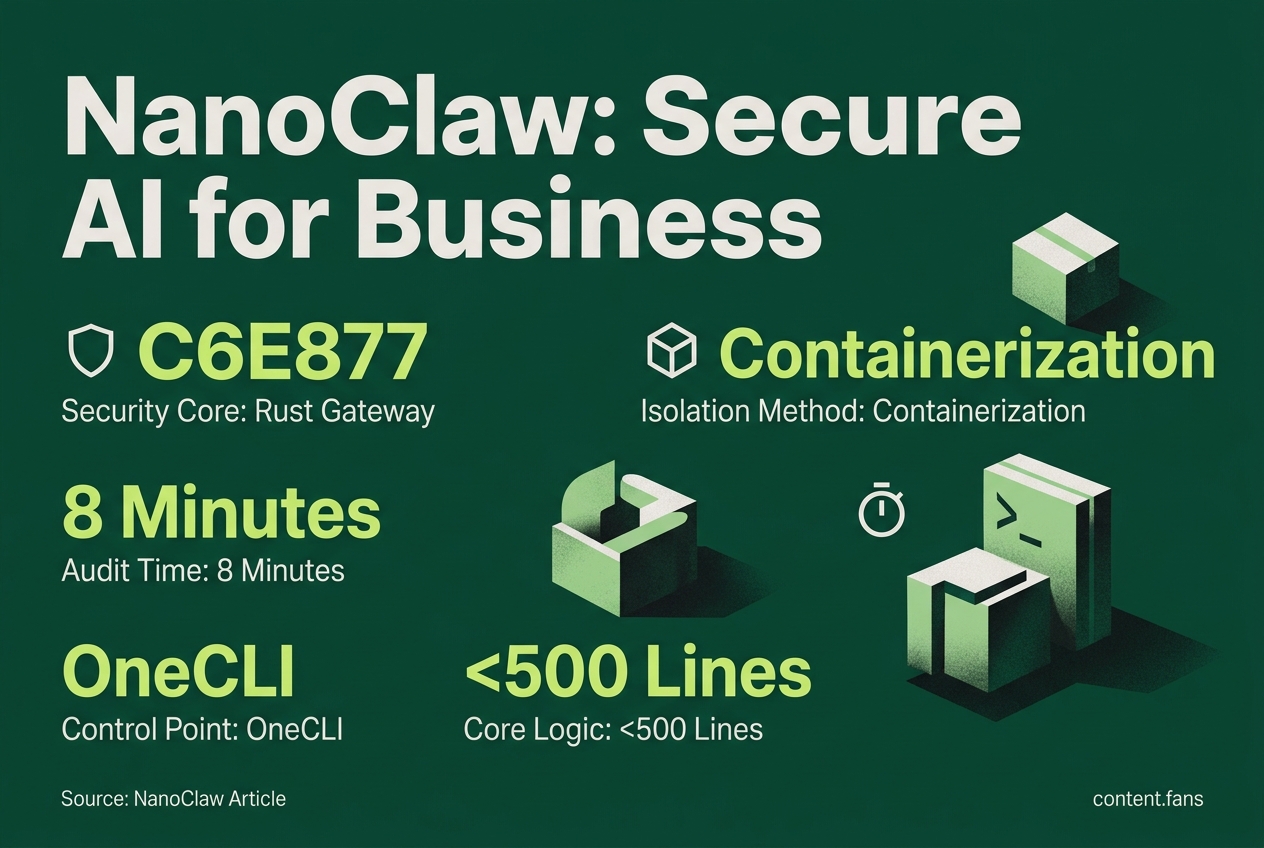
NanoClaw secures enterprise AI agents by enforcing mandatory containerization and isolating every action through a Rust-based gateway. This system verifies each request against company policies and requires human approval for sensitive operations, ensuring a secure, auditable, and least-privileged environment for AI agent deployment within a business.
NanoClaw's security design is founded on mandatory containerization. A Noma Security analysis confirms that agents cannot operate outside a containerized environment. Each agent runs as an unprivileged user within its sandbox, a measure that drastically reduces host system access and mitigates the risk of lateral movement following a successful prompt injection.
The platform enhances security by isolating agents into groups. According to the Noma Security report, assigning each workspace its own dedicated container effectively minimizes the blast radius between different departments. This allows enterprises to replicate their existing network segmentation, such as separating production and staging environments, at the AI agent layer.
The Rust gateway as single control point
Every outbound call from an agent is funneled through OneCLI, a dedicated Rust process that serves as the central point for enforcing company policy. The aforementioned VentureBeat report highlights that sensitive actions, like deleting an email or modifying a cloud deployment, automatically trigger a human approval workflow. The system only injects a short-lived credential after a user provides explicit approval.
The platform promises a rapid "eight-minute audit" for security teams, a claim supported by its core TypeScript logic being under 500 lines of code. This minimal codebase makes a thorough manual review practical during the procurement process. Furthermore, the gateway centralizes all logs, enabling defenders to meticulously trace token usage, tool calls, and performance latency for each individual agent.
Adoption signals and early metrics
Early adoption indicators show growing interest in the project, with the platform gaining traction among developers and enterprises evaluating AI agent solutions. While these metrics don't confirm production use, they often serve as a leading indicator for proof-of-concept evaluations in large organizations. The report also details plans for a subscription model offering bundled context libraries and dedicated on-call support.
A short list of enterprise-relevant guarantees cited across sources:
- Mandatory Container Sandboxing: Isolation is enforced by default, not an optional setting.
- Unprivileged Execution: Agents operate as non-root users to limit system access.
- Centralized Policy and Logging: The gateway acts as a single control point for policy enforcement and comprehensive logging.
- Human-in-the-Loop for Sensitive Actions: Destructive operations require explicit user approval.
- Rapid Code Audits: A minimal codebase allows for fast and feasible security reviews.
Where NanoClaw may fit
NanoClaw's robust security features make it particularly suitable for highly regulated sectors like finance, healthcare, and legal, where provable isolation and traceability are paramount. By embedding security controls directly beneath the prompt layer, the platform offers a compelling alternative to large cloud ecosystems reliant on traditional IAM and perimeter policies. While facing potential competition from offerings like Nvidia's NemoClaw and Google Cloud's agent tools, NanoClaw's unwavering "isolation-first" strategy remains its key competitive advantage.
FAQ: NanoClaw's Enterprise Pivot and Rust-Backed Security
3.1 Why did NanoClaw shift from open-source hobby project to enterprise "second brain"?
The maintainers saw that Nvidia and Google are racing to own the agent ecosystem, so they repackaged their <500-line TypeScript core as a managed assistant that lives inside Slack or Microsoft Teams. By keeping the codebase tiny, they can truthfully tell CISOs: "You can audit every line in eight minutes." Early traction is growing, with significant developer interest signaling trust that the team is converting into paid PoCs with regulated customers.
3.2 How does the Rust gateway keep credentials safe?
Raw secrets never reach the agent. All actions flow through a Rust-built gateway that holds the keys. When an agent wants to, say, delete a cloud bucket, the gateway intercepts the call, pings the employee for one-tap approval, and only then injects the scoped credential. Because the gateway enforces company-defined policies and runs as a separate memory-safe binary, a compromised agent still cannot forge privileged requests.
3.3 What makes NanoClaw's isolation different from container-only approaches?
NanoClaw makes sandboxing mandatory, not optional. Every agent spawns inside an unprivileged container with per-group isolation; the host user's filesystem rights are never inherited. Compare this with stacks where isolation is a config flag: one missed checkbox equals a full-host breach. Security analysts note that NanoClaw falls into the rare category of platforms where sandbox isolation is mandatory versus the industry norm of optional sandboxing.
3.4 Which enterprise use cases are signing up first?
Regulated shops: legal, finance, healthcare. They like that sensitive data can stay on-prem while still giving employees an AI helper that drafts contracts, reconciles accounts, or summarizes patient notes. Because all tool calls are logged and identity-tagged, compliance teams get the audit trails they need for HIPAA, SOX, or GDPR reviews. Early adopters also include IP-heavy manufacturers who fear IP leakage into public LLMs.
3.5 How real is the "eight-minute audit" claim?
The entire orchestration logic is ~500 lines of TypeScript; a security team can read it end-to-end over coffee. The Rust gateway is similarly compact, and both components ship with OpenTelemetry traces so reviewers can watch every credential injection in real time. While enterprise pen-tests will still take days, the minimal attack surface shortens the critical path from "Can we approve this?" to "Yes, we understand every moving part."
Relevant links:
Architectural Evolution of NanoClaw and Enterprise Platform Risk
NanoClaw creators turning open-source harness into enterprise second brain