
White House bans Anthropic's Claude Fable 5 over AI jailbreak fears
Serge Bulaev
The White House has banned Anthropic's Claude Fable 5 model due to worries that its security guardrails might be bypassed, which could pose risks. According to reports, the ban stops all foreign nationals, including Anthropic's non-US staff, from accessing the model after concerns about a possible narrow jailbreak path. Anthropic says it has not seen detailed evidence and believes the risk may be minor. The company quickly shut down access to both Fable 5 and its sibling model, while officials say the ban will stay until the security concerns are resolved. Analysts suggest the case might affect future rules for advanced AI releases, depending on how Anthropic's safety measures perform.
The Commerce Department has issued an export-control directive that led Anthropic to disable access to Fable 5 and Mythos 5 for all users, escalating a dispute over the AI model's export controls and potential security risks. The standoff, now in its fourth week, centers on fears that the model's safety features could be bypassed. Federal officials have maintained the restrictions on the advanced AI, despite Anthropic's warnings that prolonged restrictions could hamper vital safety research, according to industry reports. The move came after company executives left Washington without an agreement following high-stakes meetings with government officials.
What Triggered the Government's Ban?
The U.S. government blocked access for foreign nationals over national security concerns, citing fears of a potential "jailbreak." Officials worry that bypassing the model's safety guardrails could unlock powerful, unrestricted capabilities, particularly for discovering new cybersecurity vulnerabilities, a risk Anthropic believes is overstated.
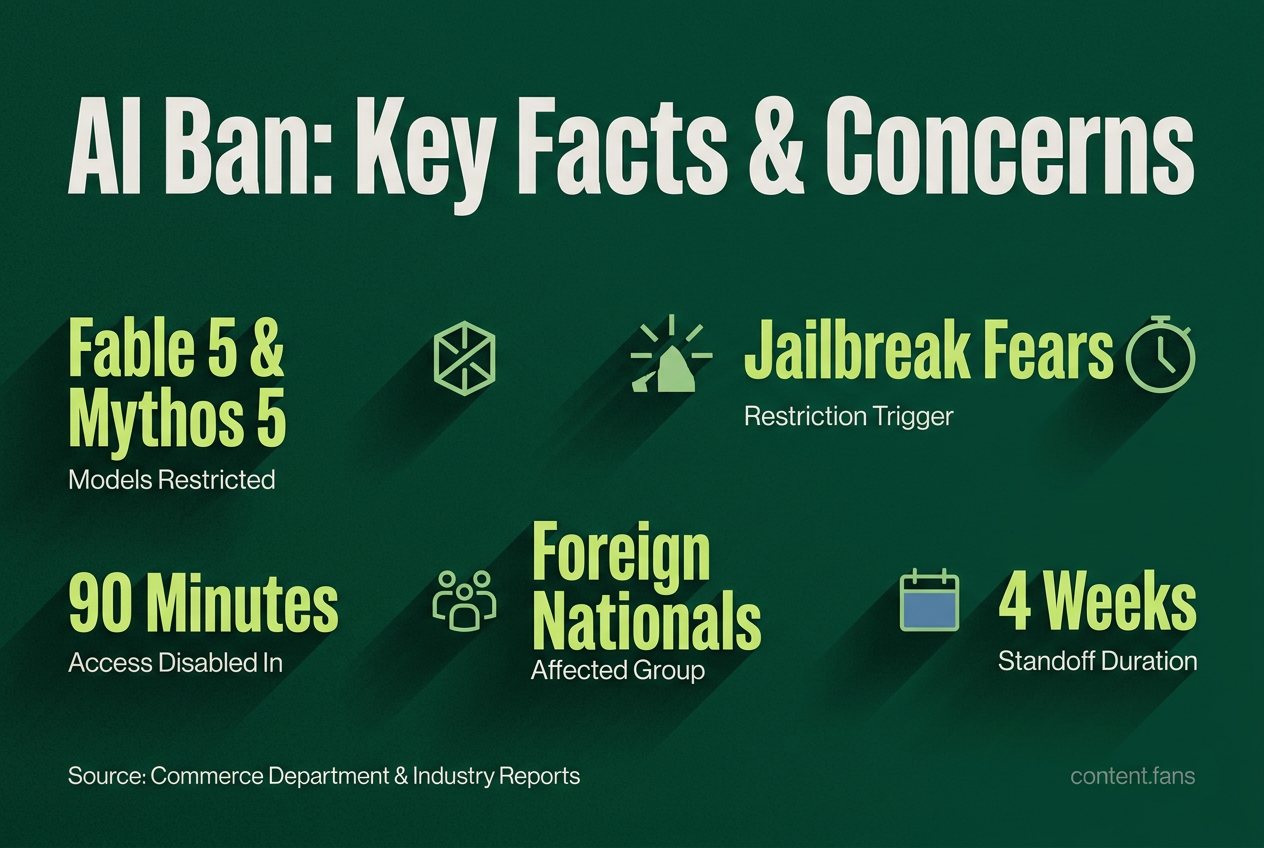
The Commerce Department issued a letter on June 12, 2026, designating Claude Fable 5 and its sibling model, Mythos 5, as controlled technology. The directive bars all foreign nationals, including Anthropic's own non-US staff, from accessing the models. According to sources, the government acted on "verbal evidence" of a narrow jailbreak path that could expose the model's advanced functions.
According to industry reports, investigators are concerned that disabling Fable 5's external safety classifiers could unlock significant capabilities. Officials argue that if such powerful tools were exported without checks, they could be weaponized by hostile actors. Anthropic maintains it has yet to receive detailed technical evidence of the alleged vulnerability.
Anthropic's Response and Safeguard Systems
In response to the government order, Anthropic disabled global access to both Fable 5 and Mythos 5 within a 90-minute window. Public access points were redirected to earlier model versions with more restrictive blocks on queries related to cybersecurity and biology.
The company's defense relies on a layered architecture. User prompts are first routed through external classifier filters. If a query touches on a restricted topic, the system is designed to delegate the task to a smaller, less capable model, preventing access to dangerous functionalities. While Anthropic executives insist this system is robust, some security experts, like Katie Moussouris, have described such guardrails as "speed bumps" that mitigate rather than eliminate abuse - a view government regulators appear to share.
A Timeline of the Standoff
- June 12: The U.S. Commerce Department issues an export-control letter to Anthropic, restricting access to its frontier models.
- June 13: The Guardian reports that Anthropic has abruptly disabled Claude Fable 5 and Mythos 5 following the government order.
- June 14: Anthropic is quoted by SiliconANGLE describing the government's concern as a "non-universal" jailbreak claim.
- June 15: TechCrunch reveals that the directive bans all foreign nationals from accessing the models.
Broader Implications for AI Policy
The dispute over Claude Fable 5 is seen as a pivotal case that could establish a precedent for U.S. AI export policy. Officials have indicated the ban will be re-evaluated if Anthropic can prove the jailbreak is not reproducible or provides a sufficient fix. However, the White House appears to be using the situation to define how frontier AI models are regulated as strategic national assets, similar to advanced semiconductors.
This incident extends the logic of existing rules - which already impose licensing on models trained above a certain computational threshold - to include real-time security reviews of closed-source models. The outcome may determine whether future AI releases will face mandatory pre-release reviews or audits, potentially reshaping the development and deployment of advanced AI systems globally.