
Walleye Capital mandates AI fluency for all 400 employees
Serge Bulaev
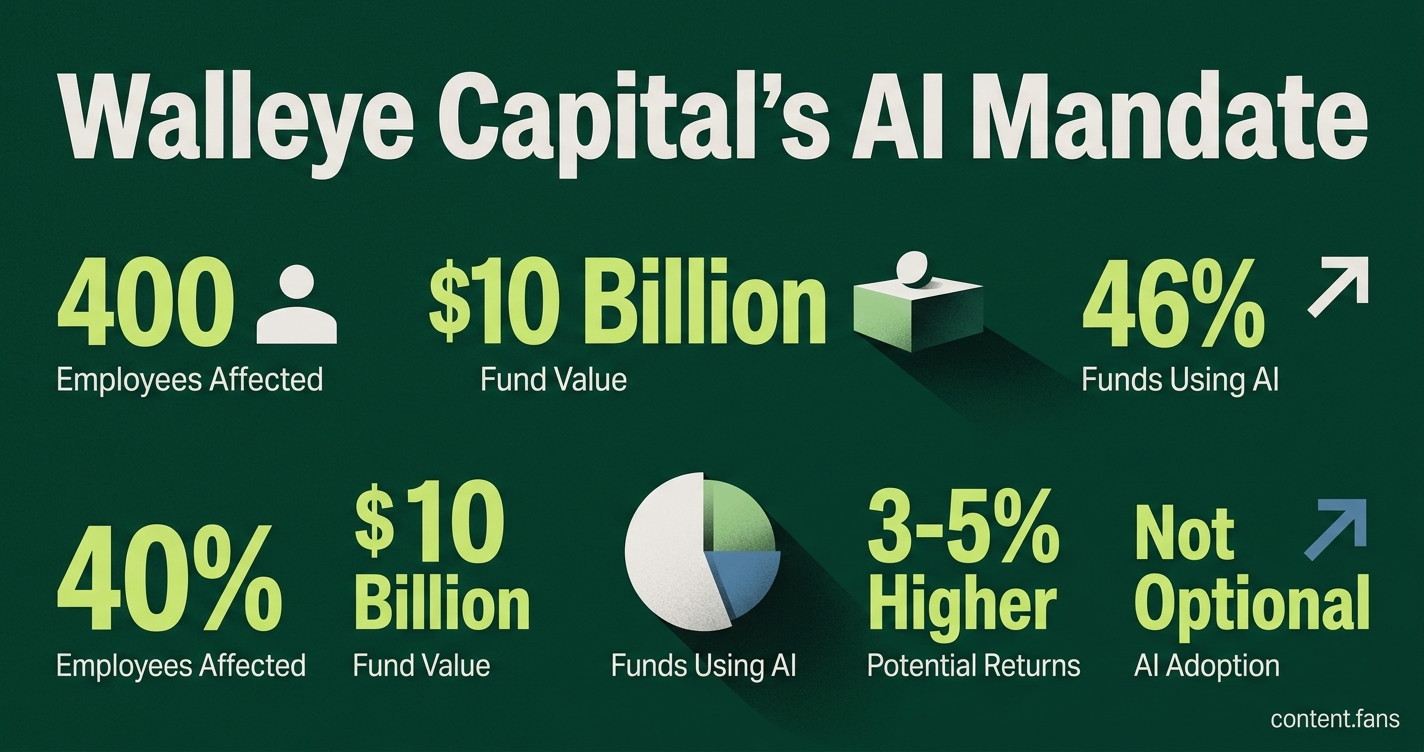
Walleye Capital, a $10 billion hedge fund, now requires all 400 employees to use generative AI tools daily. The company introduced training, usage dashboards, and public leaderboards to encourage adoption, and employees may earn rewards for developing useful tools. Reports suggest that AI helps staff work faster on tasks like drafting and data processing, and performance expectations appear to have risen. There may be no planned layoffs because of the policy, as leadership sees AI as a way to help employees, not replace them. The program's success seems to depend on both technology and fostering a culture that supports experimentation with AI.

Walleye Capital, a $10 billion hedge fund, now requires all 400 employees to use generative AI tools daily, establishing the firm's commitment to company-wide AI fluency. CEO Will England has compared avoiding the technology today to refusing to use the internet in the late 1990s, framing the directive as a fundamental operational shift.
Inside Walleye's Mandatory AI Policy
England's directive extends across every division, requiring analysts, accountants, and compliance officers to integrate large language models (LLMs) into their daily work. To ensure compliance and encourage adoption, the firm has implemented a comprehensive support system.
How Walleye Drives AI Adoption
Executives announced in a firmwide memo - reportedly drafted with ChatGPT - that AI adoption "is not optional," according to an Every podcast transcript.
The firm supports its mandate with structured training, public usage dashboards, and peer-visible leaderboards to track progress. Weekly meetups showcase new workflows, while employees can earn bonuses and gift cards when their suggested AI tools and prompts are adopted by other teams across the company.
To further integrate AI, internal systems capture and auto-transcribe Zoom meetings, feeding the text into a searchable knowledge base. Managers can query this database to surface ideas or identify compliance risks that might otherwise be missed.
Speed and Efficiency: The Core Strategic Driver
For England, the primary advantage of AI is speed. He noted that memo drafting has become significantly faster with LLM assistance. He argues this time compression frees employees from routine cognitive labor, elevating their "context level" to focus on higher-order tasks like portfolio scenario design.
This strategy aligns with broader industry movements. A J.P. Morgan survey cited by Paragon Alpha found that 46% of funds already actively use AI, with another 30% exploring adoption. Furthermore, academic research cited here supports roughly 3-5% higher annualized abnormal returns.
What Mandatory AI Means for Knowledge Workers
Sources report three immediate effects on employees at Walleye:
- Accelerated Workflows: Drafting and synthesis tasks are completed much faster, altering how analysts structure their day.
- Focus on High-Level Judgment: Routine work like PDF parsing and data aggregation is increasingly automated, shifting employee responsibility toward critical thinking and judgment calls.
- Increased Performance Expectations: The baseline for productivity has risen, as all work is assumed to have AI assistance.
The firm has stated it does not plan layoffs tied to the mandate, framing AI as a tool for leverage rather than a means of substitution. However, employees who fail to adopt the tools risk falling behind peers who can deliver work faster. This principle extends to compliance, where bots scan communications for restricted phrases, reducing post-trade remediation time.
Fostering a Culture of AI Experimentation
The program's success appears to depend as much on culture as it does on technology. By labeling AI use as "productive, not cheating," Walleye's leadership reduces resistance and encourages experimentation. The combination of weekly meetups, public metrics, and financial rewards creates a system of accountability and gentle peer pressure, normalizing AI integration into every role.
Walleye Capital manages approximately $10 billion and reports widespread employee enrollment in its AI training program, with leadership planning additional incentives pending audits of daily use.