
Google Labs: AI Upskills Workers to Orchestrate Outcomes, Not Steps
Serge Bulaev
Artificial intelligence may be changing jobs so quickly that hiring plans cannot keep up. Josh Woodward from Google Labs suggests that workers might focus more on guiding outcomes while AI handles routine steps. Surveys suggest that skills like outcome orchestration, machine learning, data engineering, and AI governance appear to be in greater demand. Companies reportedly want everyone to have some AI knowledge, with special training for certain roles. The series also suggests that watching how people really use AI could be a better way to measure progress than just looking at data.

Google Labs is redefining how knowledge workers approach AI, shifting the focus from executing individual tasks to orchestrating outcomes. Led by Josh Woodward, who oversees Google Labs, the Gemini app, and AI Studio, this vision emphasizes human judgment, adaptability, and workflow design as the skills that will matter most in the coming years.
What does Josh Woodward mean by "orchestrating outcomes" instead of "steps"?
It means workers will shift from performing procedural tasks to defining high-level goals and desired results. In this model, AI agents handle the mechanical "how-to" steps, while humans provide strategic direction, creative judgment, and quality control, effectively acting as directors of the final deliverable.
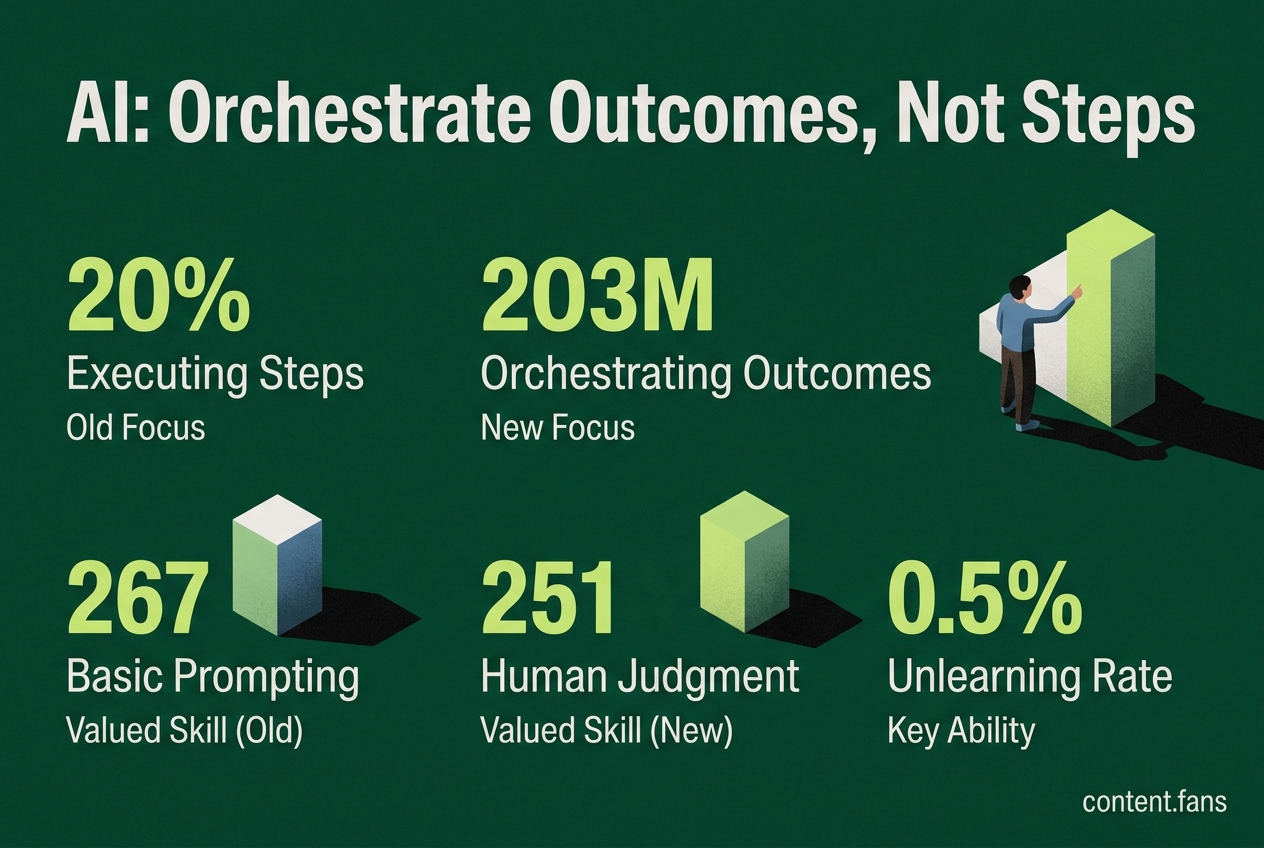
Woodward's core insight is that AI will handle the execution, freeing workers to focus on defining what success looks like. He has explained that knowledge work is moving toward "orchestrating much more about the outcome or the deliverable you want instead of the how to get there." This represents a fundamental shift: workers become directors rather than doers, using AI to handle implementation while they apply human judgment, taste, and creativity to guide results.
Which specific skills are becoming more valuable as AI advances?
Based on Woodward's statements and emerging workforce trends, several skill categories are rising in importance:
| Category | Key Capabilities |
|---|---|
| Human judgment & taste | Evaluating AI outputs, aesthetic decisions, quality assessment |
| Outcome orchestration | Defining goals, coordinating AI tools, managing deliverables |
| Product sense | Observing real user behavior, designing effective AI workflows |
| Adaptability / "unlearning" | Rapidly dropping outdated methods and adopting new approaches |
Woodward specifically notes that companies should hire for an "unlearning rate" as much as a learning rate - the ability to abandon familiar workflows when better alternatives emerge.
How does this compare to broader trends in AI-related skills?
The market confirms Woodward's emphasis on judgment over execution. Industry analysis highlights agentic AI orchestration as one of the fastest-expanding job requirements. Similarly, recent reports show growing demand for hands-on AI engineering skills (building tools, automating workflows), while basic prompting skills have peaked and begun to decline.
Research shows AI-exposed occupations are changing skills significantly faster than less exposed ones, with judgment, leadership, creativity, and problem-solving becoming more critical. The fastest-growing technical skills align with orchestration: agentic AI, RAG systems, vector databases, and multi-agent orchestration - all focused on coordinating AI systems rather than building them from scratch.
What does this mean for enterprise upskilling programs?
Organizations are responding with structured frameworks that map skills to roles rather than offering generic AI training. Effective programs include:
- Baseline AI literacy for all staff
- Role-specific tracks for technical, managerial, and operational roles
- Workflow-embedded learning that applies directly to actual business processes
- Governance and ethics training for responsible AI deployment
Leading providers like DataCamp, Pluralsight, and Correlation One emphasize measurable skill gain tied to business outcomes, with pricing typically ranging from hundreds to thousands of dollars per seat annually for self-paced programs and higher costs for intensive cohort training.
How can individuals prepare for this shift?
For workers planning career transitions, the most effective preparation combines:
- Technical foundations: Python, data literacy, and basic ML concepts
- Orchestration capabilities: LLM application development, RAG systems, and tool integration
- Human differentiators: Critical thinking, creative problem-solving, and adaptability
Woodward's advice to "watch users' eyes rather than dashboards" applies equally to individual contributors: the ability to observe, interpret, and respond to real human needs will distinguish those who thrive in an AI-augmented workplace.
For hands-on exploration, Google's NotebookLM and AI Studio offer accessible entry points to experiment with outcome-oriented AI workflows.