
Berkeley Study: 10 Minutes of AI Boosts Performance, Cuts Persistence
Serge Bulaev
A Berkeley study suggests that using AI like ChatGPT for 10 minutes may help people perform better on tasks at first, but they might give up more quickly when the AI help is removed. The study found that, after the AI was taken away, participants skipped more questions and got fewer correct answers than those who never used the AI. Brain scans also appeared to show less mental effort after using AI. The authors note these results might be temporary and only reflect a short exposure, so more research is planned to see if people adjust over time.

A University of California, Berkeley study found that just 10 minutes of AI use can boost task performance but may significantly reduce persistence on difficult problems once the assistance is removed. The research highlights a critical trade-off between short-term productivity gains and the long-term cognitive skill of persistence.
The research, detailed in an arXiv preprint, involved three randomized controlled trials with participants. In these trials, one group received brief access to ChatGPT for problem-solving, while a control group worked entirely unaided. After the AI was withdrawn, the group that had used it skipped more questions and answered fewer correctly than the control group.
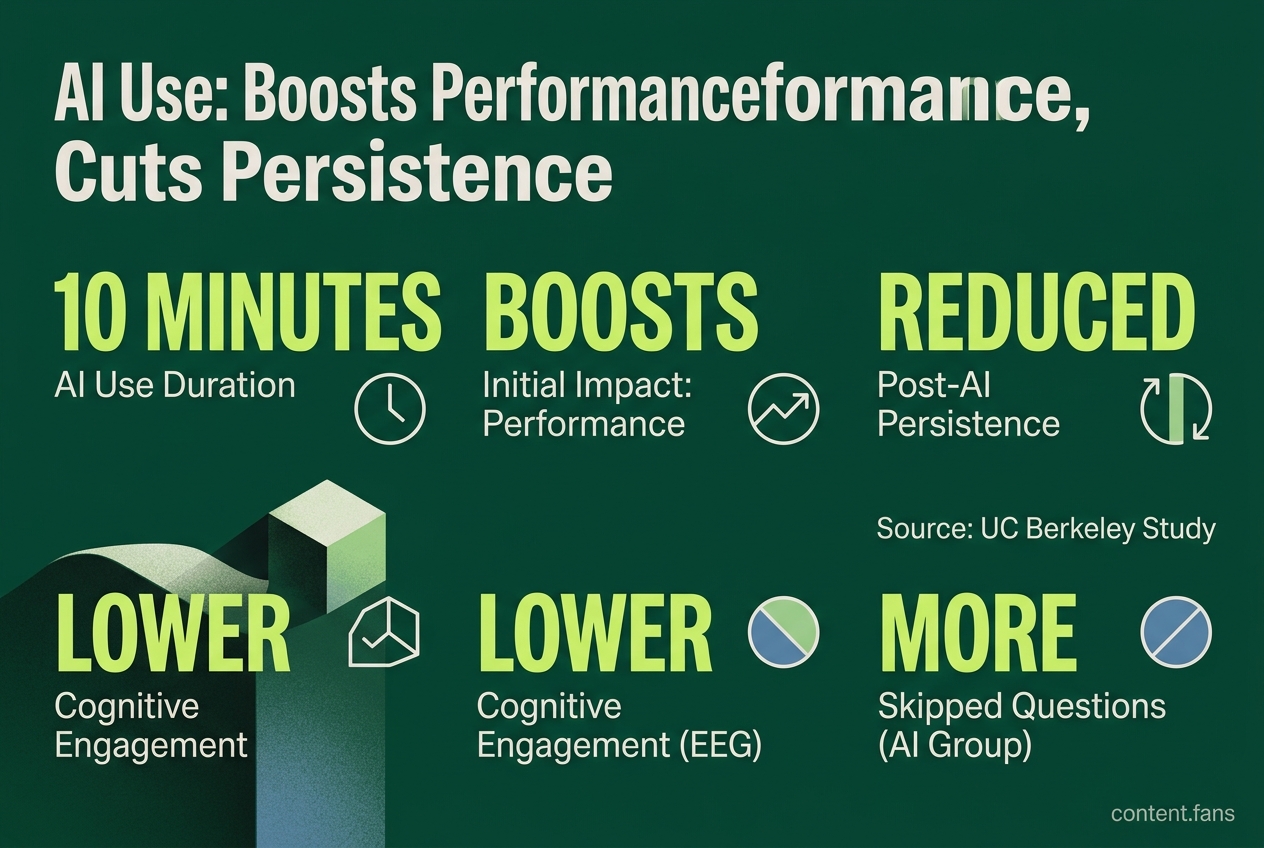
Key Experimental Design
The Berkeley study found that while short-term AI assistance improved accuracy, it led to reduced persistence once removed. Participants who used AI were more likely to skip subsequent difficult questions and showed brain activity suggesting lower cognitive engagement compared to those who never used AI.
The study's three experiments progressively built the evidence:
- Experiment 1: Volunteers solved fraction problems. The group assisted by AI for the first portion of items skipped the final questions more often than the control group.
- Experiment 2: A larger group of participants repeated the fraction task, with a pre-test added to balance for baseline skills, reinforcing the initial findings.
- Experiment 3: The task was shifted to SAT-style reading comprehension, revealing a comparable decline in persistence when the AI tool was removed.
Measuring Persistence and Engagement
Researchers focused on key behaviors: the number of correct answers, the frequency of skipped items, and the time spent on each unaided problem.
Beyond behavior, the team used electroencephalography (EEG) to measure brain activity in a subsample of participants. These recordings reportedly showed lower theta-band activity - a signal the authors interpret as reduced cognitive engagement - during the problem-solving phase after the AI was taken away.
The Debate: Cognitive Offloading vs. Tool Dependence
The study's results contribute to a larger debate on "cognitive offloading," where individuals may rely on AI to the detriment of their own critical thinking. The Berkeley authors suggest that even a brief experience with frictionless AI help can lower a person's willingness to exert effort when challenges arise.
Skeptics, including the study's authors, note that this drop in persistence might be a temporary adjustment. The experiments only captured a single, short exposure, and real-world scenarios involve more complex factors. However, the findings align with other commentary about the risks of dependent AI use.
Practical Implications and Future Research
Rather than banning AI, education specialists suggest implementing structured guardrails. These include requiring users to attempt problems first without help, using AI for feedback instead of direct answers, and scheduling dedicated no-AI practice sessions to maintain core skills.
The Berkeley group is reportedly planning follow-up longitudinal studies to determine if persistence rebounds over time with repeated exposure. Until then, the experiments offer clear, randomized evidence that a short burst of AI can both help and hinder problem-solvers within the same session.