
Visa Integrates Payments into ChatGPT for AI Agent Shopping
Serge Bulaev
Visa has partnered with OpenAI to let ChatGPT start payments for users, while Visa handles security and authorization. This new feature may allow people to ask ChatGPT to buy things, but it is still in a test phase and not widely available yet. Visa says its payment network is now inside ChatGPT, with limits and approval steps to control spending and reduce fraud. Reports suggest the focus is on safety and guardrails, and there is no set date for when everyone can use it. Other companies like Mastercard and Google are also working on similar technology, so there may be competition to set the standard for AI-powered payments.

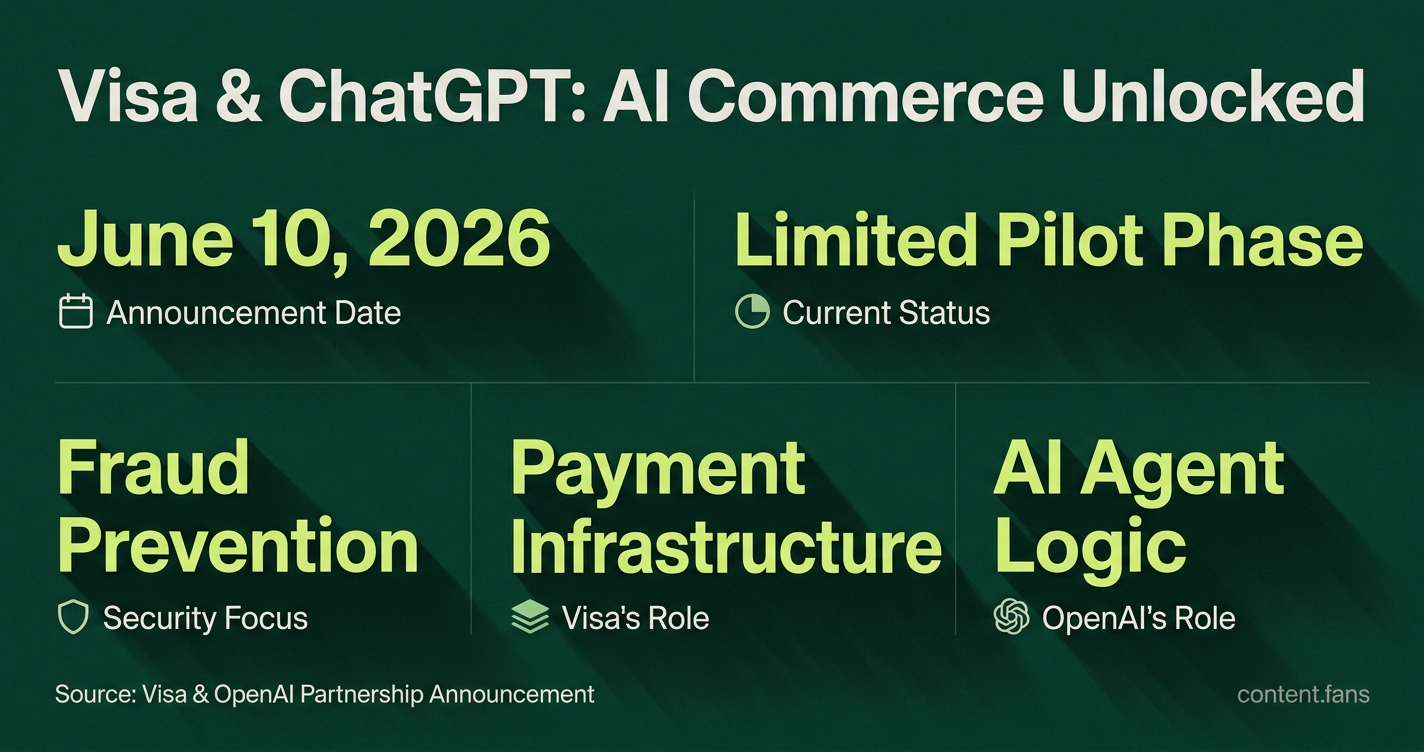
In a landmark move for AI-driven commerce, Visa integrates payments into ChatGPT through a new partnership with OpenAI. This collaboration enables the chatbot to initiate secure card payments, with Visa managing all authorization, tokenization, and fraud prevention. Announced on June 10, 2026, the initiative marks a significant step toward what industry analysts term agentic commerce.
This integration connects OpenAI's AI agents to Visa's global payment infrastructure, allowing a conversational prompt to become an approved purchase that adheres to the user's spending limits. Initial reports emphasize the security guardrails, indicating the feature is in a limited, controlled test phase rather than being ready for a broad public launch.
How Does the Visa and ChatGPT Payment Integration Work?
Visa's payment network is embedded directly within ChatGPT, allowing AI agents to initiate transactions with user permission. OpenAI provides the agent logic, while Visa handles real-time authorization, risk scoring, tokenization, and transaction routing, using the same secure infrastructure that powers all Visa card payments globally.
Through this partnership, Visa has embedded its payment network directly into the ChatGPT interface. This allows the AI agent to execute purchases on behalf of a user, pending explicit permission. While OpenAI manages the conversational agent, Visa provides the core payment infrastructure, including:
- Real-time payment authorization and risk scoring
- Spending limits that users can set or change
- Required approval steps before a purchase proceeds
- A list of approved merchants to reduce exposure to fraud
According to a Visa investor news release, the company's proprietary AI risk models will oversee transactions to ensure secure operation at scale. Details regarding the pricing or fee structure have not yet been announced.
When Will ChatGPT Payments Be Available?
The collaboration, announced on June 10, 2026, is currently a strategic partnership rather than a full-scale consumer product launch. The feature is in a pilot phase with significant security guardrails. Neither Visa nor OpenAI has released a public timeline for a wider rollout or specified geographic availability. This integration expands on previous e-commerce tests in ChatGPT, which used Stripe's Instant Checkout, by enabling AI agents to initiate purchases directly.
How Secure Is AI-Powered Shopping?
The emphasis on security is paramount. Industry reports suggest that many financial leaders believe AI tools are effective at reducing payment fraud false positives and customer churn. This industry sentiment highlights the critical role of Visa's own advanced, AI-driven risk scoring in making agentic commerce a viable and trusted technology.
Who Are the Main Competitors in AI Payments?
The move positions Visa in a burgeoning market, with several major players competing to define the standards for AI-driven payments. Bloomberg reports that Mastercard is developing its "Agent Pay" system, while Google and Shopify are promoting the Universal Commerce Protocol. OpenAI's decision to partner with established networks instead of building a native checkout system suggests that expertise in fraud prevention, identity verification, and merchant acceptance is a key competitive advantage for established card networks like Visa.
How will Visa's integration with ChatGPT actually work on launch?
Visa embedded its payment network inside ChatGPT rather than providing a separate app or plug-in, so the agent can authorize and complete transactions on the user's behalf within the same conversation. When an AI agent proposes a purchase, the user must explicitly approve the charge, either by tapping "Confirm" or through pre-set rules such as a maximum spending limit or a list of approved merchants. Visa supplies the tokenized card credentials, real-time fraud scoring and transaction routing - the same rails used for every Visa card swipe - so the checkout flow remains invisible once the user says "yes."
- Announcement timing: the partnership was revealed on June 10, 2026, but Visa described it as a directional launch with guardrails, not an instant mass-market release.
- Fees or pricing: neither Visa nor OpenAI disclosed consumer or merchant fees at announcement.
What safety measures are in place to prevent unauthorized spending?
Layered controls are the core of the design:
- Spending limits: users set daily, weekly or per-transaction caps inside ChatGPT settings.
- Required approval steps: every purchase triggers an in-chat confirmation request; nothing moves without a human "Confirm."
- Approved merchant list: users can whitelist stores; any attempt outside the list is automatically blocked.
- Real-time fraud monitoring: Visa's AI models score each transaction in milliseconds, declining anything that looks like synthetic identity fraud or account takeover.
- Tokenized credentials: the actual Visa card number is never exposed to the merchant or the agent, reducing the risk of data breaches.
Recorded Future notes that agentic commerce introduces new fraud surfaces, but Visa's design keeps the authorization path identical to existing card rails, which have 99.9 % uptime and decades of dispute-resolution history.
When will the feature be available to everyday users?
Visa and OpenAI did not commit to a full public launch calendar on June 10. Current language points to a controlled pilot phase with selected retailers and a small group of ChatGPT Plus users later in 2026. Both companies said broader rollout timing will depend on fraud-loss metrics and merchant onboarding speed.
- If you are a ChatGPT Plus subscriber, industry reports suggest new payment features may become available in the coming months, though specific timing remains unconfirmed.
What does this mean for other payment networks and tech giants?
The Visa-OpenAI move triggered a protocol race:
- Mastercard is countering with its own Agent Pay standard.
- Google & Shopify are pushing the Universal Commerce Protocol (UCP) to coordinate agent checkouts across platforms.
- Stripe, which already powered ChatGPT's earlier Instant Checkout, is now backing the Agentic Commerce Protocol (ACP) focused on merchant APIs.
Early 2026 industry recaps (Crawloria, Stellagent) note that OpenAI scaled back direct product checkout in March 2026 to let third-party protocols decide how agents pay. That means Visa, Mastercard and Stripe are effectively competing to become the rails that AI agents use for every chat-driven cart.
How big could agent-driven commerce become?
Industry reports indicate significant growth in agentic traffic, with digital payment fraud losses projected to increase substantially in the coming years. Against that backdrop:
- Visa sees agent-driven sales as a new checkout channel, not a replacement for existing cards.
- Merchant surveys show a significant portion expect first-party misuse (friendly fraud) to rise, but many industry leaders say AI-based fraud defenses are already cutting false positives.
If current trends continue, a growing share of online purchases could be initiated by AI agents in the coming years, making the Visa-OpenAI collaboration an important test of whether conversational commerce can be both scalable and trustworthy.