
Verve Therapeutics' VERVE-102 gene therapy challenges drug payment models
Serge Bulaev
Verve Therapeutics' VERVE-102 is a gene therapy that may change how drug payments work, because it aims to be a one-time treatment instead of ongoing medicine. Early data suggest the therapy is still several years from being available, but payment models for it are already being reconsidered. The new therapy appears to create challenges for insurers, Medicaid, and Medicare, as current budgets and payment plans are based on medicines people take over time, not a single treatment. Different payment models, such as installment plans or outcome-based agreements, are being explored, but each has possible problems. Important policy questions remain about how to handle these new therapies if they prove successful in clinical trials.

Verve Therapeutics' VERVE-102 gene therapy challenges drug payment models by replacing chronic medications with a single treatment. This investigational cure, while years from market, is forcing a radical rethink of reimbursement. The shift from recurring prescriptions to a large, one-time cost creates significant financial hurdles for insurers and public programs, prompting an urgent search for new payment solutions.
Where VERVE-102 stands in 2025
VERVE-102 is an investigational therapy targeting the PCSK9 gene in adults with heterozygous familial hypercholesterolemia. As of early 2025, it is in an open-label Phase 1b trial (Heart-2, NCT06164730) with an estimated primary completion date of August 2026. Verve received FDA Fast Track designation for VERVE-102, and Lilly said on May 25, 2026 that it plans to initiate the Phase 2 clinical study by the end of 2026.
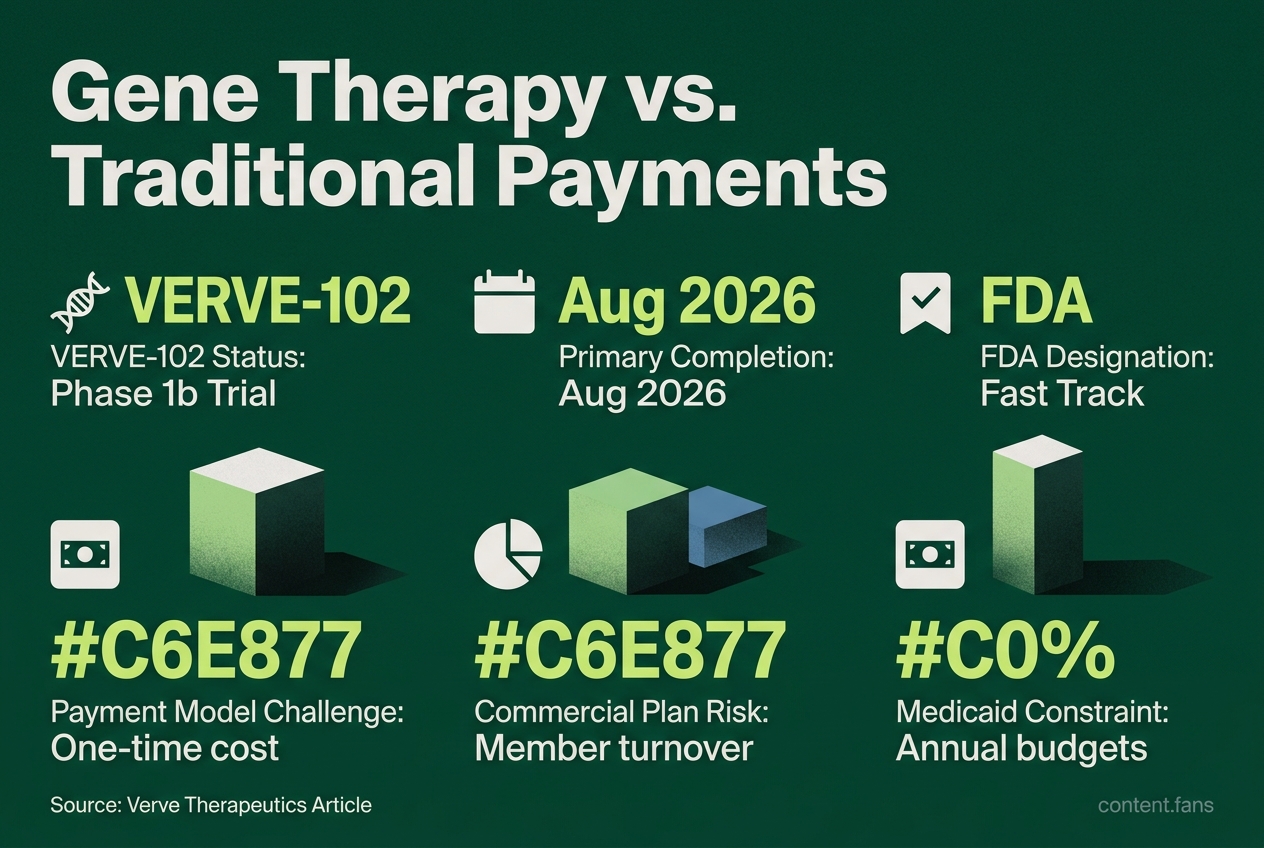
VERVE-102 is a gene-editing therapy currently in a Phase 1b clinical trial (NCT06164730) for high cholesterol, with an estimated primary completion in August 2026. Verve Therapeutics received FDA Fast Track designation and plans to begin Phase 2 trials by the end of 2026.
Why single shot therapies scramble existing payment norms
Traditional payment systems are built for recurring drug costs, not single-injection cures. A one-time therapy creates a massive upfront cost for a lifetime of benefit, a cash-flow mismatch that creates significant risk for all payers.
- Commercial Plans: High member turnover means an insurer might pay the full cost for a patient who then switches plans, preventing the original payer from realizing long-term savings.
- Medicaid: State programs are constrained by annual budgets, making it difficult to finance a large, one-time expense. In response, the CMS Cell and Gene Therapy Access Model is testing outcomes-based solutions with states.
- Medicare: As treated populations age, Medicare is projected to bear a substantial financial burden from gene therapies.
Tool kit of payment models
| Model | Mechanism | Primary downside |
|---|---|---|
| Upfront lump sum | Single payment at infusion | Immediate budget shock |
| Installment annuity | Spread over 3-5 years | Patient may switch plans |
| Outcomes based agreement | Payment tied to LDL-C or event reduction milestones | Requires tracking infrastructure |
| Warranty or refund | Manufacturer rebates if target not met | Complex enforcement |
| Risk pool | Cross payer fund shares cost | Needs governance rules |
To manage this financial disruption, several alternative models are under consideration. Hybrid approaches combining annuity payments with outcomes-based milestones are gaining traction because they smooth budget impact while sharing performance risk. Analysts also propose using third-party financial intermediaries to manage upfront payments and later reconcile rebates.
Pressure on PBMs and channel margins
One-time cures directly threaten the business model of Pharmacy Benefit Managers (PBMs), which relies on revenue from dispensing chronic medications. In response, PBMs may shift toward offering fee-based services for managing value-based contracts and verifying clinical outcomes. For employers, the loss of rebate streams from existing cholesterol drugs could also lead to a short-term increase in net healthcare costs.
Lessons from the GLP 1 surge
The recent surge in GLP-1 agonist spending provides a cautionary tale. While these drugs demonstrated long-term medical cost savings for adherent users, the immediate spike in pharmacy spending drove premiums up. This highlights a critical lesson: even when therapies produce significant health benefits, payment models must be structured to align the timing of costs with the realization of savings.
Near term policy questions
Key policy questions must be addressed before therapies like VERVE-102 become widely available:
- Should the federal government proactively expand the current CMS model to Medicare Part D to prepare for therapies targeting large cardiovascular populations?
- How will regulators define a "durable" clinical response in outcomes-based contracts when initial trial data only provides short-term follow-up?
- What rules are needed to ensure payment obligations are portable when a patient moves between different insurance plans?
Industry stakeholders are actively developing these financial frameworks so that if VERVE-102 succeeds in pivotal trials, a viable payment infrastructure is ready to support its revolutionary approach to treatment.
What is VERVE-102 and where is it in development today?
VERVE-102 is a single-course gene editing therapy designed to lower LDL-cholesterol by permanently inactivating the PCSK9 gene in liver cells. As of April 2025 it sits in the open-label Phase 1b Heart-2 trial (ClinicalTrials.gov ID NCT06164730) for adults with heterozygous familial hypercholesterolemia or premature coronary artery disease. Study timelines show primary completion is forecast for August 2026 and full study completion August 2027. The company has dosed participants in multiple dose cohorts and expects Phase 1 data before Phase 2 starts by the end of 2026, pending FDA clearance.
How does a one-and-done therapy like VERVE-102 break traditional reimbursement?
Traditional insurance budgets are built on recurring monthly claims for chronic drugs; a therapy given once and never again removes that steady cash flow. Single-day costs in the hundreds of thousands create an immediate budget shock, while the clinical benefit and payer savings unfold over decades. If a patient changes insurers, the original payer shoulders the full price but reaps none of the downstream savings, undermining the economic case for coverage.
Which new payment models are actually being piloted?
Payers and policy makers are exploring multiple payment structures:
- Annuity payments spread cost across several years
- Outcomes-based agreements link future installments to verified LDL reductions or avoided cardiac events
- Warranty/rebate clauses return money if efficacy wanes
- State-level risk pools let multiple insurers share the upfront cost
- CMS Cell and Gene Therapy Access Model for Medicaid (voluntary pilot program)
- Third-party intermediaries that front the money to centers and collect from payers over time
What early signals come from GLP-1 drugs about market disruption?
GLP-1 receptor agonists illustrate how a drug class can re-shape entire healthcare budgets. According to industry reports, prescriptions have surged significantly in recent years, pushing gross U.S. spending substantially higher. Employers who tracked adherent users for extended periods saw meaningful reductions in total medical costs, but plans still raised premiums when coverage expanded to weight-loss indications. The takeaway: drug acquisition costs hit immediately, while downstream savings are real but delayed and uneven.
Who bears the greatest financial risk if VERVE-102 reaches approval?
Medicaid programs face the tightest squeeze because annual appropriations make multi-year commitments difficult. Self-insured employers worry about turnover; they pay once, then lose the employee and any future savings. PBMs are caught in the middle, needing to design formularies that balance sticker shock with the promise of lifetime cardiovascular risk reduction. The most likely short-term compromise is a hybrid annuity + outcomes contract brokered through a neutral intermediary.