
Meta launches Muse AI agent with $20 monthly plan
Serge Bulaev
Meta has launched Muse, a personal AI agent available in the US through its app and WhatsApp, with free and paid plans starting at $20 per month. Early feedback appears positive, with high ratings on the App Store, but real user numbers are not yet shared. Muse may offer strong security features and does not use conversation data for ads, but some reviewers and users have raised trust and privacy questions. Reports suggest Muse is priced lower than some competitors and may appeal to people needing automation and large document handling. It remains uncertain if early interest will turn into long-term use, partly due to concerns about Meta's privacy record.

Meta has launched its Muse AI agent, a new personal assistant available in the U.S. through its app and WhatsApp. The product, which went live on September 8, 2026, has garnered significant early attention, reflected in positive App Store ratings from a growing number of reviews. While official user numbers are not yet public, this initial enthusiasm points to strong consumer curiosity.
Product surface and pricing
Meta Muse is a personal AI agent available in the United States through WhatsApp and the Meta app, offering free and paid plans with a standard tier at $20 per month. It runs on the powerful Muse Spark model, which supports a large context window and multimodal inputs.
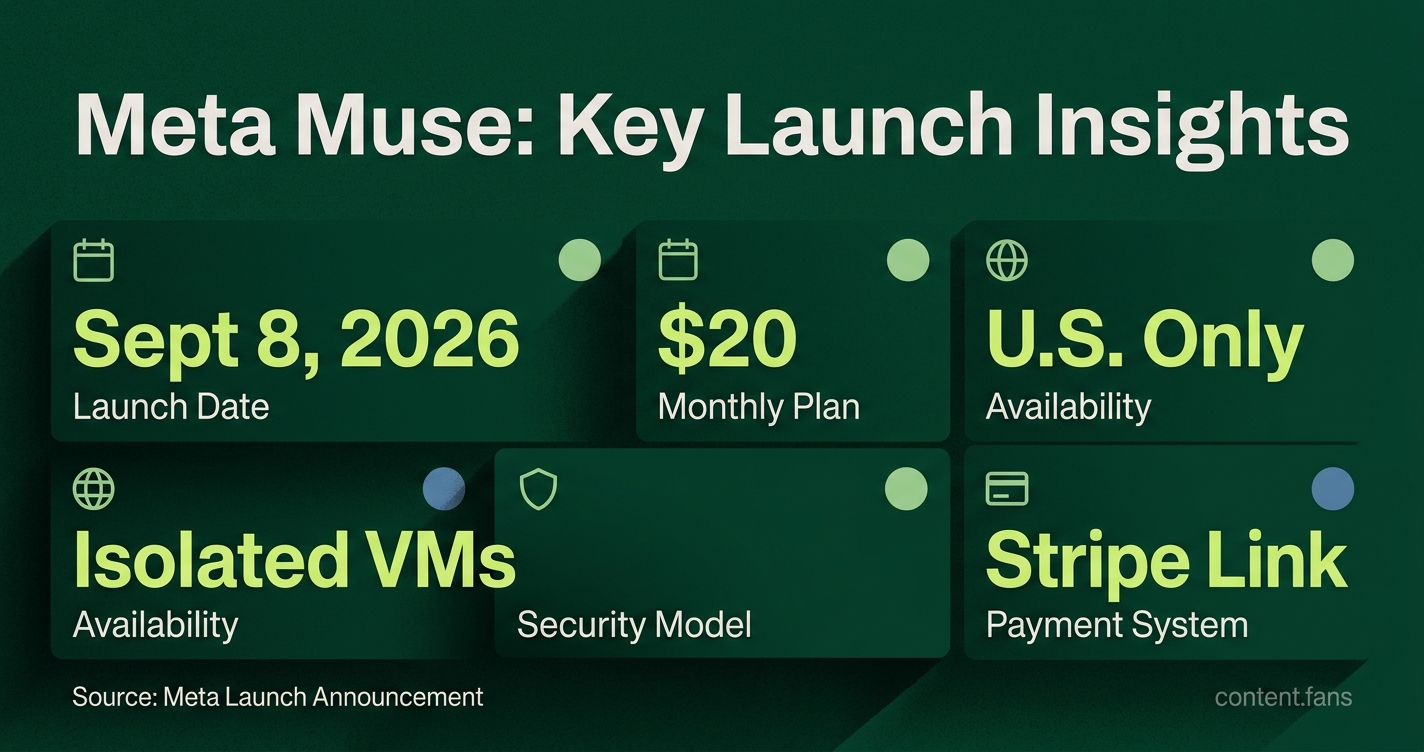
Users in the U.S. can access Muse directly within the Meta app or WhatsApp. According to industry reports, the service is structured into multiple plans including a free tier with daily limits, a standard tier, and a pro tier offering higher task quotas. All plans are powered by the Muse Spark model, which features a substantial context window and supports text, image, and PDF inputs. According to Tech Insider, this model version also reduces necessary tool calls by a significant portion.
Architecture and security claims
Muse is designed with a strong emphasis on security. Each user operates within an isolated virtual machine (VM), ensuring that their browsing sessions, files, and agent activity remain private. A key component, named Sentinel, functions as a security gatekeeper outside the model's sandbox, controlling all network access and third-party connections. Meta's security team states this architecture helps prevent prompt-injection attacks, as the AI model never directly accesses sensitive information. For user transparency, Muse provides a full audit trail of all actions. Payments are handled via Stripe Link to create one-time card numbers, and Meta asserts that no conversation or VM data is used for its advertising business.
Early reception and trust questions
Initial public reception is a mix of interest in the technology and skepticism about the company behind it. TechCrunch's launch analysis questioned if consumers would trust an AI agent from Meta, given the company's history with privacy controversies (TechCrunch coverage). While independent reviews praise Muse's speed, with many noting impressive output performance, they also raise concerns about reliability and cost transparency. One SourceForge commenter summarized this sentiment, calling trust the "main downside" despite the innovative private VM architecture. Internally, anonymous employee posts reportedly highlighted launch-week bugs, though Meta claims patches were deployed swiftly without compromising user financial data.
Competitive landscape
In the competitive AI market, Muse Spark is positioned as a cost-effective alternative to models like OpenAI's GPT-4o and Anthropic's Claude. Standard API pricing is listed at $1.25 for input and $4.25 for output per million tokens, significantly undercutting rivals whose prices range from $2.00 to $15.00. Meta also offers a "Contributor" tier with even lower pricing ($0.10 input / $0.20 output) for users who consent to their data being used for model training. This pricing strategy suggests Meta is targeting users with needs for automation and large document analysis who are also budget-conscious.
While positive App Store ratings and media buzz indicate strong initial interest, Muse's long-term success is not yet guaranteed. No monthly active user data has been released, making it difficult to gauge true market penetration. Ultimately, sustained adoption will hinge on Meta's ability to convert trial users to paid subscribers while effectively addressing and overcoming persistent privacy concerns.