
New 2026 Guide Details LLM Error Handling, Cost Control
Serge Bulaev
The new 2026 guide gives steps for handling errors and keeping costs low in LLM-powered apps. It suggests sorting errors into technical, semantic, and context-window types, and using retries, fallbacks, and human checks as needed. The guide says input should be checked before sending to the model, and all outputs should be validated for correctness. Cost control may be improved by saving tokens and caching prompts, which reportedly cuts expenses and speeds up response times. The best practices appear to help teams keep LLM systems reliable and affordable, while accepting that some uncertainty remains.

This comprehensive 2026 guide to LLM error handling and cost control is essential for teams deploying production AI features. As developers grapple with network glitches, rate limits, and hallucinations, building reliable systems is no longer a post-launch concern. This article distills current best practices into a practical framework for creating responsive, traceable, and affordable LLM pipelines while managing the inherent uncertainty of generative models.
Error Taxonomy and Response Ladder
LLM application failures fall into three main categories. Technical errors include network issues like timeouts or rate limits. Semantic errors refer to logically incorrect or nonsensical outputs, even with a valid structure. Context-window errors occur when an input prompt exceeds the model's length limit, requiring truncation or summarization before a retry.
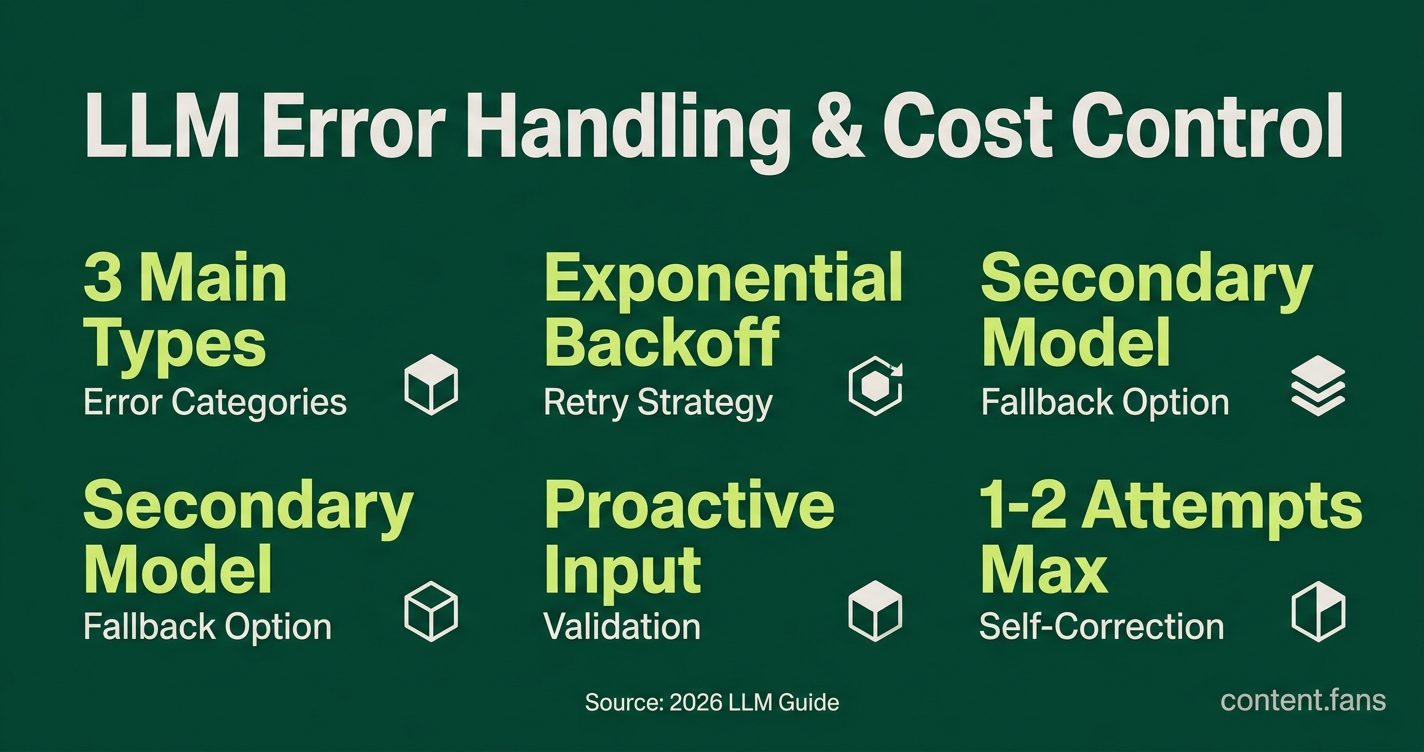
Production guides classify LLM failures into three distinct categories: technical, semantic, and context-window errors. Technical issues, like a transient HTTP 429 or 503 error, typically warrant a retry with exponential backoff. In cases of persistent provider instability, a circuit breaker pattern is recommended to prevent system overload, a strategy detailed in the DevOpsBoys playbook link. Semantic failures are more subtle; an API might return valid JSON that is logically incorrect. The FutureAgi guide suggests using weekly error-clustering sessions to identify these silent faults. Finally, context-length errors are handled by truncating or summarizing the prompt before retrying.
Core Error Handling Tactics in Practice
Effective error handling begins with proactive validation. All inputs should be validated before a model call to reject malformed data, unsafe strings, or oversized prompts. Every request must be wrapped in a timeout aligned with business needs, such as sub-2-second latency for chatbots. A structured response ladder should be implemented for when errors occur:
- Retry: Transient statuses (e.g., 429, 500-503) with capped attempts and exponential backoff.
- Fail Fast: Most 4xx client errors, except for fixable issues like prompt length.
- Fallback: Switch to a secondary model or cached response after repeated failures.
- Escalate: Route safety-critical or unrecoverable failures to a human review queue.
This tiered approach prevents cascading failures and maintains system stability.
Output Shaping and Semantic Guardrails
Ensuring output quality requires robust semantic guardrails. For structured data, always enforce strict schema validation. If a model's output fails this check, a corrective prompt that includes the error details can be sent, but self-correction loops should be limited to one or two attempts to control costs. To combat hallucinations in factual responses, use claim-level groundedness checks to verify that generated text is supported by provided citations. Recent studies have found that rolling back and regenerating failed agent runs can be significantly more effective than simple retries.
Observability, Testing, and Cost Control
Comprehensive observability is non-negotiable. Logs must capture the prompt, response, latency, token count, and all retry metadata. Attaching a unique trace ID to each request is critical for debugging across distributed services. Best practices also involve converting new production failures into regression tests that run in CI, creating a continuous improvement loop.
On the financial side, cost control is paramount. Since context-window expenses can easily exceed inference costs, token management is key. Techniques like prompt caching can significantly reduce costs and latency. For conversational AI, use sliding windows or periodic summarization to manage history length, balancing context retention with cost efficiency.
Resilience Checklist for 2026 Deployments
- Classify Errors: Explicitly define and handle retryable vs. non-retryable errors in code.
- Implement Timeouts: Enforce per-call timeouts and use exponential backoff with jitter for retries.
- Establish Fallbacks: Maintain at least one fallback path, such as a secondary model, a cached response, or human escalation.
- Validate Outputs: Validate every structured output against its schema before execution.
- Automate Testing: Log all failures and integrate them into CI regression tests to prevent recurrence.