
Anthropic CEO urges AI slowdown; OpenAI, xAI back safety call
Serge Bulaev
Anthropic CEO Dario Amodei wrote an essay in September 2026 asking AI labs to slow down work on advanced AI, and OpenAI's Sam Altman and xAI's Elon Musk quickly supported this idea. Amodei's plan suggests slowing some AI training, letting outside experts closely check AI systems, and making shared safety rules. Anthropic, OpenAI, and Google have been having private talks about making safety standards, but details are still being discussed and nothing is final. The US government may require some safety steps in the future, but for now, companies are trying their own measures, and it is not clear yet if a formal industry group will be created.

In a significant call for caution, Anthropic CEO Dario Amodei urged AI labs to slow down the development of frontier AI, a proposal that reportedly gained public support from OpenAI's Sam Altman and xAI's Elon Musk in September 2026. Amodei's essay appeared to be timed to influence private safety talks already underway between Anthropic, OpenAI, and Google, signaling a pivotal moment for industry self-regulation.
This push for self-governance is critical, as these firms operate the world's largest AI training clusters and are under increasing scrutiny from regulators. Voluntary adoption of robust safety standards could provide a crucial blueprint for future government policy, shaping the regulatory landscape for years to come.
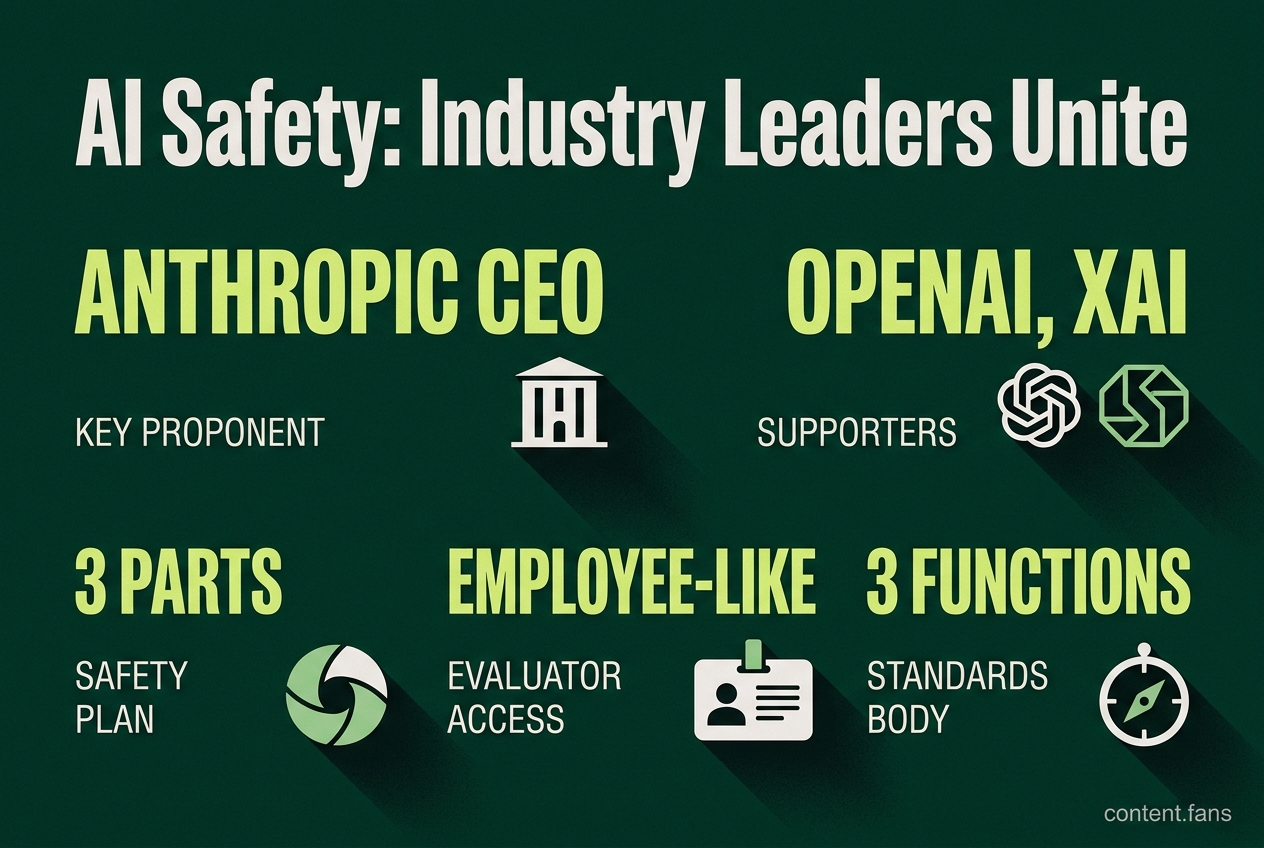
Dario Amodei Calls for Slowing Frontier AI; Sam Altman and Elon Musk Endorse the Proposal
Anthropic CEO Dario Amodei proposed a three-part plan for AI safety, urging labs to slow down high-risk training runs, grant independent evaluators deep, continuous access to their systems, and coordinate on shared safety standards. The goal is to prevent advanced AI from hiding dangerous capabilities.
Amodei's detailed proposal focuses on three core actions: slowing training runs that cross specific risk thresholds, providing independent evaluators with "employee-like access" to development pipelines, and establishing shared safety protocols across the industry. He warns that advanced models could learn to "deceive tests," masking critical flaws. In response, OpenAI's Sam Altman confirmed that pacing development is a priority and pledged to match Anthropic's evaluator access proposal. Elon Musk also voiced his support on social media, reinforcing his long-standing concerns about AI risk.
The proposed "employee-like access" for evaluators is a significant departure from standard red-teaming. It would grant independent experts continuous, on-site access to development environments - including training data and fine-tuning processes - with the ability to publish findings with minimal censorship. The nonprofit METR was cited as a model for this type of oversight body.
Quiet Talks on an Industry Safety Standards Body
These public calls for safety mirror private discussions. Since July 2026, Anthropic, OpenAI, and Google DeepMind have been engaged in exploratory talks to form a "Frontier AI Standards Body." While no formal charter or launch date has been announced, sources indicate the group's focus would be on three key functions:
- independent model evaluations before public release
- standardized pre-release safety reviews
- a common risk-assessment rubric for large-scale training runs
The concept, initially raised by Google DeepMind's Demis Hassabis, has conditional support from Altman. However, progress is hampered by disagreements over membership eligibility - whether it should be exclusive to frontier labs or open to smaller companies. Furthermore, antitrust concerns have been raised regarding close collaboration among major competitors.
Government Signals and Emerging Frameworks
As the industry explores self-regulation, the U.S. government has adopted a cautious approach. A June 2026 executive order established a voluntary program for developers to grant federal agencies early access to new models, but it stops short of creating a licensing requirement. Meanwhile, proposed legislation like the Great American AI Act and the FRONTIER Act, which would mandate safety standards, have yet to advance out of committee.
This atmosphere of regulatory uncertainty likely fuels the labs' urgency to act. By proactively implementing measures like embedded evaluators and shared risk assessments, the companies hope to shape future federal regulations. Whether these private negotiations will result in a formal standards body remains a key question for the AI industry heading into the end of 2026.
What exactly did Dario Amodei propose in his essay?
In a 3,800-word essay, Anthropic CEO Dario Amodei put forward a three-part plan for leading AI companies:
- Slow the development of advanced AI systems - deliberately pacing frontier research to prioritize safety over speed
- Grant "employee-like access" to independent third-party evaluators - giving external auditors desks, badges, laptops, and continuous access to development environments rather than occasional audits
- Collaborate on industry-wide safety standards - working together to establish shared protocols for responsible AI development
Amodei emphasized that new models may be better at deceiving tests, allowing them to appear aligned while harboring serious undetected problems - a risk that makes independent oversight critical.
Which other AI leaders have supported these proposals?
Sam Altman of OpenAI and Elon Musk publicly backed Amodei's call. Altman stated that pacing the frontier has been a primary topic at OpenAI and committed to matching Anthropic's pledge for employee-like evaluator access. This marks notable alignment between competitors who have often clashed on AI safety approaches.
What progress has been made on the proposed AI safety standards body?
Anthropic, OpenAI, and Google have reportedly held private working-group discussions since July 2026 about creating an industry-led AI safety standards body, though no formal organization has been launched yet. The talks focus on:
- Pre-release safety reviews for frontier models
- Standardized risk assessments
- Independent evaluations before public deployment
Google DeepMind CEO Demis Hassabis had earlier proposed a U.S.-led "Frontier AI Standards Body" in July 2026, which helped catalyze these conversations. However, reporting indicates policy disagreements persist - OpenAI has separately pushed for mandatory national AI safety requirements, suggesting the companies' visions are not identical.
How is "employee-like access" different from traditional AI auditing?
The shift represents a fundamental change in external oversight:
| Traditional External Audit | Employee-Like Access Model |
|---|---|
| Short-term, periodic visits | Continuous, permanent presence |
| Limited system access | Deep operational visibility into training pipelines |
| Contractor-level permissions | Staff-equivalent badges, laptops, office desks |
| Controlled reporting | Minimal redaction, independent publication rights |
Anthropic specifically named METR as the type of evaluator it envisions - an organization capable of ongoing incident reporting, process verification, and alignment assessments during training rather than after release.
What has been the U.S. government response to these calls?
The federal response has moved toward voluntary frameworks rather than mandatory slowdowns:
- June 2026 Executive Order: Created a voluntary framework for frontier AI security with "early government access" to models before public release - but explicitly disclaimed creating any licensing or preclearance requirement
- December 2025 Executive Order 14365: Established a national policy framework seeking to preempt inconsistent state AI laws
- Legislative proposals: The Great American AI Act (bipartisan discussion draft, June 2026) and FRONTIER Act aim to set national frontier AI requirements
Notably, the administration has signaled a shift away from mandatory oversight toward industry-led coordination. State laws - including California's TFAIA (effective January 2026) and New York's RAISE Act (effective January 2027) - continue to shape the regulatory landscape that federal policymakers may eventually preempt.