
Companies Adopt Personal AI Benchmarks to Optimize Workflows
Serge Bulaev
The text suggests that companies are adopting personal AI benchmarks, where employees keep private tests that reflect their daily tasks. These personalized evaluation suites may help teams decide when AI helps, when human review is needed, and when upgrades offer little benefit. The process involves quickly updating test sets with new mistakes and tailoring checks to specific job roles. Some evidence shows that smaller, specialized AI models often meet work requirements and may save costs. This approach appears to work across different tools and might be spreading to more teams beyond just AI researchers.

Companies are adopting personal AI benchmarks to optimize workflows and gain a clear view of where AI adds real value. These custom evaluation suites, tailored to individual job tasks, help teams decide when an AI assistant is effective, when human review is critical, and when model upgrades offer negligible benefits.
What Are Role-Specific AI Evals?
A role-specific evaluation suite is a collection of custom tasks designed to measure an AI's performance on an employee's specific duties. This approach moves beyond generic accuracy tests, using job-family rubrics to assess factors like tone, policy adherence, tool use, and correct escalation procedures.
The concept of an evaluation suite, defined as "a collection of tasks designed to measure specific capabilities or behaviors," comes from expert guidance on agent testing (Anthropic engineering note). This framework has prompted a shift from generic tests to detailed rubrics. Braintrust's 2026 article says AI eval tools commonly include CI/CD integration and production monitoring, but the cited survey attribution is not substantiated by the source provided (Braintrust review).
How to Create a Personal Benchmark in 5 Steps
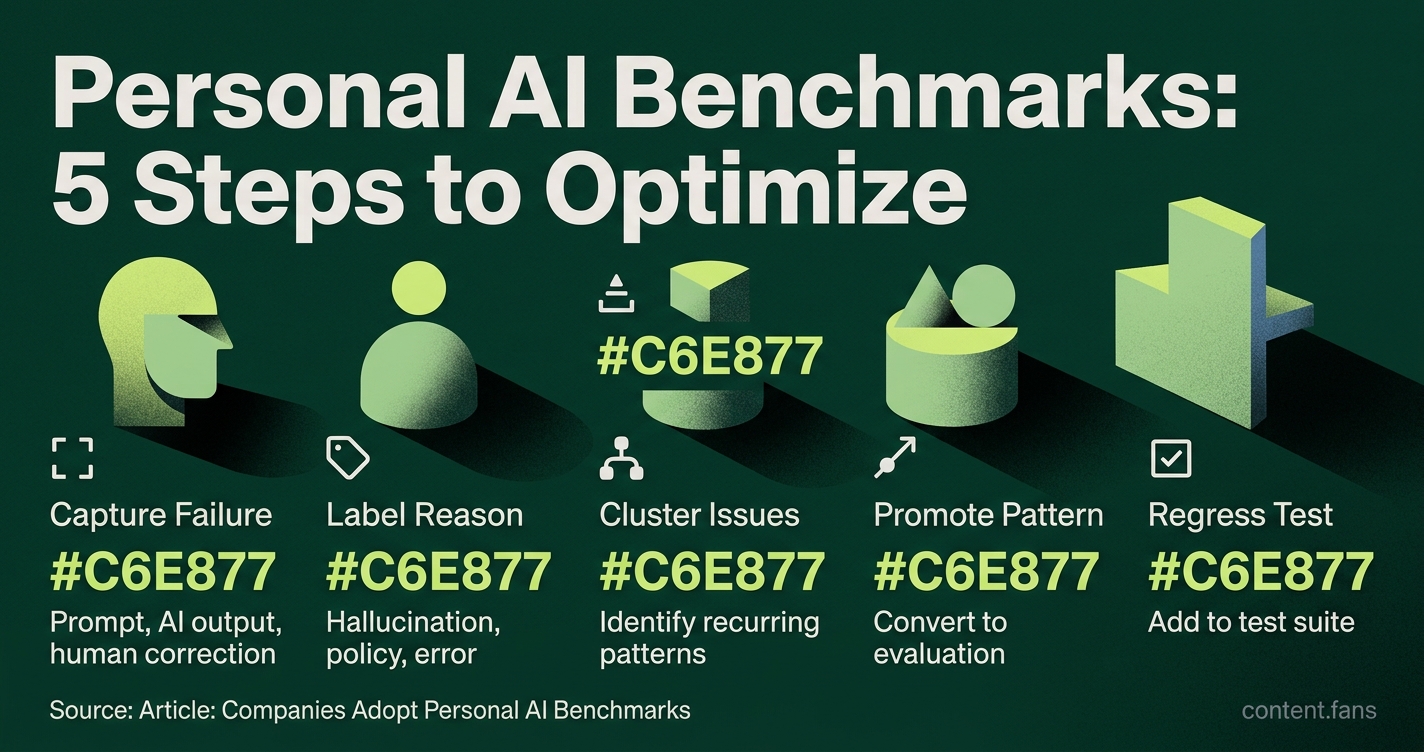
The process involves a lean, five-step loop that turns real-world AI failures into reusable tests:
- Capture: Record the full failing interaction, including the prompt, AI output, and the human's correction.
- Label: Identify the reason for the failure (e.g., hallucination, policy violation, retrieval error).
- Cluster: Group repeated issues to identify recurring patterns of failure.
- Promote: Convert the identified pattern into a deterministic or rubric-based evaluation.
- Regress: Add the corrected example to a regression test suite that runs with every model change.
This rapid cycle ensures test sets stay current, incorporating new errors in hours rather than months.
Key Dimensions of a Personal Benchmark
Personalization means focusing on metrics that vary by job role. These often include task completion, decision quality, policy compliance, and time-to-resolution. For instance, a customer support agent's benchmark might track empathy and escalation accuracy, while an engineer's could measure the generation of unsafe code. Many suites also log intermediate steps and tool calls, not just final answers, to evaluate complex agentic workflows.
The Advantage of Smaller, Specialized Models
A key insight from this approach is that smaller, specialized AI models can often meet specific work requirements effectively. During one internal test, a 14-billion-parameter model successfully handled most of a team member's template-based research tasks. This aligns with forecasts that by 2027, enterprises will use small, task-specific models three times more than general LLMs due to cost and privacy benefits (Gartner prediction). Personal benchmarks can precisely identify when a lightweight model is sufficient, leading to significant cost savings.
Best Practices for Implementation
Successful teams maintain a searchable log of all traces and label corrections immediately. They run regression tests on every pull request and process more complex, LLM-judged scores overnight on sampled sessions. This vendor-agnostic approach works with various tools, from Anthropic-style harnesses to Braintrust CI gates, which explains its growing adoption beyond AI research teams into frontline operations.