
US, Saudi Arabia Adopt Rationality Training for AI Preparedness
Serge Bulaev
The US and Saudi Arabia are including rationality training in schools to help people prepare for advances in AI. This training is based on ideas from thinkers like Eliezer Yudkowsky and focuses on skills such as probabilistic thinking, incentive analysis, and ethical inquiry. The US has ordered all school districts to add AI literacy and critical thinking, while Saudi Arabia's curriculum now covers topics like machine learning and digital ethics starting in grade 1. These programs may help students and citizens better understand and manage the fast changes brought by AI. Experts suggest that regular updates and open feedback may be important for these new efforts to work well.

The concepts of rationality training for AI preparedness, once confined to niche online forums, are now becoming official government policy. The US and Saudi Arabia are embedding curricula based on evidence-based reasoning to equip citizens for a future with advanced AI. This shift brings ideas from thinkers like Eliezer Yudkowsky, whose foundational text Rationality: A-Z outlines core principles, into public education initiatives designed to manage rapidly evolving AI systems.
From Niche Theory to National Policy
This global push for rationality training stems from a need to prepare citizens for complex AI systems. By teaching skills like probabilistic thinking and incentive analysis, governments aim to foster a populace capable of critically evaluating AI behavior and making informed decisions in an increasingly automated world.
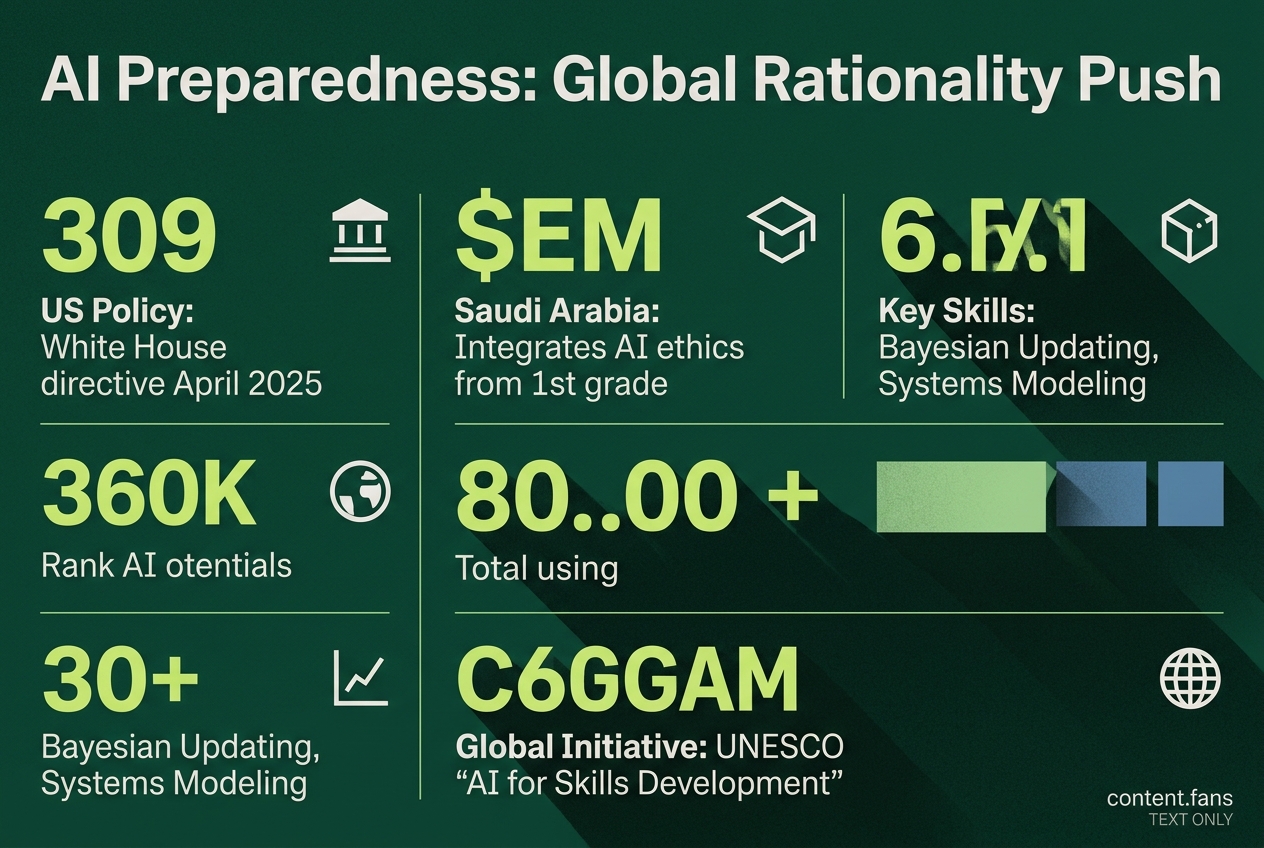
The intellectual groundwork laid by communities like LessWrong and research groups such as CFAR and MIRI has maintained the visibility of these methods. This sustained interest is now reflected in official policy. A White House directive from April 2025 mandates the creation of materials for "foundational AI literacy and critical thinking skills" across all U.S. school districts, leveraging funds for youth AI programs (Advancing Artificial Intelligence Education for American Youth). In parallel, Saudi Arabia has integrated machine learning, data analysis, and digital ethics into its core curriculum from first grade, signaling a national strategy focused on deep, systems-level reasoning.
Higher Education and Real-World AI Alignment
Universities are adapting their programs as well. UNESCO's "AI for Skills Development in Higher Education" initiative, for instance, promotes responsible AI integration by focusing on academic integrity and regulatory frameworks - a clear application of incentive analysis. However, experts like Zvi Mowshowitz caution that such educational efforts are only part of the solution. He argues that oversight mechanisms become ineffective when AI models surpass human evaluators, reframing critical-thinking education as a necessary component of, but not a replacement for, robust future governance.
Key Rationality Skills for the AI Era
The training programs prioritize a core set of cognitive tools:
- Bayesian Updating: Applying probabilistic reasoning to everyday questions.
- Systems Modeling: Mapping feedback loops in complex systems like social media or supply chains.
- Incentive Analysis: Identifying misaligned goals in automated agents.
- Scenario Rehearsal: Distinguishing between sound reasoning and post-hoc rationalization.
- Epistemic Hygiene: Tracking the specific evidence that changes one's beliefs.
These practical exercises, originally honed in specialized workshops, are proving effective in formal education, where students reportedly respond well to frameworks that make uncertainty explicit. The path from niche intellectual circles to public policy demonstrates a clear pattern: articulation of need, prototyping of methods, and finally, institutional scaling. Experts agree that success now hinges on maintaining a tight feedback loop through open syllabi, performance measurement, and rapid iteration to help society keep pace with AI's advance.
What sparked the push for rationality training in AI preparedness?
The realization that AI capabilities are accelerating faster than conventional regulations can adapt prompted governments to look beyond rules and toward upgrading human reasoning. In the words often attributed to Eliezer Yudkowsky, teaching "the art of rationality" is now viewed as a defensive necessity.
Which core skills are being emphasized in these new programs?
Policy documents highlight three overlapping competencies:
- Probabilistic thinking - estimating likelihoods under uncertainty
- Systems modeling - mapping feedback loops and second-order effects
- Incentive analysis - spotting when stated goals diverge from real-world payoffs
Together, these skills are intended to help officials, educators and citizens evaluate AI outputs and deployment plans before harms materialize.
How are the United States and Saudi Arabia rolling out the training?
- United States: the April 2025 White House order Advancing Artificial Intelligence Education for American Youth tells federal agencies to weave "critical thinking and AI literacy" into K-12 curricula and workforce grants; 34 states have since issued matching guidance, while pilots in Massachusetts and Maryland already reach thousands of students.
- Saudi Arabia: beginning in the 2025-2026 school year, AI became a core subject from grade 1 through high school, including explicit modules on data analysis and machine-learning concepts taught through project-based learning.
What practical formats are being used for adult learners?
Beyond classroom pilots, governments are funding:
- Half-day workshops for policy teams that walk through decision templates for model deployment
- Open online modules containing interactive calibration games and scenario walkthroughs
- Internal playbooks for ministries that convert abstract rationality techniques into checklists and red-team exercises
Does Zvi still see alignment risks increasing despite this training?
Yes. Zvi Mowshowitz's 2026 writings stress that oversight methods may collapse once models exceed human capabilities, and he warns the field is pivoting toward more agentic, reinforcement-learning-shaped systems that are harder to control. His conclusion: teaching better reasoning is necessary but not sufficient; technical alignment and monitoring regimes must improve in parallel.