
US Immigration Slows AI Talent Flow, Threatens Lab R&D
Serge Bulaev
US labs like Anthropic and OpenAI rely on global researchers, but stricter US visa rules and security checks may be slowing international hiring. Data suggest H-1B approval rates have dropped sharply and fewer AI experts are moving to the US. These changes might cause longer job vacancies, delays in projects, and higher costs for companies. Some firms appear to be considering opening labs in other countries to keep working with top talent. The future of hiring international AI experts in the US remains uncertain as policies and security rules keep changing.

The challenge of US immigration slowing the AI talent flow now defines staffing at frontier labs like Anthropic and OpenAI. These companies rely on international researchers, but with the United States tightening security screens and facing processing delays, they face a difficult balance between recruitment challenges and national security mandates.
Visa friction hits frontier labs
Recent data highlights the increasing difficulty for overseas hires. Available sources indicate H-1B denial rates were around 2.5% in FY2024, with about 400,000 H-1B approvals processed. Concurrently, industry reports suggest a significant decline in AI professionals moving to the U.S. in recent years. These trends lead to extended job vacancies, intense competition for domestic talent, and rising legal costs for visa sponsorship.
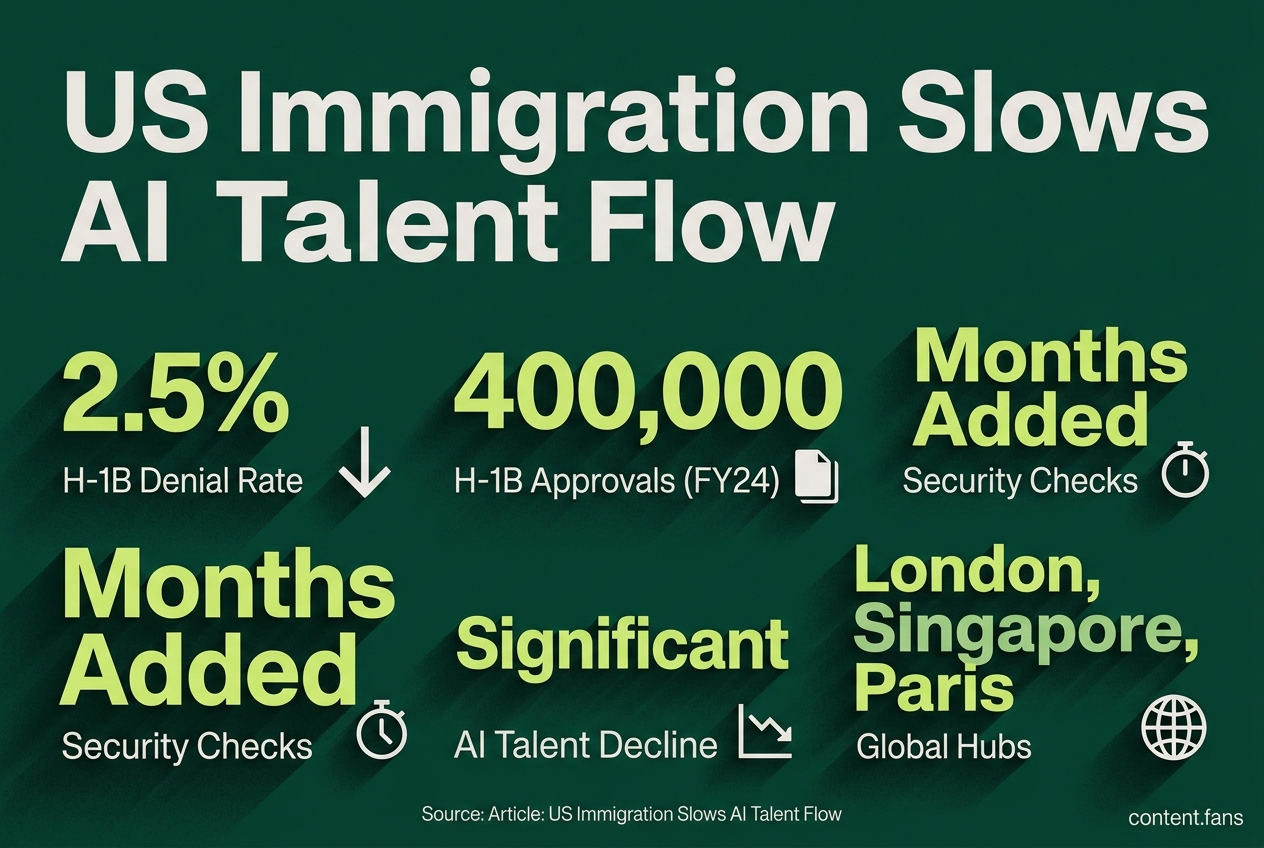
Stricter immigration policies and heightened national security reviews are creating significant hurdles for AI professionals seeking to work in the U.S. This is marked by extended processing times for security checks and an overall decline in talent relocation.
Security policy adds a second gate
National security concerns add another layer of complexity. An October 2024 White House memorandum framed AI as a national-security and leadership priority and instructed agencies to coordinate on streamlining visa processing for applicants specialized in AI and other sensitive technologies. This policy promotes a "selective openness," welcoming certain specialists while applying stricter checks on foreign nationals working with frontier models. Attorneys note these new background reviews can add months to visa processing times.
Early signals inside Anthropic and OpenAI
While companies like Anthropic and OpenAI have not issued official statements, industry evidence suggests these immigration frictions are affecting lab operations. Key impacts include:
- Recruitment Challenges: Higher rates of offer renegotiations as visa delays outlast offer validity periods.
- Project Delays: Specialized teams, such as safety and alignment units, are postponing milestones due to stalled security clearances for international hires.
- Rising Costs: Labs are reporting increased budgeting concerns for H-1B fees under proposed rule changes.
Geographic hedges take shape
In response, AI firms are exploring geographic diversification. Industry reports indicate growing interest in establishing secondary hubs in cities like London, Singapore, and Paris. These locations serve as strategic fallbacks, enabling companies to retain top talent that would otherwise be lost to competitors during lengthy U.S. visa delays. While San Francisco and San Jose remain the epicenters of AI investment, these incremental international expansions signal a potential long-term shift toward distributed research and development.
The balance between attracting global talent and ensuring national security remains in flux. Policymakers are debating measures from expanded green-card access for STEM PhDs to stricter export controls on large language models. For the foreseeable future, frontier AI labs must navigate this complex immigration landscape, constantly aligning their hiring strategies with the dual pressures of global competitiveness and evolving security regulations.
What immigration bottlenecks are hitting AI talent hardest in 2024-2025?
Industry reports suggest significant challenges in H-1B processing and declining numbers of AI researchers entering the U.S. in recent years. The most acute pain points are:
* Slower visa issuance - routine security check delays now stretch weeks beyond historic norms
Rising costs - proposed H-1B surcharge changes could substantially increase employer costs for certain roles
OPT uncertainty - proposed limits on Optional Practical Training threaten the pipeline of new graduates from U.S. universities
For frontier labs like Anthropic and OpenAI, these frictions translate into delayed onboarding of alignment specialists and higher retention risk for current visa-holders.
How are U.S. AI companies responding to the tighter talent pipeline?
Instead of public complaints, firms are quietly diversifying hiring geographies and internal policies:
- Remote-first teams now include hubs in Singapore, Toronto, London, and Tel Aviv, allowing R&D to continue without waiting for U.S. visas
- Selective model access controls, such as Anthropic's nationality-based restrictions on its latest Claude variants, aim to balance security compliance with recruiting needs
- University partnerships with schools in Canada, the UAE, and South Korea are being expanded to reduce dependence on U.S. immigration pathways
OpenAI and similar firms have not announced hiring freezes, but job posts increasingly list "location-flexible" or "global remote eligible" alongside traditional Bay Area roles.
Are alternative global AI hubs actually gaining researchers?
Industry reports suggest many leading AI cities are now in Asia-Pacific, including Singapore, Seoul, Beijing, and Dubai. The shift is driven by:
* Government incentives - Singapore and other countries offer substantial grants for AI PhD students
University clusters - Major universities in Korea and Singapore have significantly expanded AI faculty in recent years
Cloud and cost advantages - lower GPU rental costs in various international markets reduce the need for expensive U.S. compute
While San Francisco and San Jose remain "superstar" ecosystems, the emerging hubs attract talent that previously would have relocated to the U.S. by offering faster visa processing and direct research funding.
What policy debate is shaping the next round of rules?
Washington is wrestling with "managed openness" - a framework that keeps global talent flows but adds targeted security checks. Key flashpoints:
- White House memos emphasize the importance of AI talent for national security priorities, yet new export-control language could restrict which foreign nationals may access frontier model weights
- Policy recommendations urge Congress to create streamlined pathways for AI PhDs while simultaneously mandating enhanced vetting for anyone touching models above certain compute thresholds
- Industry lobbyists warn that overly broad restrictions risk pushing breakthrough work to Beijing or the EU, citing the significant role of immigrants in founding top U.S. AI startups
The unresolved question: can the U.S. screen for security risks without throttling the very talent pipeline that created its AI lead?
What practical steps can labs take now to protect R&D continuity?
- Hybrid workforce planning - flag every critical research track and map at least two geographic backups (Canada, UK, Singapore)
- Visa cost budgeting - treat each sponsored hire as a substantial line item, accounting for potential fee increases
- Model compartmentalization - separate core weights from alignment code so foreign staff can contribute to safety research even when full model access is restricted
- University pipeline MoUs - sign multi-year talent exchange agreements with schools in Paris, Bangalore, and Abu Dhabi to guarantee annual intern and post-doc inflows
Early adopters are already measuring "time-to-desk" (offer letter to first productive commit) and finding that roles filled outside the U.S. often start significantly faster when immigration bottlenecks are removed.