
US Government mandates post-quantum crypto migration by 2030
Serge Bulaev
The US government has set deadlines for federal agencies to move to post-quantum cryptography by 2030, and private companies working with them must also follow this schedule. Executive Order 14412 says quantum-safe key systems must be in place by the end of 2030, and digital signatures by the end of 2031. There is concern that attackers may already be saving encrypted data to break later with quantum computers, so early action seems important. Agencies and vendors are required to make detailed plans and test new cryptographic methods soon. Organizations that wait too long may face problems with rushed updates and double maintenance work.

The US Government mandates post-quantum crypto migration by 2030, requiring federal agencies and their private-sector partners to adopt quantum-resistant standards. Under the executive order "Securing the Nation Against Advanced Cryptographic Attacks," the deadline for quantum-safe key establishment is December 31, 2030, with digital signatures to follow by December 31, 2031. Nextgov (citing a person familiar with the draft) and The Hacker News note that agencies must submit migration plans within 30 days of the order's signing, meaning the clock is already ticking.
This timeline is critical due to the persistent threat of "harvest-now, decrypt-later" attacks. As highlighted by Palo Alto Networks, adversaries are already capturing encrypted data today, planning to break it with future quantum computers. Data stolen now could be exposed in the 2030s, compromising secrets with long-term confidentiality requirements.
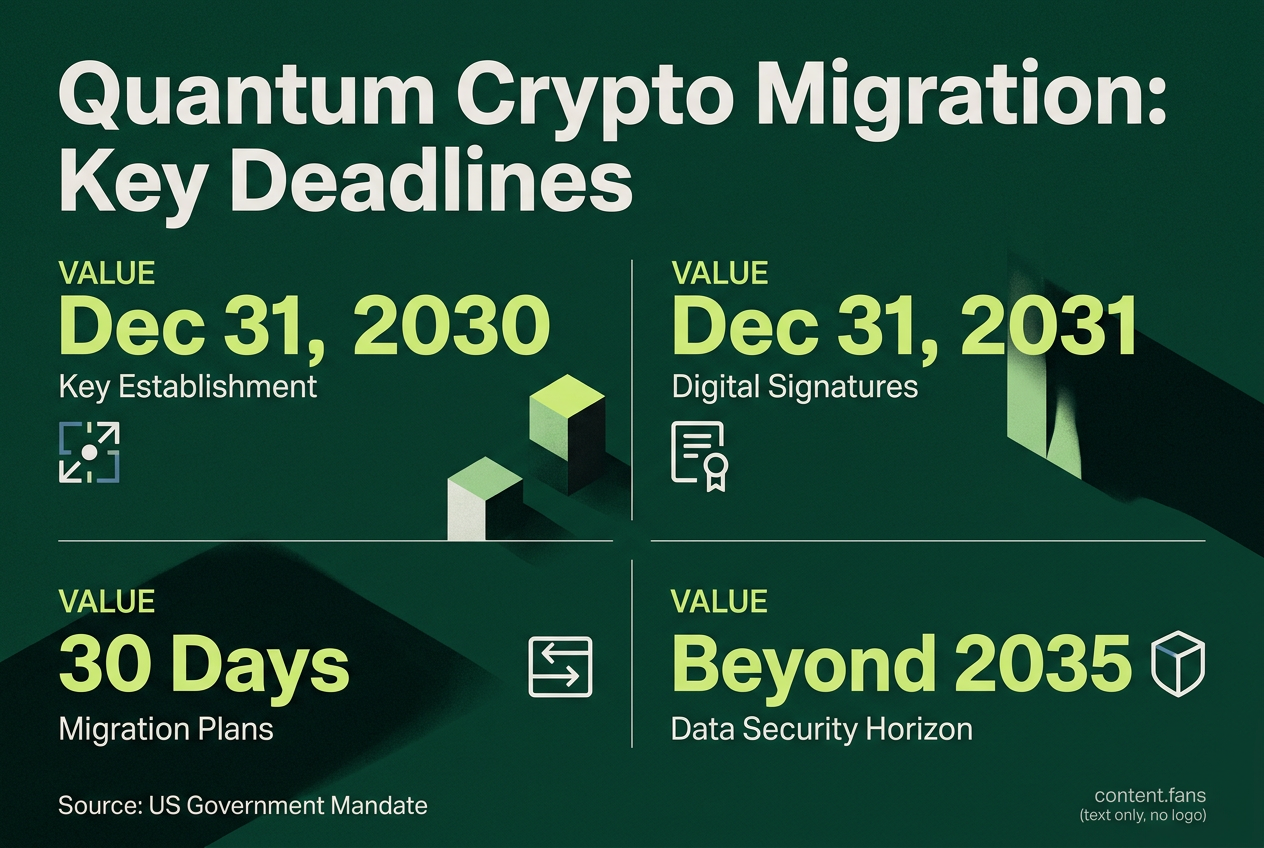
Essentially, any enterprise with federal dependencies or data requiring long-term secrecy must start its PQC migration now. A strategy of secure discovery, hybrid deployment, and phased migration is essential to meet the 2030 deadline and mitigate future risks.
Practical steps to migrate to post quantum cryptography before 2030
Migrating to post-quantum cryptography involves performing a complete inventory of existing cryptographic assets, prioritizing systems based on data sensitivity, and updating signing workflows. Organizations should begin testing new PQC algorithms like ML-KEM and ML-DSA to ensure crypto-agility and prepare for phased, hybrid deployments ahead of deadlines.
- Create a Cryptographic Inventory. Following the model of OMB memos M-23-02 and M-26-15, firms must create a "Cryptographic Bill of Materials" (CBOM). This inventory should identify all quantum-vulnerable algorithms, root certificates, hard-coded keys, and legacy systems that require complex migration paths.
- Prioritize by Data Sensitivity. Rank systems based on their "confidentiality horizon." Data that must remain secure beyond 2035, such as long-lived credentials and archived backups, presents the highest risk and should be prioritized for migration first.
- Update Signing Workflows. Begin integrating new PQC signature algorithms like ML-DSA or Falcon for new software binaries and firmware. Maintain classical signatures for backward compatibility, but ensure build pipelines are updated to handle larger key sizes to prevent future rework.
- Validate and Test. Formally validate all PQC implementations using official NIST test vectors for standards like ML-KEM-768 and ML-DSA. Establish performance baselines during testing to provide necessary audit evidence for compliance and regulatory oversight.
Compliance milestones to watch
| Requirement | Deadline | Applicable systems |
|---|---|---|
| PQC migration plan (federal departments) | Apr 2026 | Federal IT systems |
| Discovery and planning phases | 2028 | Civilian agencies |
| Quantum-safe key establishment | Dec 2030 | High-Value Assets |
| High-priority migration completion | 2031 | Critical systems |
Managing supply-chain expectations
Supply chain partners working with federal systems must align their products with the forthcoming FIPS 203 (ML-KEM) and FIPS 204 (ML-DSA) standards. As compliance requirements are being phased with earlier deadlines for high-risk federal systems, procurement policies should be updated to require hybrid key exchange, crypto-agile APIs, and proof of validation against NIST test vectors.
Budget and resource planning
Federal investment in quantum-resistant technologies is expected to accelerate PQC adoption in commercial hardware security modules (HSMs), key management services (KMS), and public key infrastructure (PKI). Enterprises should align their hardware refresh cycles with vendor roadmaps that incorporate ML-KEM firmware.
Organizations should begin planning their migration strategies now, considering the complexity of cryptographic transitions and the need for thorough testing and validation. Delaying action until final mandates will lead to higher costs, rushed implementations, and increased operational risk.
What exactly do the federal deadlines require?
The timeline for post-quantum cryptography adoption is still being developed by NIST and future executive actions, with agencies working toward comprehensive migration strategies.
- Key establishment (encryption) systems are expected to transition to post-quantum cryptography (PQC) standards as they become available.
- Digital signatures (authentication) will follow similar migration timelines based on NIST guidance.
National Security Systems are on a separate CNSA 2.0 track managed by NSA.
How urgent is the "harvest-now-decrypt-later" risk?
Adversaries are already storing encrypted traffic so they can decrypt it once large-scale quantum computers arrive - estimated between 2030 and 2035.
- Any data that needs to stay confidential beyond 2030 faces immediate exposure today.
- A simple risk test: if Confidentiality Lifetime minus CRQC arrival is positive, assume that data is being harvested.
What first steps should an enterprise take now?
- Build a Cryptographic Bill of Materials (CBOM): list every RSA, ECC, TLS version, certificate, and key in the environment.
- Classify data by sensitivity horizon: the longer the required secrecy, the higher the priority.
- Enable crypto-agility: ensure components can swap algorithms without re-architecting the stack.
- Start hybrid deployments: for external-facing endpoints, combine classical X25519 with ML-KEM-768 in TLS today to eliminate forward risk.
How is the US Government backing this transition financially?
The government is providing strategic investment in quantum-resistant technologies through various funding mechanisms under the CHIPS and Science Act and other initiatives to support the transition to post-quantum cryptography.
What algorithms and standards should we plan for?
NIST's final standards (FIPS 203-205) specify:
- ML-KEM (Kyber) for key encapsulation - choose ML-KEM-768 or ML-KEM-1024.
- ML-DSA (Dilithium) for digital signatures.
- Falcon for lightweight signatures and Sphincs+ as a conservative backup.
Validate every implementation against official NIST test vectors; organizations should complete pilot projects according to their specific compliance timelines and risk assessments.