
Cision: 91% of PR Pros Use AI in Workflows
Serge Bulaev
A recent survey from Cision suggests that about 91% of public relations professionals now use AI tools in their daily work. Many teams rely on AI for tasks like monitoring, reporting, and writing, and this may show the industry is moving from trying these tools to making them a regular part of work. At the same time, large PR agencies are merging, while smaller agencies focus on special skills. Executive voices and careful measurement appear to be getting more important, as teams try to show clear results and build trust. Spending on earned media might double by 2027 if AI continues to give more visibility to trusted sources.

New data reveals a fundamental shift in the public relations industry, with AI technology now deeply integrated into daily operations. A landmark 2026 survey from Cision shows that 91% of PR pros use AI in workflows, moving the tools from experimental to essential. While automation drives precision, human judgment remains critical for defining relevance. This analysis explores how that balance is shaping PR tools, industry consolidation, and the increasing demand for measurable results.
AI in Daily Workflows
PR professionals are embedding AI into core tasks to improve efficiency and gain insights. Common applications include using generative tools for writing and content creation, automated platforms for media monitoring and sentiment analysis, and intelligent systems for personalized pitching, meeting transcription, and rapid background research.
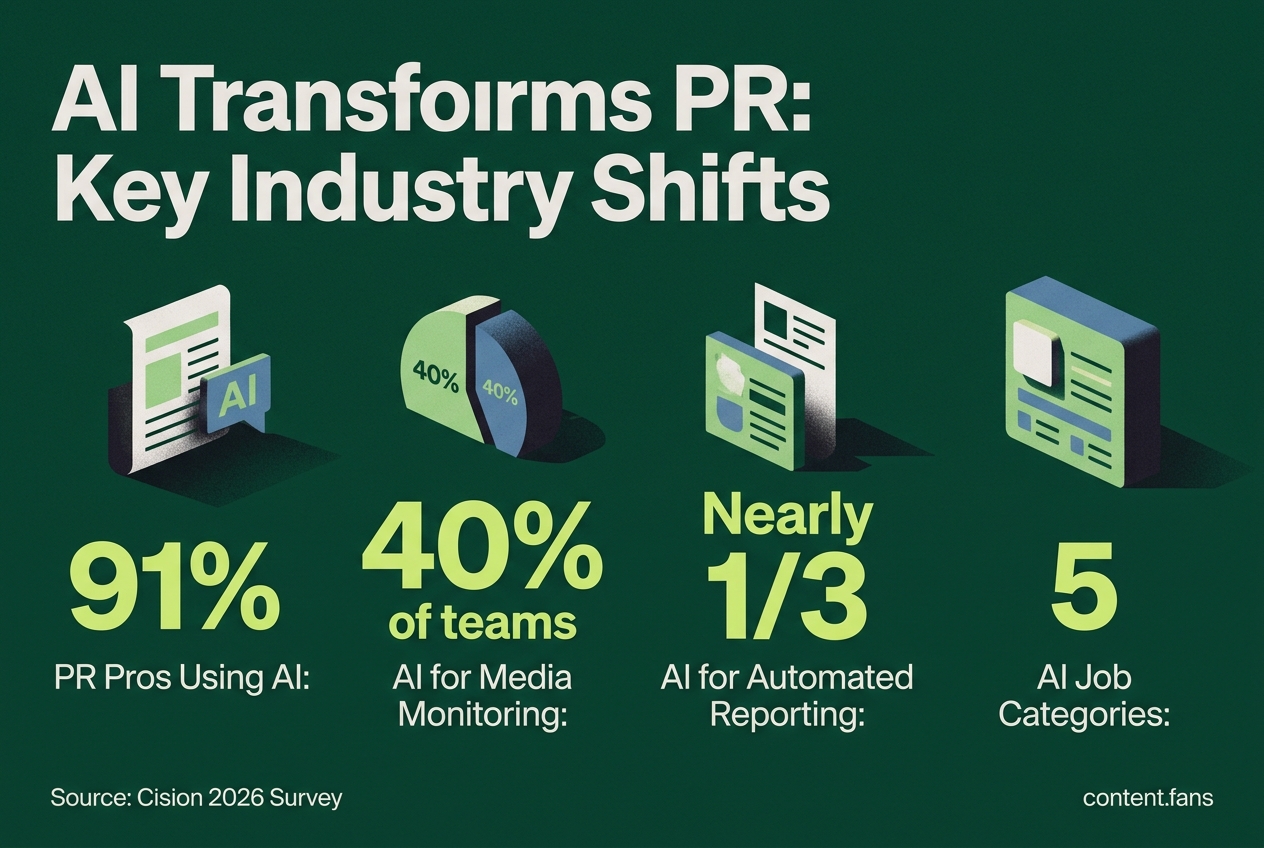
Guides published this year cluster the newest PR platforms into five clear jobs: pitching, monitoring, writing, meeting capture, and analytics. The table below selects reliable options for each task.
| Job | 2026 platform picks | Typical payoff |
|---|---|---|
| Personalized pitching | PressPal.ai, Prowly, Propel | Faster, data-backed outreach |
| Monitoring & listening | Brand24, CisionOne, Meltwater | Real-time sentiment and alerts |
| Writing & edits | ChatGPT Plus, Jasper, Grammarly Business | Drafts and clarity checks |
| Meeting capture | Otter, Fireflies | Searchable transcripts, summaries |
| Intelligence | Perplexity, SignalAI | Rapid background research |
Industry data indicates widespread adoption, with 40% of teams already using AI for media monitoring and nearly a third employing it for automated reporting. This confirms a clear trend away from experimentation and toward fully embedded AI-powered workflows.
Recommended tool stacks vary by team size:
- Solo consultant: ChatGPT Plus, Grammarly Business, Brand24, Prowly.
- Small agency: Prowly, Brand24, OnePitch, Otter, Canva.
- Enterprise comms: CisionOne, Meltwater, Talkwalker, Brandwatch, SignalAI.
Agency Consolidation 2025-2026
While the variety of AI tools expands, the agency market is consolidating. Omnicom announced a planned acquisition of Interpublic Group. Omnicom Public Relations said Porter Novelli is integrating into FleishmanHillard, while Golin and Ketchum are being merged into a combined agency.
This follows WPP's earlier merger of BCW and Hill & Knowlton into the new entity Burson. In contrast, independent agencies are acquiring niche expertise, with Highwire buying The Bliss Group and Arketi Group purchasing digital firm Sperling. This trend shows large holding companies eliminating brand overlap while independents focus on specialization.
Executive Voices and Measurement Pressures
As audiences seek authenticity, executive branding and founder-led narratives are gaining significant momentum. According to industry reports, leadership visibility is emerging as a core communications trend, alongside hyper-personalization and Generative Engine Optimization (GEO). This shift suggests that "earned media" is evolving to include visibility within AI-driven answer engines that prioritize authoritative sources.
Simultaneously, pressure for accountability is intensifying. While industry reports indicate storytelling remains a top skill among PR professionals, leadership demands clear connections between PR activities and business outcomes. This emphasis on outcome-driven analytics over simple activity metrics is becoming increasingly important across the industry.
Key Takeaways for PR Teams
These converging trends - AI integration, market consolidation, and a focus on measurement - point to a transformed communications landscape with several key implications for PR teams:
- AI is automating repetitive tasks like monitoring and drafting, freeing up professionals to focus on high-value strategic counsel and narrative development.
- The agency landscape is polarizing, with a few dominant global networks and a growing number of specialized agencies focusing on specific data capabilities or industry sectors.
- As digital channels fragment and misinformation accelerates, authentic leadership voices and precise, outcome-based metrics are becoming critical for building trust and demonstrating value.
According to industry reports, these developments may influence budget allocations in the coming year. Forecasts from Gartner, cited by Everything PR, suggest earned media spending could double as AI search and discovery engines increasingly prioritize and amplify trusted, authoritative sources.