
India demands Meta align content policies with new 2026 IT rules
Serge Bulaev
Indian officials have told Meta that the company may keep its existing recommendation systems if they follow Indian laws. New rules from February 2026 require platforms like Meta to remove unlawful content within three hours and add stronger checks for deepfakes. The government wants Meta to prove that its systems, both human and automated, can quickly find and remove illegal posts, especially in Indian languages. Officials suggest that transparency about how Meta handles risky content and deepfakes may be enough for compliance, without needing a full algorithm change. Meta appears to be cooperating but has pushed back on strict age checks, suggesting education instead.

According to industry reports, India demands Meta align content policies with its updated IT rules, clarifying that its existing algorithms can remain if they comply with Indian law. The government's message is firm: while a complete algorithm overhaul is not required, Meta's platforms must adhere to tightening legal guardrails. These include amendments to the IT Rules, which mandate stricter content moderation requirements and new obligations for handling deepfakes.
Context behind the 'No Algorithm Overhaul Sought' phrase
The Indian government is requiring Meta to demonstrate that its moderation systems can effectively detect and remove unlawful content - including deepfakes and CSAM - within required timeframes. The focus is on verifiable compliance with Indian law, particularly for content in regional languages, rather than on forcing algorithmic changes.
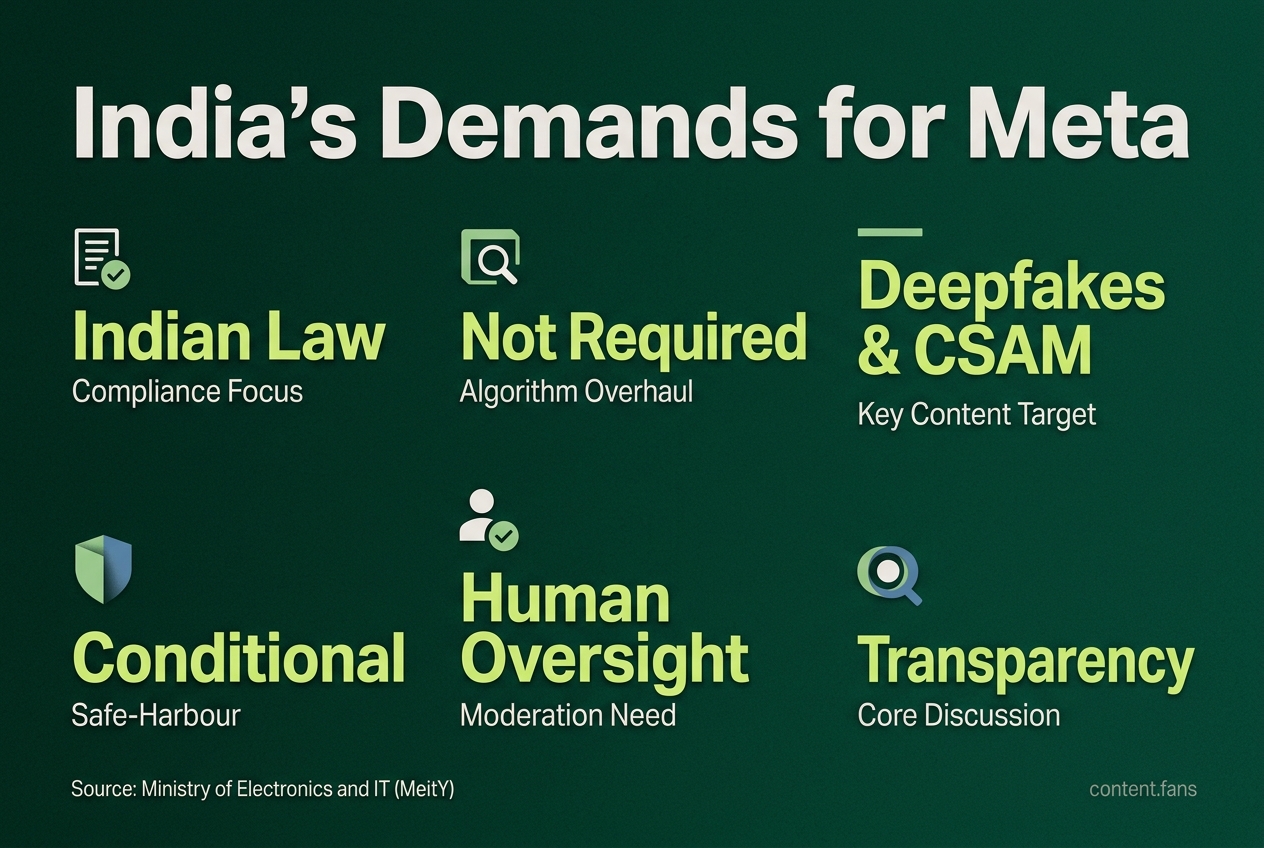
Officials from the Ministry of Electronics and IT (MeitY) have clarified that Meta "must comply with Indian law," stating it is "factually incorrect" to characterize the government's position as a demand for a complete algorithmic overhaul. The government's primary focus is on the platform's ability to manage illegal content like child sexual abuse material (CSAM), deepfakes, and other posts violating Indian law. Section 79 safe-harbour protection can be lost if an intermediary fails to expeditiously remove or disable access to unlawful content after receiving valid legal notice (such as a court order or government notification).
Key Compliance Touchpoints
- Rapid Takedowns: The verified compliance touchpoints in the provided sources center on conditional safe-harbour, due diligence, and removal of unlawful content after lawful notice.
- AI Content Regulation: Mandatory labeling and origin checks for synthetic or AI-generated media.
- Zero-Tolerance on CSAM: CSAM is broadly criminalized in many jurisdictions, but provider/non-compliance liability depends on the specific statute and compliance context; some laws even exempt good-faith compliance activity from liability.
- Human Oversight: Increased "human-in-the-loop" reviews, with an emphasis on moderators fluent in Indian languages.
- Algorithmic Transparency: Ongoing disclosure of how recommendation systems rank and suppress high-risk content.
These requirements are based on recent IT rule changes and proposals to make MeitY advisories legally binding. Officials have requested a compliance roadmap from Meta, detailing how its Indian operations will meet these new standards and what transparency data it will provide.
Transparency is Non-Negotiable
Government briefings confirm that the core of the discussions is transparency, not direct changes to Meta's code. If Meta can demonstrate how its systems limit the spread of deepfakes and other harmful content, regulators may consider its algorithms compliant. However, the company faces criticism from activists for not publicly releasing its India-specific human rights impact assessment.
In response, Meta has reportedly outlined its use of automated filters and an expanding team of human reviewers fluent in languages like Hindi, Tamil, and Bengali. The company continues to push back on proposals for strict age-verification, advocating instead for education and media literacy initiatives as parallel safeguards.
What Tighter Rules Mean for Users in India
For users, these stricter regulations are expected to reduce the visibility of deepfakes and other synthetic media, complemented by clearer labeling of AI-generated content. However, the increased emphasis on human review, especially for content requiring cultural and linguistic context, may introduce delays in content moderation and distribution for borderline posts. Ultimately, Meta's continued safe-harbour status depends on demonstrating verifiable compliance with Indian law, not on a complete algorithmic rewrite.
What are the key changes in India's IT Rules regarding content moderation?
Recent amendments to India's IT Rules introduce stricter compliance timelines and expanded content categories for platforms like Meta. The window for removing unlawful content has been significantly reduced after notification. The rules also bring deepfakes and synthetically generated content into the formal due-diligence framework, requiring platforms to implement labeling and traceability measures. Additionally, proposals seek to make IT ministry advisories legally binding, meaning non-compliance could directly affect safe-harbour protections under Section 79 of the IT Act.
Is the Indian government demanding a complete overhaul of Meta's algorithms?
No. Government sources have explicitly stated it would be factually incorrect to claim that India ordered Meta to completely overhaul its algorithms. The official position emphasizes aligning Meta's content policies, platform guidelines, and moderation systems with Indian law rather than relying solely on global corporate policies. While recommendation systems are under scrutiny to determine whether they merely host content or actively curate and amplify it, officials stress the focus remains on legal compliance rather than fundamental algorithmic reconstruction.
What specific moderation practices is India requesting from Meta?
Indian officials are pressing for greater human intervention in content review processes, particularly insisting on reviewers who understand Indian languages and local context. The government maintains zero tolerance and zero compromise for child sexual abuse material (CSAM). Platforms must also strengthen safeguards against deepfakes and address instances where synthetic content reappears after initial removal. The demands include ensuring "human-in-the-loop" review for sensitive takedowns and better handling of cultural nuances that automated systems might miss.
How has Meta responded to India's compliance demands?
Meta has engaged in multiple technical meetings with Ministry of Electronics and Information Technology (MeitY) officials to explain its existing moderation mechanisms and compliance workflows. While the company has pushed back against certain requirements, such as privacy-preserving age assurance mandates (arguing instead for education and media literacy approaches), Meta has indicated willingness to discuss operational changes including enhanced human review. However, civil society organizations note that Meta has not publicly released its India human rights impact assessment, stating that security concerns prevent full disclosure of the report.
What are the implications for Meta's legal liability and user experience?
The updated framework creates direct links between compliance failures and legal exposure. Platforms that fail to meet due-diligence obligations, including rapid takedown requirements or advisory compliance, risk losing safe-harbour protections and facing increased liability for user-generated content. For users, this may result in fewer viral deepfakes and synthetic media circulating on platforms, alongside more visible labeling of AI-generated content. However, stricter moderation could also introduce more friction in content distribution, with potential delays for borderline material as human reviewers assess context and language-specific nuances.