
GitHub Ships Agent HQ, Enterprise AI Controls for Copilot in 2026
Serge Bulaev
GitHub has introduced Agent HQ and Enterprise AI Controls for Copilot Enterprise teams, which may help manage how AI coding tasks happen during code reviews. The system suggests using external AI models while GitHub runs the control tools to coordinate agents, log their actions, and keep each run separate for security. Teams might control which agents and models are allowed by listing them in a special file, and admins now have tools to watch and audit agent sessions. The Model Context Protocol appears to be growing, with many servers and downloads, possibly showing it is becoming standard. Some features are fully available, while others, like agent hooks, are still being tested, and GitHub seems to be adding more control features before giving agents more independence.

GitHub is evolving Copilot into a comprehensive agent orchestration system with the introduction of Agent HQ and Enterprise AI Controls. This strategic shift positions GitHub as a central control plane for coordinating multiple AI agents, sandboxing their execution for security, and recording actions for auditability.
Why Orchestration, Not Model Ownership
GitHub is positioning Copilot as a neutral switchboard for leading AI models from Anthropic, OpenAI, Google, and others, rather than locking users into a single model family. This model-agnostic approach is supported by Enterprise AI Controls, which GitHub has announced as part of broader enterprise Copilot updates. These controls provide governance capabilities for managing AI agent interactions with codebases, emphasizing policy-governed routing over model ownership.
Agent HQ provides a central interface for coordinating AI agent tasks within the pull request workflow. Enterprise AI Controls offer administrators governance tools, including policy enforcement and audit capabilities to manage how agents interact with codebases, ensuring security and compliance.
Agent HQ and the Pull Request Gate
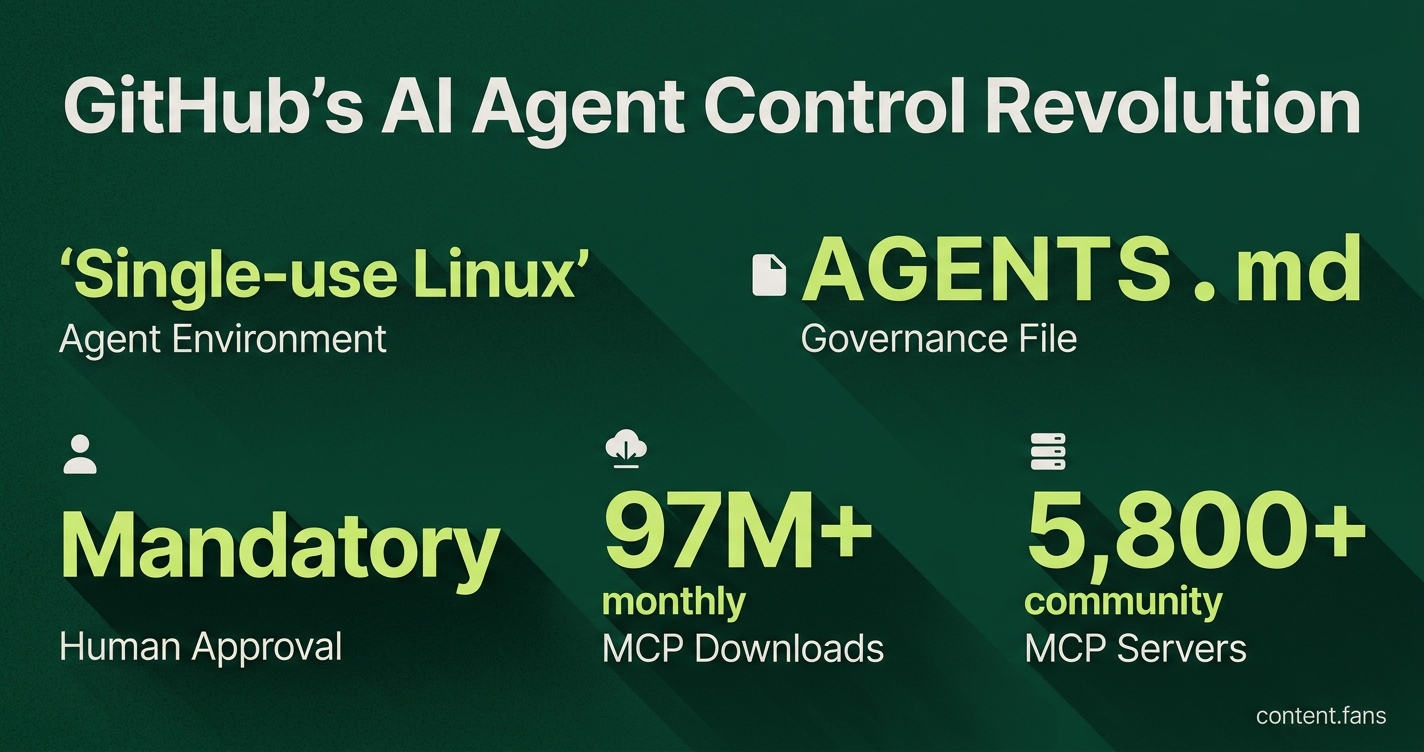
Within the developer workflow, Agent HQ acts as a mission control center. Developers can assign tasks to agents, monitor their progress, and review generated diffs before merging. While GitHub Docs note that agents can autonomously create implementation plans and draft pull requests, mandatory human approval remains the final gate. Agent tasks run in single-use Linux environments spun up by GitHub Actions, guaranteeing a clean, isolated workspace for every job. Industry reports indicate the Copilot app makes this parallel agent work visible and manageable in real-time.
Repository-Based Governance
Governance policies are stored directly in the repository. Teams can define approved agents and models in an AGENTS.md file, which is versioned alongside the codebase. The AI Controls plane then enforces these settings, blocking any unlisted models from accessing repository context.
- Ephemeral sandboxes prevent state leakage between agent runs.
- Agent HQ centralizes task assignment, monitoring, and approval.
- The
AGENTS.mdfile enables version-controlled governance. - Enterprise AI Controls provide session history tracking for agent activities.
- Model routing adheres to team-level policies defined in the repository.
MCP and the Wider Ecosystem
The control plane also integrates with the Model Context Protocol (MCP), a standard for connecting agents to external tools and APIs. The 97 million monthly SDK downloads and 5,800+ community-built servers were reported in December 2025, and by mid-2026 some sources cited much higher download totals. With backing from major players like OpenAI, Google, and Microsoft, MCP is becoming foundational infrastructure for the agent ecosystem.
Custom agents, sub-agents, and plan agents are available in JetBrains IDEs. Agent hooks, in public preview, allow enterprises to inject compliance scripts into each session. Cloud automations for scheduling tasks like issue triage or nightly test fixes apply CI/CD principles to agentic workflows.
Outlook for Enterprise Users
GitHub's features are being rolled out across multiple readiness tiers, with various capabilities in different stages of availability. This tiered rollout reflects a cautious philosophy of shipping robust governance before expanding agent autonomy. Administrators can audit agent sessions, developers can delegate complex tasks, and security teams can trace model interactions from draft to merge.
GitHub has significantly expanded its Copilot platform beyond code completion into a full agent orchestration system. The company is positioning itself as a neutral control plane that coordinates multiple AI agents while maintaining enterprise governance and human oversight.
What is Agent HQ and how does it centralize multi-agent operations?
Agent HQ serves as GitHub's mission control interface for managing multiple AI agents across different model providers. Industry reports suggest the GitHub Copilot app operates as a centralized control plane that makes agent work visible, auditable, and steerable in real time. The interface supports parallel agent execution through isolated cloud and local sandboxes, giving enterprises granular control over where Copilot runs tool calls and shell commands. This orchestration layer allows teams to assign, monitor, and approve agent activities without switching between disconnected tools.
How do ephemeral environments enhance security for agent execution?
GitHub runs agents in ephemeral, single-use Linux environments powered by GitHub Actions, with each session starting from a clean workspace. This architecture eliminates persistent state between runs, reducing the attack surface and ensuring reproducible execution conditions. The temporary nature of these environments means sensitive data or credentials from previous sessions cannot leak into new agent operations. For enterprises, this provides built-in isolation without requiring custom infrastructure setup.
Which AI models are available through Copilot's agent ecosystem?
GitHub treats underlying models as swappable components rather than locked-in dependencies. Agents available within paid Copilot subscriptions include Anthropic, OpenAI, Google, Cognition, and xAI models. The platform's model-agnostic architecture allows enterprises to route tasks across multiple vendors based on policy, cost, or performance requirements. GitHub announced enterprise teams model policy targeting in public preview on 2026-07-31, allowing enterprise admins to set baseline models and grant additional models to specific enterprise teams.
What governance controls does Enterprise AI Controls provide?
GitHub has announced Enterprise AI Controls as part of broader enterprise Copilot updates, providing administrators enhanced control and auditability over AI operations. The platform includes governance capabilities for managing AI agent interactions and policy enforcement through version-controlled configuration files like AGENTS.md, allowing policy changes to follow standard code review workflows.
How does MCP standardization fit into GitHub's agent architecture?
GitHub has embraced the Model Context Protocol (MCP) as the standard for agent-to-tool integrations. MCP provides a unified protocol with tools, resources, and prompts that any compatible agent can consume. The ecosystem has grown substantially, with significant adoption across the developer community. This standardization means enterprises can integrate capabilities like Stripe's official MCP server for payments without building custom connectors for each agent or model.
What keeps humans in the loop despite increasing agent autonomy?
GitHub maintains human review as the quality gate by routing all agent-generated changes through draft pull requests before merge. The coding agent can research repositories, create implementation plans, and make code changes - but developers retain final approval authority. Additional automation features allow scheduled or event-triggered runs (nightly test fixes, issue triage, release note preparation) while preserving this review checkpoint. Custom agents, sub-agents, and plan agents are available, with agent hooks in public preview for running custom commands during sessions to enforce policies automatically.