
LinkedIn Drives 80% of B2B Manufacturing Leads in 2026
Serge Bulaev
Around 80% of B2B manufacturing leads in 2026 may come from LinkedIn, making it the main social channel for this industry. Reports suggest that generating leads through LinkedIn tends to be more expensive for manufacturing, with costs between $250 and $350 per lead, and the average sales cycle appears to last 110-130 days. Experts recommend that companies use LinkedIn along with other channels like outbound marketing and industry events, and adjust their strategies based on their own data. These figures are based on available global data, but actual results for manufacturing may vary.

LinkedIn is widely cited as generating about 80% of B2B social media leads overall, and some secondary sources extend that to manufacturers, though the exact claim about manufacturing-specific conversions requires further verification. While the platform plays a significant role, success requires a nuanced strategy that accounts for the industry's long sales cycles and varying lead costs. This analysis examines available data to provide a framework for manufacturing marketers to calibrate expectations and optimize their LinkedIn programs.
The Role of LinkedIn in the Industrial B2B Mix
LinkedIn's prominence in the industrial B2B sector stems from its professional user base and precise targeting capabilities. It allows marketers to connect directly with decision-makers based on job title, industry, and seniority, making it an effective platform for generating manufacturing leads.
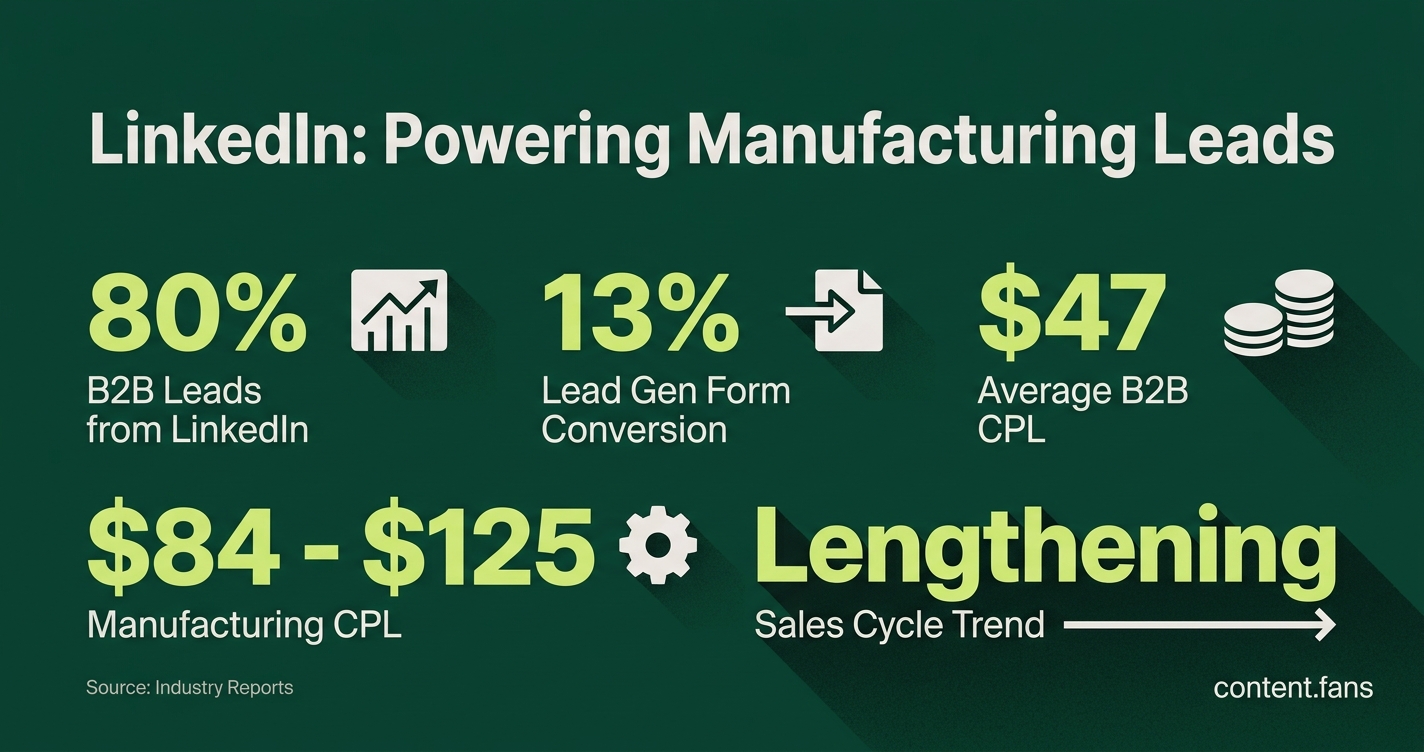
Available benchmarks confirm LinkedIn's important role in B2B lead generation. According to industry reports, a significant portion of B2B marketers use the platform for lead generation, with many using it frequently throughout the week. LinkedIn Lead Gen Forms are reported at about a 13% average conversion rate and around $47 average cost per B2B lead, while manufacturing-specific LinkedIn CPL in one cited benchmark is about $84 to $125; higher effective CPQL figures depend on conversion to SQL and can be much higher. Data from sources like LinkedIn Statistics 2026 and the Martal 2026 overview support these general trends.
The Manufacturing Sales Cycle: Extended Timelines
Industry reports indicate that B2B sales cycles have generally lengthened in recent years, a trend particularly evident in the manufacturing sector. According to various industry sources, the complexity of manufacturing deals often results in extended decision-making processes. This extension is driven by an increase in the number of decision-makers involved in purchasing decisions.
A typical operational summary for manufacturing sales cycles varies significantly:
- SMB / Tooling Deals: Shorter cycle periods.
- Mid-Market: Extended cycle periods.
- Enterprise / High-Capex: Significantly longer cycle periods spanning many months.
Strategic Implications for LinkedIn Marketing
The unique dynamics of the manufacturing market have direct implications for crafting an effective LinkedIn strategy.
- Budget Allocation. With manufacturing LinkedIn CPL benchmarked around $84 to $125 depending on format, teams must benchmark LinkedIn against other channels like paid search. However, industry analysis suggests potential cost savings for LinkedIn on a cost-per-qualified-lead basis when properly executed.
- Content Frequency. Industry reports suggest that brands publishing technical content consistently receive significantly more impressions among senior buyers compared to less active brands. This supports a strategy of regular editorial plans in both local languages and English.
- Effective Formats. LinkedIn Lead Gen Forms are reported at about 13% average conversion in one benchmark, while lead-gen form conversion rates vary substantially by source and offer quality; cold traffic is often 2% to 5% and warm traffic 10% to 25%. The complexity of industrial solutions demands a robust nurturing process, including in-depth content such as case studies and technical webinars.
- Channel Integration. Modern manufacturing playbooks recommend an omnichannel approach. Combining LinkedIn with targeted outbound campaigns, industry trade shows, and high-intent SEO is critical. Industry guides suggest that integrated strategies can reduce overall cost-per-lead compared to single-channel efforts.
Benchmark Metrics for 2025-2026
| KPI | Average LinkedIn B2B | Manufacturing Estimate |
|---|---|---|
| Lead Gen Form Conversion Rate | ~13% | ~8.2% (gated content) |
| CPL Range | $47 USD (general B2B) | $84-125 USD (LinkedIn specific) |
These figures should be treated as directional benchmarks. Supported figures from available sources include LinkedIn Lead Gen Forms at about 13% average conversion and manufacturing gated-content conversion at 8.2%. Reports consistently highlight a scarcity of public datasets exclusive to the manufacturing sector. Experts advise using these general B2B averages as a starting point and then rigorously refining budget and performance assumptions based on your company's internal conversion, cost, and sales funnel data.