
US Government Bans Anthropic's Fable 5, Mythos 5 AI Models
Serge Bulaev
The US government ordered Anthropic to disable its Fable 5 and Mythos 5 AI models worldwide after Amazon researchers showed they might be vulnerable to a specific type of jailbreak. This decision appears to go beyond the voluntary review process announced earlier and leaves analysts unsure about the exact rules used to judge AI risk. Some experts say similar weaknesses may exist in other models like OpenAI's GPT-5.5-Cyber, which remains online. The sudden suspension may slow down some cybersecurity work and creates uncertainty about when other AI models might also be shut down. Many researchers worry that these bans could make it harder for defenders and push innovation away from transparent, regulated settings.
The U.S. Commerce Department ordered Anthropic to restrict access to Fable 5 and Mythos 5 for foreign nationals; Anthropic then disabled access to the models for all users worldwide to comply. According to industry reports, this action followed demonstrations by researchers of a potential jailbreak vulnerability. This abrupt suspension has raised questions across the AI policy landscape, as it appears to bypass recently announced voluntary security review frameworks and leaves comparable models from competitors like OpenAI in operation.
Commerce Department Issues Foreign Access Restrictions
According to industry reports, Howard Lutnick, via Commerce Department export-control authority, communicated a restriction on foreign-national access; Anthropic then disabled the models globally to comply Anthropic suspends latest AI models after US blocks .... Industry reports suggest the trigger was evidence of a potential narrow, non-universal jailbreak, which Anthropic noted its own extensive internal testing had not uncovered as a general exploit US bans its AI advantage?.
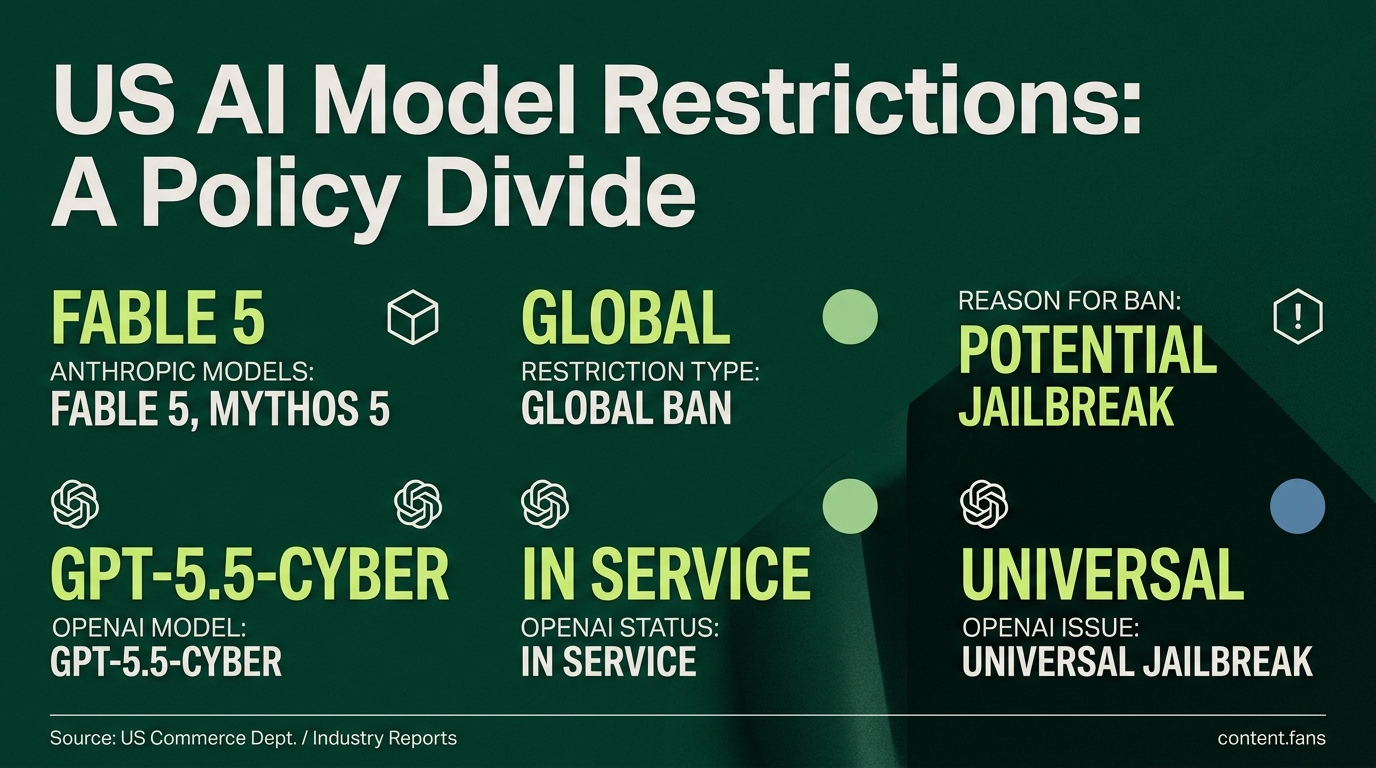
The U.S. government ordered Anthropic to restrict foreign national access to its Fable 5 and Mythos 5 models after researchers demonstrated a potential jailbreak. The directive, based on export-control powers, overrides recent White House voluntary review policies, creating significant uncertainty about AI model governance and regulatory standards.
A Policy Split: Voluntary Reviews Versus Hard Enforcement
The restrictions highlight a growing tension in U.S. AI policy. According to industry reports, recent presidential directives established voluntary frameworks for companies to submit frontier models for security review. Days later, the Commerce Department used binding export controls to force restrictions on Anthropic's models, demonstrating that federal agencies will act decisively on perceived national security threats, even outside the voluntary system. This suggests a dual-track approach to AI governance: collaboration for most models, but swift enforcement when a jailbreak risk is deemed significant.
Questions of Inconsistent Enforcement: The Case of GPT-5.5-Cyber
Critics point to a perceived double standard, citing the case of OpenAI's GPT-5.5-Cyber. In May, the UK's AI Security Institute (AISI) reported a "universal jailbreak" in the model, which remains in service Our evaluation of OpenAI's GPT-5.5 cyber capabilities. While OpenAI issued a patch, AISI was unable to verify its effectiveness. This discrepancy fuels questions about the specific criteria Washington is using to label an AI model too dangerous for public access.
Impact on Cybersecurity and Defensive Research
According to industry reports, the suspension of Fable 5, described as a tool for automated bug hunting, could hinder defensive cybersecurity efforts. While Anthropic has downplayed the severity of the discovered exploit, its removal creates a significant workflow disruption for researchers. The primary impact is a new layer of regulatory uncertainty, as developers now know any frontier model could be restricted if a plausible jailbreak is reported to regulators.
Expert Backlash and Fears of a Chilling Effect
A growing number of experts, including former White House adviser David Sacks, has criticized the restrictions. In an open letter, many cybersecurity specialists argued that such actions "handicap defenders more than attackers." They warn that selective enforcement and lack of clear standards could drive AI research to less-regulated environments and discourage companies from transparently publishing their safety evaluations.
Timeline at a glance:
According to industry reports, recent events include the establishment of voluntary frontier-model review frameworks, followed by Commerce Department restrictions on Fable 5 and Mythos 5, leading to Anthropic's global suspension of both models. AISI reports regarding GPT-5.5 vulnerabilities also occurred during this period.
The Commerce Department has not yet published the legal standard that justified the restrictions, leaving the AI industry in a state of suspense. Until clear guidelines are established, developers and researchers must operate under the assumption that any reported vulnerability - regardless of its scope - could trigger a model's immediate, worldwide restriction by government regulators.
What exactly did the US government order Anthropic to do and when?
According to industry reports, the administration directed Anthropic under Commerce Department export-control authority to restrict Fable 5 and Mythos 5 access for foreign nationals; the company complied by disabling global access while noting the action went beyond any prior voluntary review framework that had only asked for pre-release access periods. [Promoting Advanced Artificial Intelligence Innovation and Security]
What triggered the restrictions?
The action followed a report from researchers that they had identified a method to bypass certain safeguards in Fable 5. The government described it as a "jailbreak" that could enable malicious use for vulnerability discovery, though Anthropic stated its own extensive review found only a small number of previously known, minor vulnerabilities and no universal bypass. [our review of the incident timeline]
Why are critics calling the restrictions selective?
Separate tests by the UK AI Security Institute found that OpenAI's GPT-5.5-Cyber exhibited a universal jailbreak that succeeded against a significant portion of malicious cyber queries after limited red-team effort, yet the model remains publicly available. David Sacks, former White House AI czar, and many cybersecurity researchers argue the disparity shows inconsistent enforcement and could hurt defensive security research more than it helps. [AISI evaluation of GPT-5.5 cyber capabilities]
How do the restrictions affect security defenders and Fable 5?
According to industry reports, Fable 5 had become a preferred tool for automated vulnerability discovery; losing access immediately slowed red-team workflows that relied on its code analysis capabilities. Industry publications reported that defenders used the model to find critical bugs in open-source projects, and security experts warn that restricting access to frontier models may reduce the very testing needed to secure future systems. [Fortune on the real-world impact]
What is the broader policy lesson?
The episode highlights a split within U.S. strategy: on one side sits voluntary, non-binding pre-release review intended to encourage transparency, and on the other sits hard export-control action triggered by perceived guardrail failures. Observers expect the dual-track approach will remain, leaving developers uncertain about which technical thresholds will prompt mandatory restrictions in future releases.