
US Expands AI Control Over Chips, Models, and State Laws
Serge Bulaev
The United States is increasing control over AI-related hardware, software models, and regulations to keep its lead in artificial intelligence. New rules limit China's access to advanced chip technology and aim to standardize AI laws across states, but some experts warn these moves might push other countries to find ways around them. There is debate about whether a single national rule for AI will help by making rules simpler or hurt by reducing consumer protections and competition. The European Union is also making its own AI rules, so global companies may still have to follow different laws in different places.
The U.S. government is expanding its strategic control over the entire artificial intelligence stack, a policy now guiding nearly every federal action on AI. From chip manufacturing to model parameters and legal frameworks, federal agencies are treating key AI components as levers of geopolitical power. This strategy is evident in new export controls and domestic legal proposals, all based on the premise that controlling the core inputs of AI shapes its future development.
Washington Frames the Entire AI Stack as Strategic-Control Over Chips, Models, and Rules
The U.S. is implementing a multi-pronged strategy to manage AI development. This includes restricting China's access to advanced chip-making tools like EUV lithography machines, controlling the export of powerful AI models, and pushing for a unified national regulatory framework to supersede individual state laws.
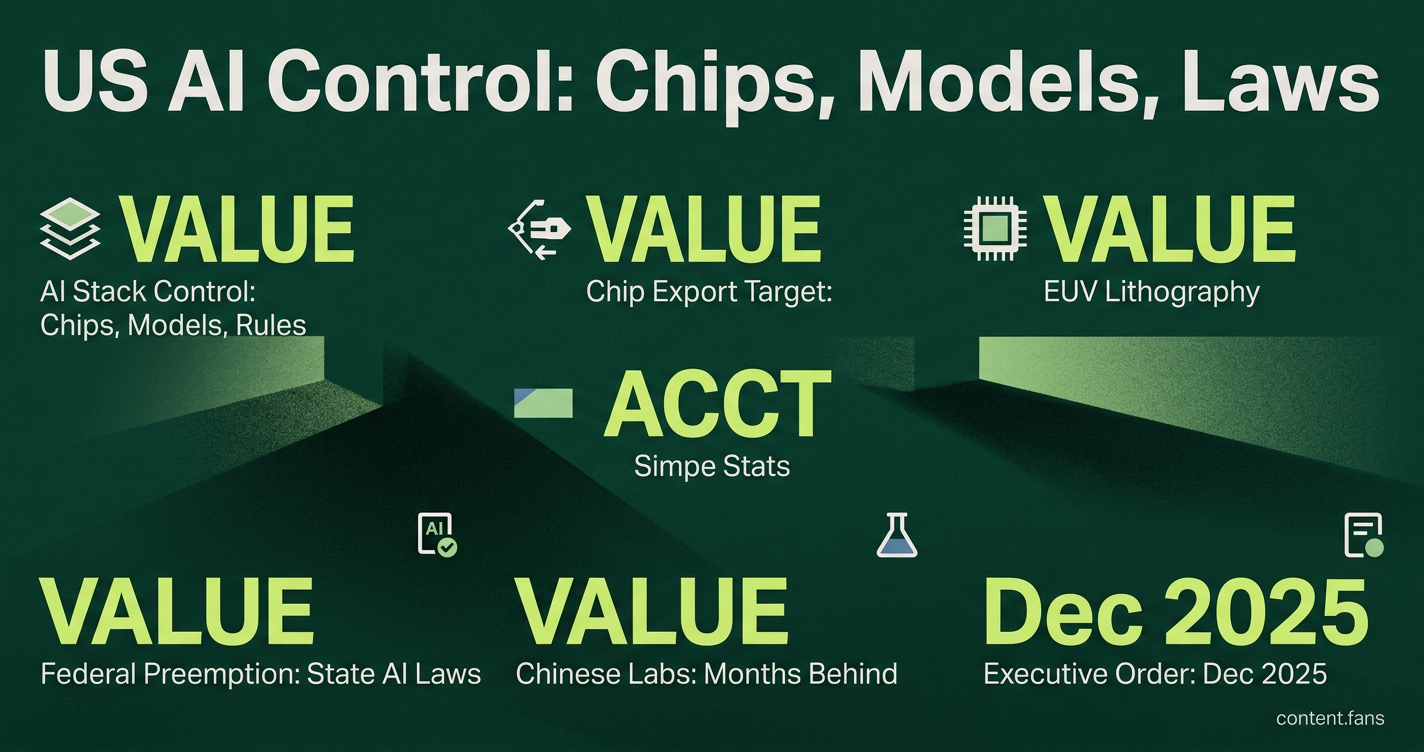
These controls build upon existing restrictions that already limit China's access to essential hardware like extreme ultraviolet (EUV) lithography tools. According to analysts at CSIS, blocking sales of ASML's EUV machines is a deliberate move to keep advanced chip fabrication outside of China. Brookings further notes that the resulting compute gap leaves Chinese labs "months behind" U.S. frontier models, although they are adapting with more efficient systems.
Federal Preemption Push on Domestic AI Laws
Federal oversight now extends from hardware to the legal code itself. A pivotal December 2025 executive order directs federal agencies to challenge state AI laws deemed overly burdensome for development (White House text). This has been followed by congressional proposals for federal legislation that would establish a moratorium on new state-level AI development rules.
The goal is to replace a complex patchwork of state regulations with a single, uniform national standard. However, policy experts are divided. Proponents believe uniformity will lower compliance costs and speed up innovation. In contrast, organizations like the Center for American Progress argue that federal preemption could dismantle vital consumer safeguards established by states. Currently, existing state AI laws remain in effect, as Congress has not passed any overriding legislation.
Debates on Effectiveness and Possible Spillovers
Experts disagree on whether these controls will achieve their long-term goals. Supporters contend the rules buy the U.S. valuable time by raising the cost of frontier AI development for competitors. A model from Carnegie identifies key choke points in advanced GPUs, large-scale data centers, and licensed model weights. However, critics at Chatham House warn that while these barriers are effective short-term, they may ultimately accelerate foreign self-sufficiency programs, especially China's efforts to create domestic alternatives.
This debate mirrors the one over domestic law. While corporate leaders favor a single federal rulebook for its simplicity, advocacy groups caution that it could eliminate beneficial state-level policy experiments and entrench the power of large incumbents. The primary concern is that a national standard set too early could be shaped by the dominant players, stifling future competition.
Key Levers Washington Targets
The U.S. strategy focuses on several key control points:
- Advanced Hardware: Controlling access to high-performance compute chips and the specialized equipment used to manufacture them.
- Powerful AI Models: Restricting the distribution of closed-source model weights that exceed certain computational thresholds.
- Legal Frameworks: Establishing federal authority to preempt and standardize conflicting state-level AI regulations.
- Technology Licensing: Applying licensing requirements to foreign products that are derived from U.S. technology.
The U.S. is not acting in a vacuum. The EU AI Act has a phased implementation schedule with various enforcement dates. This forces multinational AI developers to navigate at least two distinct and powerful regulatory regimes. Consequently, even if Washington successfully creates a uniform domestic standard, global firms will still contend with a complex and fragmented international compliance landscape.
What exactly is the U.S. trying to control in the AI stack?
Washington now treats every hardware and software layer as a strategic lever: EUV lithography tools that print transistors, the closed model weights that encode frontier intelligence, and even the legal rulebook itself. The federal government has established export controls for advanced chips and AI models, while a parallel White House push asks Congress to preempt state AI laws to keep the domestic playing field uniform.
How do the new chip and model-weight export controls work?
Exports, re-exports, or in-country transfers of covered chips or closed weights require a BIS licence for most destinations. A foreign-direct-product clause extends U.S. reach to overseas data-centres that used American chips, but open-weight models are explicitly exempt. The rule is tiered: only the most powerful closed weights face restrictions, matching the policy goal of bottlenecking adversary access without outlawing open research.
Will these controls slow China's AI progress or speed it up?
They have already cut Chinese labs off from NVIDIA-class GPUs and ASML EUV tools, leaving frontier training "months behind" the U.S. line, according to Brookings. Yet the same pressure is driving domestic-chip optimisation (DeepSeek's V4 runs on Huawei Ascend) and long-term self-sufficiency plans. The consensus view among policy analysts is "constraint plus adaptation": delays are real, but a complete stop is unlikely.
Why does the federal government want to override state AI laws?
Industry lobbyists argue the emerging patchwork of state rules raises compliance costs and legal uncertainty. A March 2026 White House framework therefore urges Congress to preempt state development-level regulation while preserving state powers over fraud, child safety and zoning. Congressional proposals would freeze state model-training rules and centralise reporting at the federal level.
Could federal preemption backfire by entrenching Big Tech?
Critics - including the Center for American Progress and Carnegie Endowment - warn that blanket preemption removes policy laboratories that states provide and could leave a weak national floor, favouring incumbents who can absorb national-scale compliance. With no comprehensive federal AI statute yet in force, many state laws remain legally enforceable, meaning firms still need dual-track compliance while the preemption campaign plays out in Congress and the courts.