
US companies adopt China's GLM-5.2 AI, raising security concerns
Serge Bulaev
Some U.S. companies are using the Chinese AI model GLM-5.2 because it may be much cheaper than American models. Officials warn that using this technology might put important data and supply chains at risk, and there are questions about long-term security. Experts say GLM-5.2 could be used for hacking and may fall under Chinese laws if run on Z.ai's cloud. There is no clear federal ban yet, but some government officials and analysts suggest new rules could be needed. The main debate is whether the cost savings are worth the possible dangers.

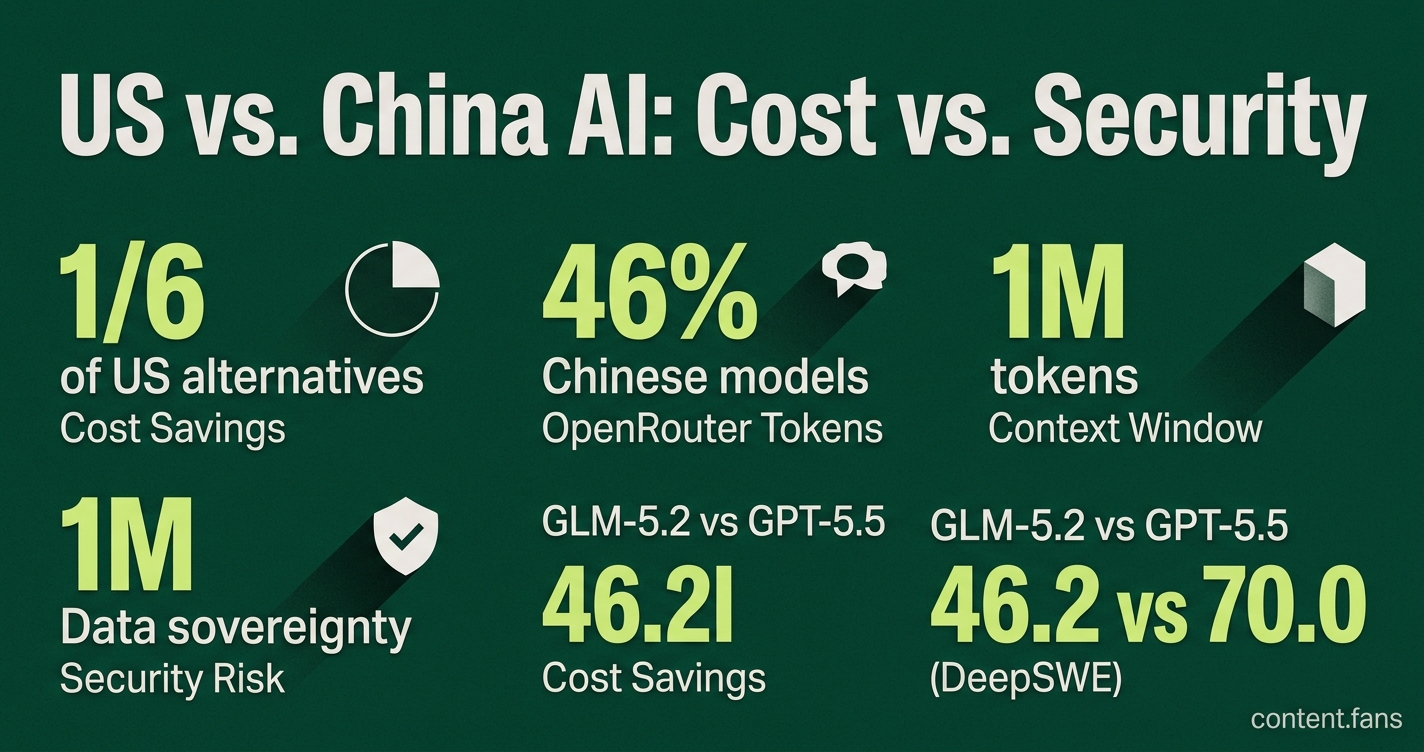
The adoption of China's GLM-5.2 AI model by U.S. companies is fueling a fierce national-security debate. Following the open-weight release by Z.ai in June 2026, American enterprises are drawn to its potential to cut inference costs to one-sixth of domestic alternatives. However, officials warn this cost-saving measure could lead to significant data sovereignty and supply-chain vulnerabilities. This creates a central conflict for corporate America: balancing short-term economic advantages against profound long-term security risks.
National-security debate over U.S. companies adopting Chinese AI model GLM-5.2
The adoption of China's GLM-5.2 AI by US firms raises national security alarms due to its origin. Concerns center on potential data exposure under Chinese law, supply chain vulnerabilities from open-weight distribution, and the model's powerful, unregulated capabilities for malicious use like cyberattacks.
While no federal policy specifically targets GLM-5.2, industry reports suggest its developer's parent company may face regulatory scrutiny. This designation could place the model under existing Export Administration Regulations, and a Substack analysis highlights a regulatory gap, noting that open-weight Chinese models can circulate globally without U.S. oversight The GLM-5.2 Dilemma.
U.S. Commerce officials have established precedents for controlling powerful AI systems, though specific enforcement actions remain under review. The White House's March 20, 2026 framework is a legislative blueprint urging Congress to preempt state AI laws to create a single national standard, establishing a foundation for unified AI governance.
Cost pressure inside corporate America
The primary driver of GLM-5.2 adoption is economic. Industry trackers show GLM-5.2 beats GPT-5.5 on key coding benchmarks but underperforms on others (e.g., DeepSWE 46.2 vs. 70.0) and cannot be said to surpass GPT-5.5 overall, while charging a fraction of closed-API rates. This cost-performance advantage is reflected in usage data showing Chinese models accounted for approximately 46% of OpenRouter enterprise tokens by mid-2026, with significant weekly volumes reaching industry reports of 18-25 trillion tokens. Key advantages include:
- Lower Inference Costs: Delivers significantly cheaper processing per token.
- Expanded Context: Offers a one-million-token context window, ideal for complex codebases.
- Customization Control: Enables internal fine-tuning without vendor restrictions.
This trend has led analysts to caution that massive U.S. datacenter investments could face challenges if workloads continue to migrate to open, locally hosted models, according to industry reports.
Security and data-sovereignty concerns
Cybersecurity experts label GLM-5.2 a "security emergency" because the open-weight model can run locally without safety guardrails. Security researchers have noted that Chinese open-source models can identify software vulnerabilities at low cost, potentially democratizing advanced hacking tools for malicious actors.
The risks vary by deployment. Using Z.ai's cloud API subjects data to China's National Intelligence Law, creating a legal pathway for compelled disclosure. Self-hosting mitigates this but introduces risks like weight-tampering through unofficial distribution channels. This has strategists weighing an outright ban on powerful foreign models versus creating international governance standards.
Policy tools on the table
Washington is evaluating several policy tools to address the risks posed by GLM-5.2 and similar models:
- Expand the Entity List: Broaden designations to include AI model distribution platforms, not just parent companies.
- Require Provenance Attestation: Mandate verification of an AI model's origin for all federal procurement.
- Mandate Vulnerability Disclosures: Compel disclosure for open-weight models that surpass defined capability thresholds.
- Incentivize Domestic Alternatives: Promote U.S.-based open models to compete on cost and capability.
Each policy carries tradeoffs between national security, competitiveness, and innovation. While regulators deliberate, U.S. firms continue to adopt GLM-5.2, balancing its immediate financial benefits against the evolving landscape of security risks.