
Consulting Firms Adopt Playbook to Validate Client-Facing AI Workflows
Serge Bulaev
Consulting firms are starting to use a playbook to check and approve their AI work for clients, which may help keep quality high even when deadlines are tight. The process includes quick checkpoints at several steps, with different team members reviewing and signing off on the work. Tools that track sources, changes, and approvals seem to help make these reviews easier. Key performance indicators, such as how often work is finished on time or by AI, may show if the process works. Some reports suggest that tracking every AI prompt and having regular reviews might reduce unapproved AI use.

As consulting leaders face compressed timelines and AI-driven outputs, a structured playbook to validate client-facing AI workflows is essential. Implementing early, lightweight checkpoints safeguards deliverable quality without sacrificing speed. This guide outlines where to place validation gates, who provides sign-off, and which metrics confirm the guardrails are effective.
Map controls across the journey
The traditional four-week cycle of Research, Draft, Review, and Final is obsolete. Leading AI consulting firms typically follow a structured model where pilot validation spans 4 - 8 weeks, with rapid blueprint pilots taking 2 - 4 weeks, beginning with team-wide "tournament style voting" to select the most promising use cases. Winning workflows are benchmarked against manual baselines before senior review and approval. For regulated engagements, a parallel track ensures compliance by mapping system boundaries and linking every requirement to a specific test case, with regular stakeholder reviews.
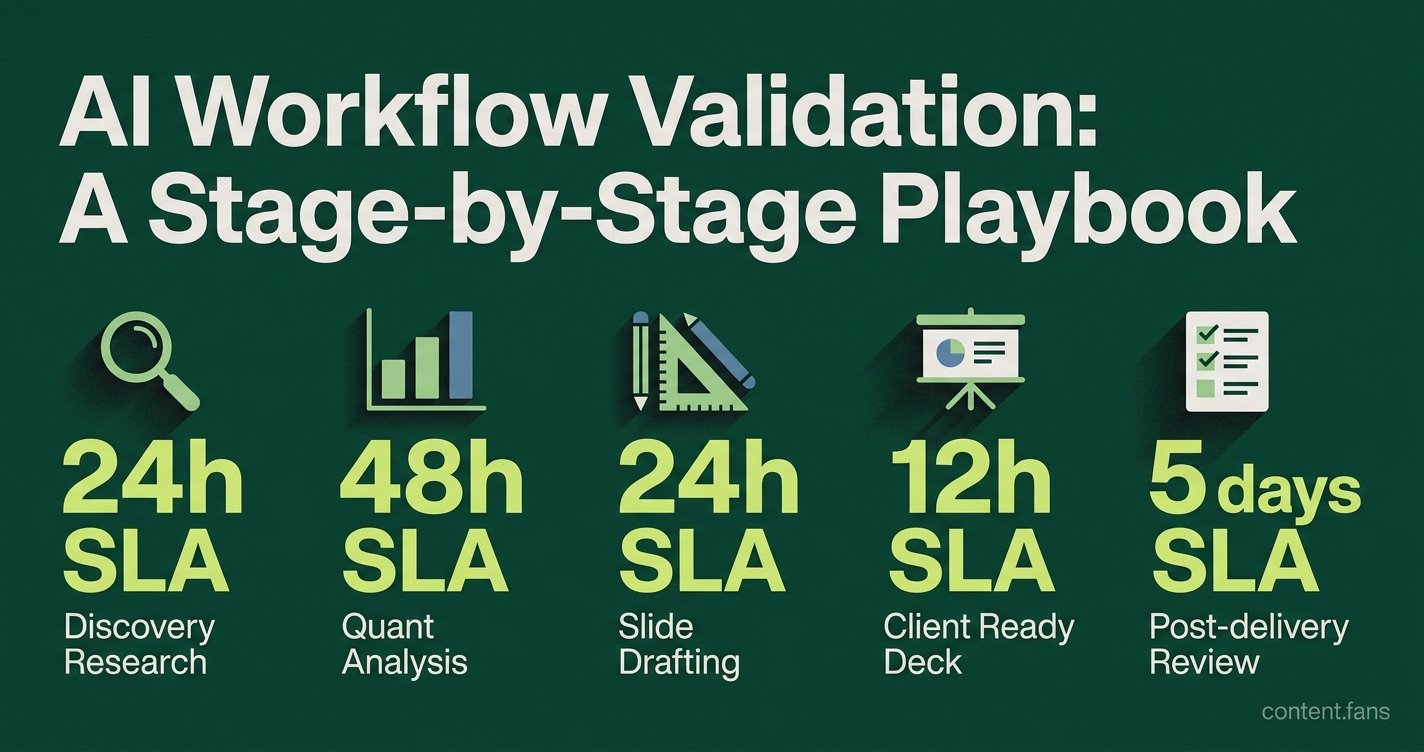
Firms validate AI work by embedding checkpoints throughout the project lifecycle, from research to final review. This involves benchmarking AI outputs against manual baselines, using source-grounded tools, and requiring formal sign-off from designated validators at each stage to ensure quality, accuracy, and compliance before client delivery.
AI Workflow Validation Stage Map
| Stage | Primary validator | Tooling requirement | Approval SLA |
|---|---|---|---|
| Discovery research | Project lead | Source-grounded AI workspace | 24 h |
| Quant analysis | Senior analyst | Version-controlled repo | 48 h |
| Slide drafting | Engagement manager | Audit trail capture | 24 h |
| Client ready deck | Partner | Formal sign-off log | 12 h |
| Post-delivery review | Partner + client sponsor | KPI review dashboard | 5 days |
Tooling that keeps proof
Effective validation relies on tools that provide immutable proof of review and provenance:
- Source-Grounded AI Workspaces: These platforms require citation for every generated figure, flagging unsourced data before export, a key practice for maintaining quality standards.
- Version-Controlled Documentation: Hubs with branch-based version control give reviewers a clear history of all changes.
- Auditable Workflow Engines: Systems that automatically apply timestamped digital signatures to approvals create searchable audit trails for compliance.
KPIs to prove it works
To measure the effectiveness of the validation playbook, firms should track a combination of traditional and AI-specific Key Performance Indicators (KPIs). Core metrics include Utilization Rate, On-Budget Delivery, and On-Time Delivery. Key AI-focused metrics are the Automation Efficiency Rate (tasks completed by AI vs. humans) and the Knowledge Synthesis Score, which measures research accuracy. Failure to meet any defined SLA should automatically trigger a root-cause analysis.
Lightweight controls that curb unapproved AI use
To curb the use of unapproved "shadow AI" tools, firms can implement lightweight governance controls. By logging every AI prompt to a central database, leadership can maintain oversight. During weekly review sessions, teams can sample these logs and "live redo" a recent task using a sanctioned tool to identify discrepancies or quality drift. If the process is inefficient or inaccurate, it is returned to a pilot phase for refinement.
Sample engagement language (excerpt)
Contracts and Statements of Work (SOWs) should include explicit clauses governing AI usage to ensure transparency and accountability:
- Vendor confirms that all generative AI outputs have been human-reviewed and approved according to a documented validation workflow.
- Vendor will maintain a seven-year audit trail of all prompts, model identifiers, and reviewer sign-offs, to be supplied upon written request.
- Breach of the AI review process entitles the CLIENT to withhold payment for any deliverable lacking documented approval.
This playbook framework aligns with emerging best practices emphasizing delegated oversight, mandatory approval gates, and data-driven milestones. The core principle is that validation must be an integral part of the workflow, traveling with the deliverable from start to finish, not a final check at the end.
Where should validation checkpoints sit in a consulting workflow?
Validation must be embedded at every stage of a consulting workflow, not just a final gate. Leading firms integrate checkpoints from initial research to client delivery. They test AI-assisted processes using tournament-style pilots and validation sprints before full adoption.
Key integration points include:
- Research: Verifying AI-sourced data against trusted documents.
- Analysis: Comparing AI-assisted and manual outputs on time and quality.
- Deliverable Creation: Requiring source-grounding for all claims.
- Final Review: Mandating human expert approval before client handoff.
This continuous validation approach minimizes rework and combines AI's speed with human oversight.
Who owns validation and approval at each stage?
Effective validation requires assigning clear ownership rather than relying on informal reviews. Firms should delegate specific roles and responsibilities across the workflow. A typical ownership structure includes:
| Stage | Validator | Responsibility |
|---|---|---|
| Tool selection | Compliance officer | Confirm no-training policies, SOC 2 certification, tenant isolation |
| Research outputs | Engagement manager | Verify source-grounding and cross-check against client materials |
| Analysis quality | Senior consultant | Lead "live redo" validation and sprint reviews |
| Final deliverables | Partner + subject expert | Human review and approval before any client exposure |
Service Level Agreements (SLAs) are critical for defining turnaround times, such as 24 hours for manager review and under four hours for partner-level sign-off.
What lightweight tooling enables audit trails without slowing teams?
To create audit trails without adding friction, firms should implement lightweight provenance-tracking tools. The most effective solutions combine three elements:
- Version-controlled repositories for all deliverables with mandatory "second set of eyes" review before handoff
- Prompt and workflow logging during validation sprints to assess replicability
- Audit-trail-enabled platforms that capture who used which AI tools, when, and with what outputs
These tools are essential for demonstrating compliance and defending quality standards.
Which KPIs best track validation effectiveness?
Firms should monitor a balanced scorecard of KPIs to track validation effectiveness across efficiency, quality, and governance:
Efficiency Metrics:
- Utilization Rate: Targeting optimal performance levels.
- Automation Efficiency Rate (AER): The percentage of tasks successfully automated by AI.
Quality Metrics:
- On-Budget Delivery: Aiming for minimal negative variance.
- Knowledge Synthesis Score (KSS): Measuring the accuracy of AI-assisted research.
- Error rate in client deliverables: Tracked weekly during pilot periods.
Governance Metrics:
- Unapproved AI tool usage: Instances of non-sanctioned platform use.
- Approval cycle time: Hours from draft completion to authorized delivery.
The BCG study found consultants using AI completed tasks 25.1% faster and produced 40% higher quality results on tasks 'inside the frontier' of AI capability.
How should engagement contracts address AI use?
Engagement contracts must be updated to address AI use explicitly. Modern contract language should include:
"All AI-assisted analysis shall be validated against client-provided source documents. Deliverables containing AI-generated content shall maintain complete audit trails of prompts, tools used, and human review stages. Firm warrants that no client data trains third-party AI models and that all processing occurs within SOC 2 Type II certified environments."
Additional provisions should specify:
- A pre-approved list of AI tools with required security certifications.
- Mandatory human review for critical outputs, such as final recommendations.
- A shift toward outcome-based quality standards over hourly metrics.
This language is crucial as a growing number of major consulting engagements are now tied to outcome-based contracts, linking validation directly to revenue.