
OpenAI, Google Supplied AI Models to Pentagon-Blacklisted Chinese Firms
Serge Bulaev
This situation suggests there are loopholes in export controls that let Chinese firms access US technology.

Recent reports that OpenAI and Google supplied AI models to Pentagon-blacklisted Chinese firms via foreign subsidiaries have highlighted critical loopholes in U.S. export controls. According to a Financial Times story, the tech giants licensed advanced AI models to Singapore-based arms of Alibaba, Baidu, and Tencent - companies on the Pentagon's 1260H list for alleged military connections. Policy experts view this as proof that geography-based controls are insufficient, as the sales are currently legal under U.S. rules because the subsidiaries are incorporated in Singapore.
Export Loopholes and National Security Risks
U.S. tech giants legally provided advanced AI models to Singapore-based subsidiaries of blacklisted Chinese firms like Alibaba and Tencent. This is permissible because current U.S. export controls are geography-based, treating these subsidiaries as Singaporean entities despite their Chinese parentage, creating a significant regulatory gap.
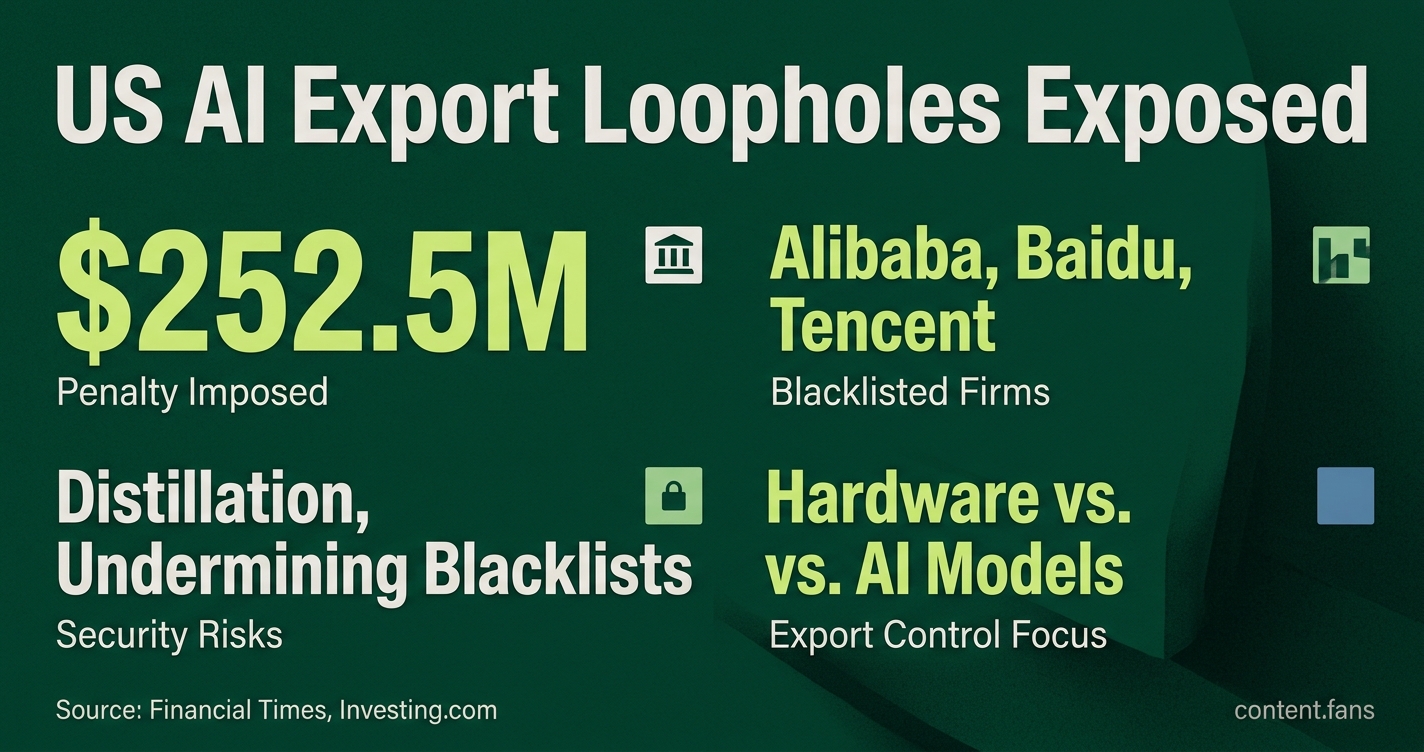
The arrangement presents two significant security risks. The first is "distillation," where developers use powerful AI systems to train and improve their own domestic models. Citing this concern, OpenAI reportedly suspended a significant number of API keys tied to Alibaba affiliates and reported the activity to U.S. authorities, as covered by Investing.com. The second risk is that it undermines the effectiveness of blacklisting a parent company. U.S. export rules have traditionally focused on physical hardware shipments, not remote access to AI models. This gap has led competitors like Anthropic to proactively ban all Chinese-owned entities from using their systems, regardless of location.
How Washington is Responding
In response, according to industry reports, the U.S. Commerce Department has moved to close hardware loopholes. New guidance reportedly requires licenses for advanced GPU exports to any company with a Chinese parent, regardless of the subsidiary's location. While the Bureau of Industry and Security (BIS) acknowledged that significant numbers of processors may have been rerouted before such rules, industry reports suggest such transfers are now subject to stricter controls. Enforcement actions are also increasing. On February 11, 2026, BIS announced a $252.5 million civil penalty (specifically $252,500,300) against Applied Materials Inc. and its Korean subsidiary for illegally exporting semiconductor equipment to China. This is the second-highest penalty ever imposed by BIS. The agency has also indicted individuals for using a Thai front company to acquire controlled chips.
Remaining Vulnerabilities in AI Export Controls
Despite recent rule changes, experts identify key vulnerabilities that still allow indirect access to U.S. technology:
- Cloud Computing: Chinese firms can rent computing power on U.S.-made GPUs located in foreign data centers through Infrastructure-as-a-Service (IaaS) agreements.
- Transshipment Hubs: Hubs like Singapore, Taiwan, and Malaysia often lack strict re-export controls, fostering "grey markets" for advanced chips.
- Remote Verification Gaps: Proposed legislation like the Chip Security Act, which would mandate location checks for hardware, has not yet been fully implemented.
These gaps make it difficult and expensive for regulators to track the final destination of hardware and monitor who accesses advanced AI models.
Proposed Solutions and Policy Debates
To counter these vulnerabilities, policymakers are debating several key proposals:
- Regulating Remote Access: According to industry reports, proposed legislation would classify cloud computing rentals as exports, subjecting them to licensing requirements.
- Implementing Multi-Layered Controls: Analysts from the Center for Strategic and International Studies (CSIS) advocate for controls on computing power, AI models, and inference capabilities simultaneously, arguing that restricting a single layer is ineffective.
- Mandating On-Site Audits: Provisions in the draft Chip Security Act propose requiring physical inspections and inventories of GPUs in jurisdictions known for high diversion risks.
This ongoing policy shift indicates Washington is moving beyond controlling physical goods to regulating data center access and software as export events. The Singapore case serves as a crucial lesson for U.S. companies: modern compliance requires deep diligence into ownership structures, cloud usage, and end-user behavior, not just shipping logistics.
How did OpenAI and Google legally supply AI models to blacklisted Chinese firms?
OpenAI and Google provided AI models to Singapore-based subsidiaries of Alibaba, Baidu, and Tencent, whose parent companies are on the Pentagon's 1260H blacklist. This practice is currently legal because U.S. export restrictions focus on geographic location, not ultimate ownership. According to industry reports, while chip shipments to Chinese-headquartered firms may face stricter licensing requirements, software model access remains regulated differently, allowing these transactions via third-country entities.
What risks arise from this regulatory loophole?
The arrangement exposes a critical gap in U.S. export controls: blacklisted Chinese firms can potentially use the models for distillation, a process where outputs from advanced U.S. models are used to improve competing Chinese systems. In one case, OpenAI suspended a significant number of API accounts linked to an Alibaba-affiliated entity due to suspected distillation attempts. This loophole may accelerate China's AI development despite sanctions intended to slow it.
How are U.S. authorities responding to close the gap?
The Bureau of Industry and Security (BIS) has shifted from regulatory clarification to aggressive enforcement. On February 11, 2026, BIS announced a $252.5 million civil penalty against Applied Materials Inc. and its Korean subsidiary for illegally exporting semiconductor equipment to China. This is the second-highest penalty ever imposed by BIS. Additionally, criminal indictments have targeted individuals using Thailand-based front companies. According to industry reports, proposed legislation would extend controls to cloud-based GPU access, treating remote API usage as an export transaction.
What makes Singapore subsidiaries an attractive route for Chinese firms?
Singapore serves as a transshipment hub due to its robust digital infrastructure and favorable regulatory environment. Chinese tech giants can legally incorporate subsidiaries there, which are then treated as Singaporean entities under current U.S. rules. This allows them to bypass direct restrictions while maintaining operational control. The jurisdiction lacks the enforcement mechanisms to rigorously monitor re-exports, making it an effective grey market route.
What measures can strengthen future AI export controls?
Experts recommend a multi-layered approach:
- Capability-based controls instead of geography-based ones, focusing on the sensitivity of the technology rather than the location of the entity
- Post-delivery verification and on-site audits for high-risk exports, as proposed in the Chip Security Act
- Enhanced due diligence requirements for cloud providers to verify end-user identities and usage patterns
- Government-to-government assurances for large-scale exports exceeding significant thresholds
These measures would address the current enforcement gaps and make it significantly more resource-intensive for adversaries to circumvent controls.