
OpenAI, xAI, and Meta Launch New Models, Reshaping AI Competition
Serge Bulaev
OpenAI, xAI, and Meta have each launched new AI models, which appears to be speeding up competition and changing how companies compare these tools. OpenAI released GPT-5.6, Meta launched an image generator called Muse Image, and xAI previewed a larger model using real-time data. Each company is focusing on different features like context size, reasoning, and pricing, suggesting that organizations may need to mix different models to meet their needs and safety standards. Experts believe that safety methods and privacy controls now vary between labs, and companies might require policies for using several providers instead of just one. Early studies suggest that challenges in using these new models include higher costs, technical integration, and the need for human oversight, with many pilot projects not moving past early testing stages.

The recent launch of new models from OpenAI, xAI, and Meta is reshaping AI competition, compressing yearly roadmaps into a matter of days. This rapid succession of releases has shifted the industry's focus from incremental text improvements to a broader, cross-modal contest, as AI companies compete across multiple capabilities and modalities.
For developers, this presents both a broader toolkit and a more complex evaluation challenge. AI labs are now targeting distinct advantages in areas like context window size, agent reliability, and pricing models. Consequently, the central question for organizations is shifting from "Which single model is best?" to "What combination of models delivers optimal performance and safety at the lowest cost?"
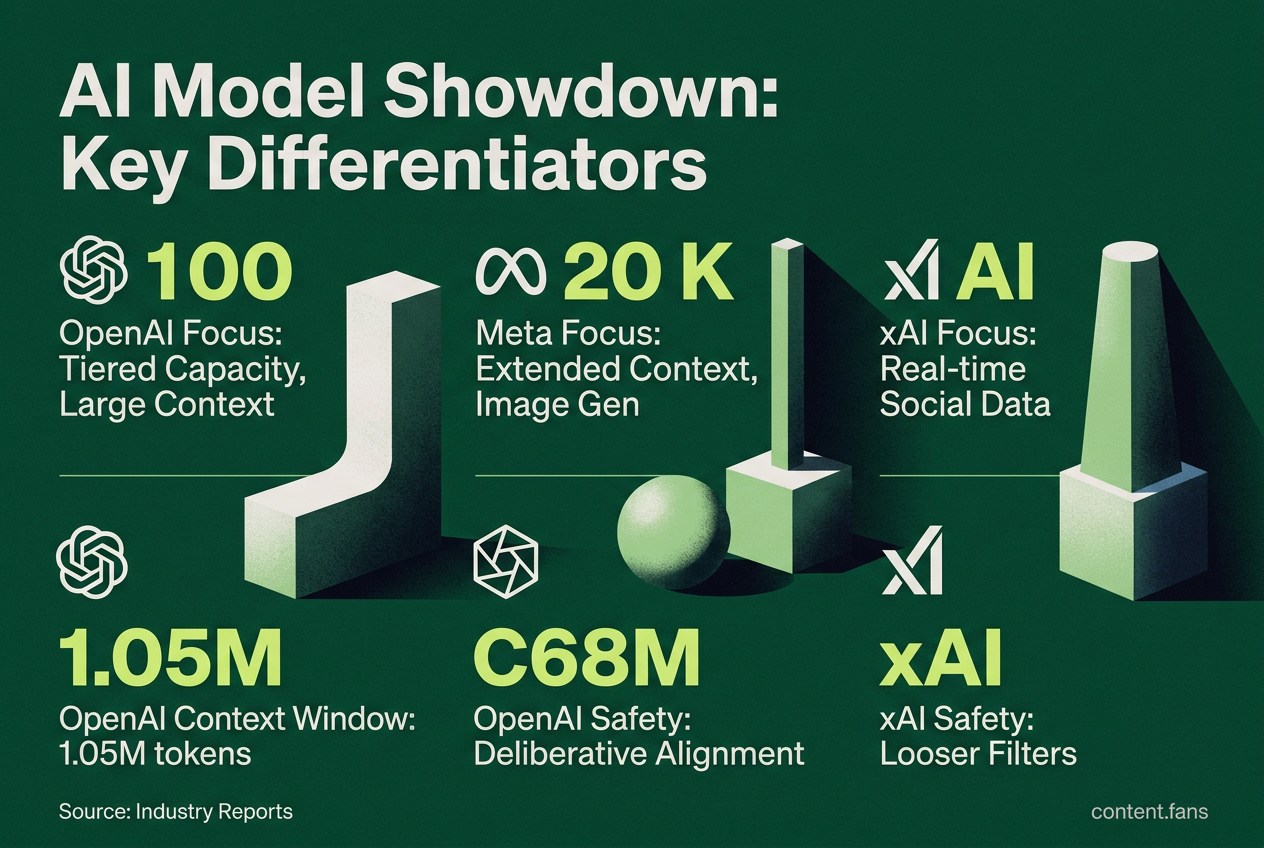
Feature sets at a glance
The new models from OpenAI, xAI, and Meta show divergent priorities. According to industry reports, OpenAI's latest models focus on tiered capacity and large context. Meta's Llama series extends context windows dramatically and adds image generation capabilities, while xAI's models leverage real-time social data for up-to-the-minute, opinionated responses.
OpenAI's GPT-5.6 is available in three tiers (Sol, Terra, Luna) with a context window of 1.05 million tokens (1,050,000). Meanwhile, according to industry reports, Meta's Llama series pushes context windows significantly higher, and its image models introduce prompt-based image generation. xAI's Grok models emphasize real-time ingestion of X social data and an "irreverent" tone intended to rival leading models on mathematical reasoning.
According to industry reports, benchmark data indicates:
- OpenAI's latest models show strong performance on mathematical reasoning tasks with reduced hallucination rates.
- Meta's Llama models demonstrate competitive performance on coding and structured reasoning tasks.
- xAI's Grok models show strong code synthesis capabilities when assisted by live social streams.
Safety guardrails and trade-offs
The safety and alignment philosophies of each lab are notably distinct. OpenAI implements "deliberative alignment," enabling its models to reference internal policies during reasoning. Meta embeds various safety techniques into its open-weight models, reportedly improving accuracy compared to earlier model generations. In contrast, xAI prioritizes creative freedom with looser filters to leverage real-time data. This divergence suggests enterprises will likely need multi-provider governance policies instead of relying on a single vendor's guardrails.
OpenAI's earlier o1 series, rated medium-risk for CBRN content, led to reinforced controls. Meta addresses privacy concerns by enabling on-premise fine-tuning, an attractive option for companies hesitant to send sensitive data to cloud APIs. xAI's real-time data integration, however, introduces provenance challenges for regulated industries.
Enterprise impact and cost calculus
According to industry reports, enterprises experimenting with multimodal AI consistently face three major hurdles:
- High Integration Costs: The engineering effort for data ingestion, preprocessing, and audit logging often matches or exceeds model usage costs.
- Unpredictable Pricing: Multimodal token pricing is significantly higher than text-only, causing image-processing pipelines to frequently exceed budget forecasts.
- Need for Human Oversight: Visual hallucinations remain a common issue, necessitating human-in-the-loop (HITL) verification, especially during pilot phases.
To navigate these challenges, analysts recommend a layered strategy:
- Abstract the model layer so switching vendors is operational not architectural.
- Pair frontier reasoning models with lower-cost small language models for routine classification.
- Start with a single, measurable workflow and embed retrieval-augmented generation to ground responses.
With Gartner reporting that over 50% of generative AI projects were abandoned by end of 2024, implementing weekly risk reviews and robust data classification from the outset is becoming a critical governance baseline.
Competitive direction
As capability for basic writing tasks reaches parity, the competitive frontier is shifting toward reasoning fidelity and agent autonomy. According to industry reports, recent releases from major AI companies have confirmed that premium reasoning is no longer dominated by a single player. Looking ahead, the next wave of differentiation is expected to come from new architectural approaches - pitting transformer-scaling against post-transformer research from groups like Liquid AI - rather than simply an increase in parameter counts.
What models did OpenAI, xAI, and Meta recently release?
According to industry reports, OpenAI has been expanding access to its latest foundation models with multiple variants. xAI (Elon Musk's company) has been developing releases focused on rapid information processing. Meta has been introducing image-generation capabilities alongside its Llama series featuring models with extended context windows for coding and reasoning tasks.
How do these models differ in capabilities and safety approaches?
Each lab pursues distinct proprietary strategies rather than unified standards:
| Company | Standout Capability | Safety Approach |
|---|---|---|
| OpenAI | Deliberative alignment - models internally reference safety policies during reasoning | Constitutional AI training; "medium risk" assessment for CBRN concerns |
| Meta | Extended context windows; improved accuracy on various benchmarks | Open-weight access for data privacy; enterprise-focused guardrails |
| xAI | Real-time X (Twitter) data access; "irreverent" personality | Less restrictive creative freedom; opinionated outputs |
According to industry reports, Meta's latest models show competitive performance against leading models on coding benchmarks, while xAI's approach prioritizes speed and real-time data over strict content restrictions.
Why does this compressed release timeline matter for enterprises?
The simultaneous launches intensify competitive pressure while creating operational complexity. Enterprises now face:
- Many GenAI projects abandoned after proof of concept due to poor data quality and unclear business value
- Multimodal token pricing significantly higher than text-only, with image processing consuming substantially more tokens
- Integration complexity requiring substantial engineering effort on data pipelines as well as model selection
The pace reflects an industry shift from "can it reason" to "can it reliably execute complex agentic tasks without human correction."
What risk management strategies should enterprises adopt?
Successful deployment requires moving from "model-first" to "system-first" thinking:
Architectural priorities:
- Model portability - abstract the model layer so switching providers becomes an operational decision, not architectural rewrite
- Multi-model strategy - use frontier models for complex reasoning, cost-efficient models for high-volume processing
- Human-in-the-loop oversight mandatory for high-stakes visual workflows to counter hallucinations
Governance essentials:
- Deploy audit trails, output monitoring, and data classification from day one
- Review Data Processing Agreements specifically for visual data training commitments
- Implement weekly risk reviews with accountable owners
How is the competitive landscape shifting beyond these three players?
While leading AI companies compete for enterprise API revenue, the market is becoming increasingly competitive:
- According to industry reports, recent releases from major AI companies have created genuine multi-vendor competition for premium reasoning
- Chinese open-weight models drive competitive pricing pressures
- Significant investment has been raised by numerous foundation-model companies, with architecture becoming a key battleground between Transformer-scaling and Post-Transformer approaches
The market continues to show strong growth projections, with Asia-Pacific as a rapidly growing region.