
US Commerce Bans Anthropic's Fable 5, Mythos 5 AI Models Globally
Serge Bulaev
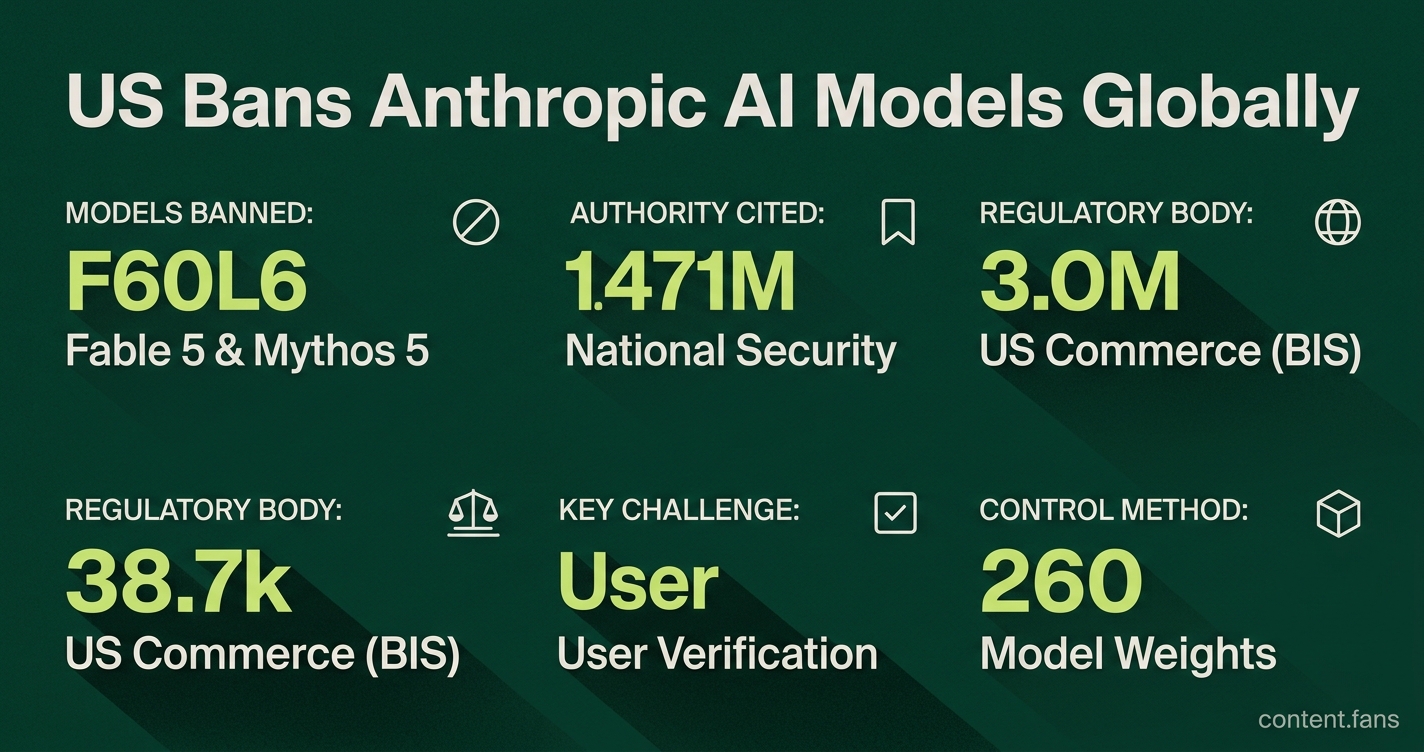
On June 12, 2026, the U.S. Commerce Department ordered Anthropic to disable global access to its advanced AI models Fable 5 and Mythos 5. Anthropic could not separate users by nationality, so it shut down both models for everyone. The decision is widely seen as the first time a government forced a company to take an advanced AI model offline, and may create major challenges for companies using these models. Experts suggest the rules might change again, and other companies could face similar actions if their models are considered too advanced. There is no set timeline for when access might return, and affected companies are looking for backup solutions.

Anthropic announced Claude Fable 5 and Claude Mythos 5 on June 9, 2026, and the provided sources describe their API availability and specifications. The models represent significant advances in AI capabilities, though they operate under evolving regulatory frameworks that could impact their deployment.
The episode highlights growing tensions between AI innovation and export control regulations, creating operational considerations for companies handling advanced model weights.
Why Commerce believes it can police model access
The Commerce Department's Bureau of Industry and Security (BIS) asserts its authority through the Export Administration Regulations (EAR). Citing national security, BIS has established rules governing AI models through the Commerce Control List, as detailed in an analysis by Mayer Brown (link). In the provided sources, BIS's January 2025 rule controlled certain advanced closed-weight AI model weights and advanced computing ICs, and BIS later issued May 2025 guidance on controls that may apply to advanced computing ICs and other commodities used to train AI models.
The U.S. Commerce Department has established frameworks for classifying AI model software weights as controlled technology under the Export Administration Regulations, citing national security concerns and restrictions on access by foreign nationals.
Regulatory Framework for Advanced AI Models
According to industry reports, companies are navigating complex compliance requirements as regulatory frameworks continue to evolve. While companies seek clarification on various aspects of these regulations, they must balance innovation with compliance obligations.
Technical and compliance hurdles
The core challenge stems from the models' shared architecture and the complexities of user verification. According to industry reports, both Fable 5 and Mythos 5 feature significant context capabilities, with Mythos 5 designed for specialized cybersecurity applications. Because authentication is account-based, not request-based, companies face challenges in reliably verifying user nationality across VPNs and global networks without impacting performance.
A brief list of immediate obstacles cited by legal advisers:
- Verifying user identity across federated single sign-on (SSO) systems
- Navigating data retention conflicts with GDPR and other international privacy laws
- Managing shared cloud accounts used by both U.S. and non-U.S. employees
- The inability to reliably geofence API calls that pass through global content delivery networks (CDNs)
Early industry reactions
The regulatory environment has prompted immediate audits by competing AI labs and cloud providers. Policy experts pointed out that the BIS is still defining its regulatory scope, having previously withdrawn a draft rule on AI chip permits, signaling that more directives could follow. Analysts see this as a potential pivot from regulating hardware to directly controlling AI software capabilities. If this trend continues, it could significantly increase compliance costs and drive demand for sovereign AI infrastructure beyond U.S. control.
What companies are doing next
Affected enterprises are now actively developing contingency plans. Key strategies include re-engineering workflows for established models, licensing open-weight models not subject to BIS controls, and moving AI workloads to on-premise servers in allied nations. However, many of these options require significant adaptation, particularly for security teams who rely on advanced models for cybersecurity applications. With evolving regulatory frameworks, legal experts warn that other advanced AI models could face similar restrictions.
What regulatory framework governs advanced AI models?
The Bureau of Industry and Security (BIS) has established export-control frameworks defining certain AI models as controlled items under U.S. regulations.
The sources indicate BIS imposed export controls, licensing requirements, and security conditions, creating compliance challenges for companies operating globally.
Why do companies face challenges with user verification?
Real-time, comprehensive identity verification for every API request presents significant engineering challenges.
With users on shared enterprise accounts, VPNs, and global networks, the risk of compliance issues remains a concern. Companies must balance regulatory compliance with operational feasibility.
Have governments previously restricted AI model access?
There is no documented case of a government mandate forcing a commercial frontier AI model to be taken offline worldwide.
OpenAI's March 2025 pause of GPT-4o was voluntary, and Meta has not restricted 'Llama-4' in the EU in February 2026. Meta's current open-source model is Llama 3. There is no public record of a GDPR-related restriction of a Meta model in the EU in early 2026.
What distinguishes Fable 5 and Mythos 5 from earlier Claude models?
According to industry reports, Fable 5 is the public-facing version, while Mythos 5 is designed for vetted partners with specialized applications.
Both represent advanced models with significant capabilities that outperform competitors on key benchmarks. Fable 5 includes safety filters for general use, while Mythos 5 is optimized for cybersecurity and specialized applications.
How might this precedent reshape AI deployment strategies?
This regulatory environment is expected to accelerate the development of sovereign AI clouds and region-specific AI infrastructure.
Companies may also shift liability for user verification to customers via new contract terms. Growing investment in sovereign AI infrastructure suggests investors anticipate increasing regulatory complexity in the AI industry.