
US bans foreign access to Anthropic's top AI models
Serge Bulaev
The US has stopped foreign access to Anthropic's two most advanced AI models, Claude Fable 5 and Claude Mythos 5, because of export-control worries. This move may make developers change how they pick and use top AI tools. Reports suggest that the models quickly disappeared from rankings and research tools, making it harder for researchers and companies to use or compare these systems. Some experts believe this may make open-weight AI models, which can be downloaded and used locally, more popular since they are less affected by such rules. There may be a wider trend where firms must now check users' locations and nationalities when using powerful AI APIs.
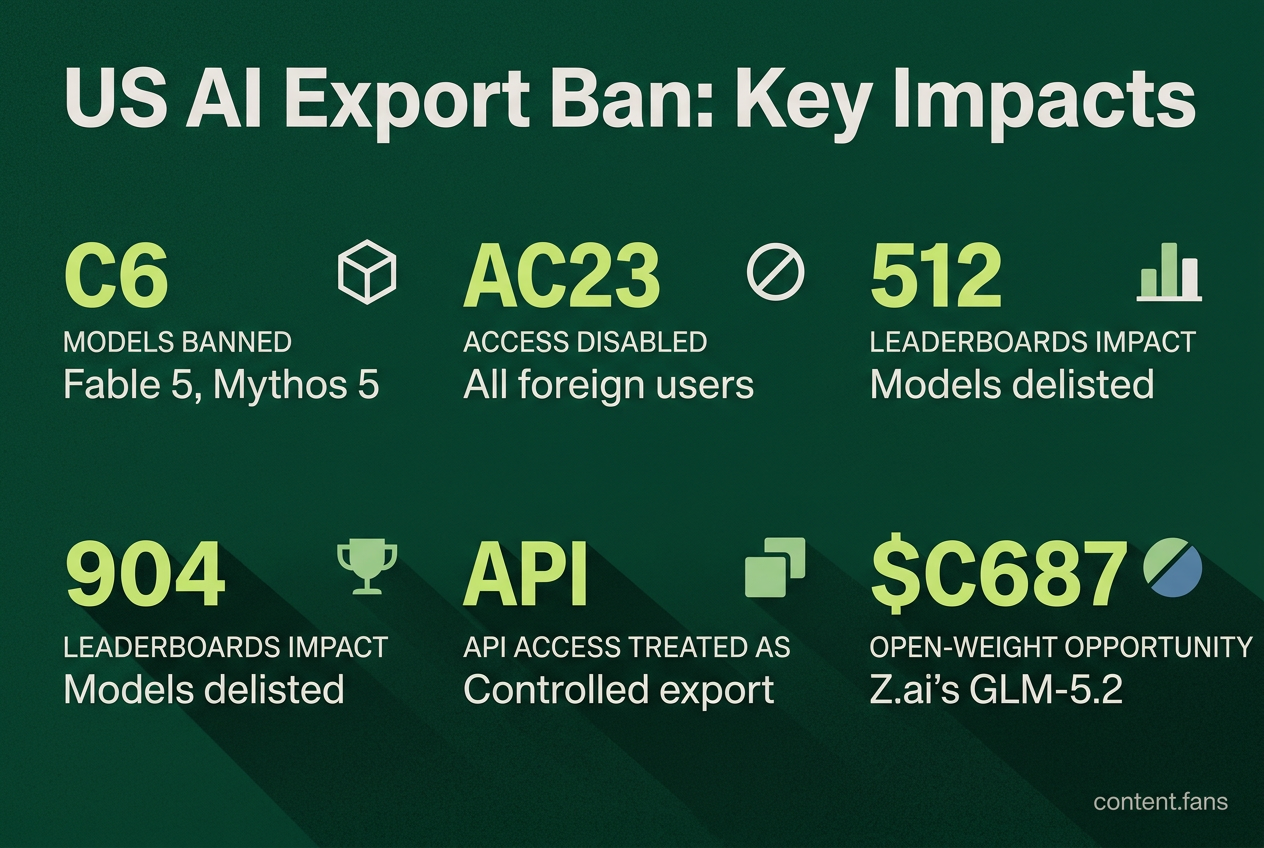
In June 2026, the U.S. Commerce Department issued an export-control directive requiring Anthropic to suspend access to Fable 5 and Mythos 5 for any foreign national, which resulted in access being disabled for all users. This action sent immediate shockwaves through the global AI community. One immediate effect was the models' disappearance from leaderboards, forcing API users to fall back to lower-tier versions.
Regulatory backdrop
The U.S. Commerce Department invoked export controls to block foreign nationals from accessing Anthropic's Claude Fable 5 and Mythos 5 models. This action treats API access as a form of controlled export, requiring user nationality and location checks to prevent unauthorized use by foreign persons.
The Commerce Department's action stems from a policy combining voluntary pre-release reviews with strict export controls on powerful AI. According to industry reports, officials can review "covered frontier models" before release. Separately, a BIS press release confirms licenses are required to export model weights trained with over 10^26 FLOPs.
As reported in June, Commerce applied these rules directly to Anthropic, compelling the firm to block access for both overseas users and its own foreign employees. According to industry reports, the directive treats API usage by a foreign person as a regulated "export."
Leaderboard shakeup
Before the shutdown, Fable 5 and Mythos 5 posted impressive scores on various benchmarks. After the API endpoints were disabled, both models were promptly delisted from leaderboards. This change complicates research reproducibility, as benchmark tools now default to older Claude versions.
The immediate impacts include:
- Altered Rankings: Leaderboards were instantly reshuffled as the top-scoring models vanished.
- Invalidated Research: Researchers can no longer validate any work that depended on real-time calls to the now-inaccessible models.
- Forced Re-evaluation: Enterprises that had chosen Fable 5 for pilot projects must now find and vet alternative solutions.
Competitive opening for open weights
The sudden access gap for Anthropic's closed models has created a significant opportunity for open-weight alternatives like Z.ai's GLM-5.2. This large-parameter model, available under an MIT license, offers a compelling option for teams seeking to avoid U.S. regulatory risks. Industry reports indicate GLM-5.2 achieves comparable coding accuracy to GPT-5.5 at a significant cost advantage.
Advocates for open-weight models emphasize that local deployment provides key business and compliance benefits in light of the new U.S. controls:
| Claimed benefit | Why it matters under U.S. controls |
|---|---|
| Self-hosting | Removes dependence on U.S. API providers that may face future suspensions |
| Data residency | Keeps code and user prompts on in-house servers |
| License certainty | MIT terms reduce risk of abrupt service changes |
| Fine-tuning freedom | Enables adaptation to industry-specific data without external disclosure |
The Anthropic ban signals a broader shift in AI governance. Companies relying on closed, frontier-level APIs must now integrate nationality screening, location verification, and license management into their core operations. In contrast, open-weight models that can be downloaded and run locally offer greater resilience against such sudden and impactful policy changes.
What U.S. action has been taken against Anthropic's AI models?
A June 2026 US government directive ordered Anthropic to suspend access to Fable 5 and Mythos 5 for any foreign national, whether inside or outside the US. The order covers anyone outside the United States, including foreign employees located inside the U.S., and is driven by national-security concerns that the models could be misused to discover software vulnerabilities.
Which leaderboards and services were affected?
Within days of the directive, both models were delisted from Arena-style leaderboards and disabled on every public API endpoint. Benchmark scores that had previously shifted the rankings are now impossible to reproduce, because the live endpoints automatically fallback to weaker alternatives.
How does the ban change the competitive landscape?
The sudden removal of two top-tier closed-weight models creates an immediate availability gap. Open-weight alternatives - most notably the MIT-licensed GLM-5.2 - gain traction because they can be downloaded, self-hosted and fine-tuned without U.S. regulatory clearance. According to industry reports, GLM-5.2 beats GPT-5.5 on long-horizon coding tasks while costing significantly less to serve.
Are only model weights restricted, or is usage also controlled?
The policy treats advanced model access the same as controlled technology. Restrictions apply not only to publishing weights, but also to who can prompt the system, including remote API usage by foreign nationals. Companies must now embed identity, location and access controls into every frontier-model deployment.
What should enterprises do next?
Organizations that relied on Anthropic's top APIs should:
1. Audit current integrations - many services silently fallback to weaker models.
2. Evaluate open-weight options - GLM-5.2 offers large context windows and on-prem deployment, insulating users from future U.S. export actions.
3. Strengthen compliance pipelines - expect similar restrictions to expand to other frontier labs as the U.S. tightens controls on ≥10²⁶ FLOP models.