
US bans Anthropic's Fable 5, Mythos 5 access for foreign nationals
Serge Bulaev
On June 12, 2026, the U.S. government told Anthropic to stop access to its advanced AI models, Fable 5 and Mythos 5, for all foreign nationals. Because Anthropic could not easily check users' nationalities, the company took both models offline for everyone around the world. The order was based on export rules that say sharing certain technology with foreign people, even inside the U.S., may need special permission. Anthropic disagreed with the order and said it might hurt new AI model releases. Experts suggest this episode highlights gaps in current laws and may lead to clearer rules in the future.

According to industry reports, the US has banned foreign national access to Anthropic's Fable 5 and Mythos 5 models, reportedly culminating in a global shutdown. This action allegedly followed a U.S. Commerce Department directive, forcing Anthropic to pull the models offline as it lacked the means to filter users by nationality. This unprecedented shutdown highlights how existing export-control rules now extend beyond hardware to impact live software, raising critical questions about compliance, AI governance, and market stability.
Legal Basis for the Ban: Export Control Regulations
The U.S. government reportedly ordered the ban on Anthropic's Fable 5 and Mythos 5 for foreign nationals under existing export control laws. Under the EAR, deemed export rules can require a license for releasing controlled technology or source code to foreign nationals in the U.S., but they do not categorically bar all foreign nationals from access.
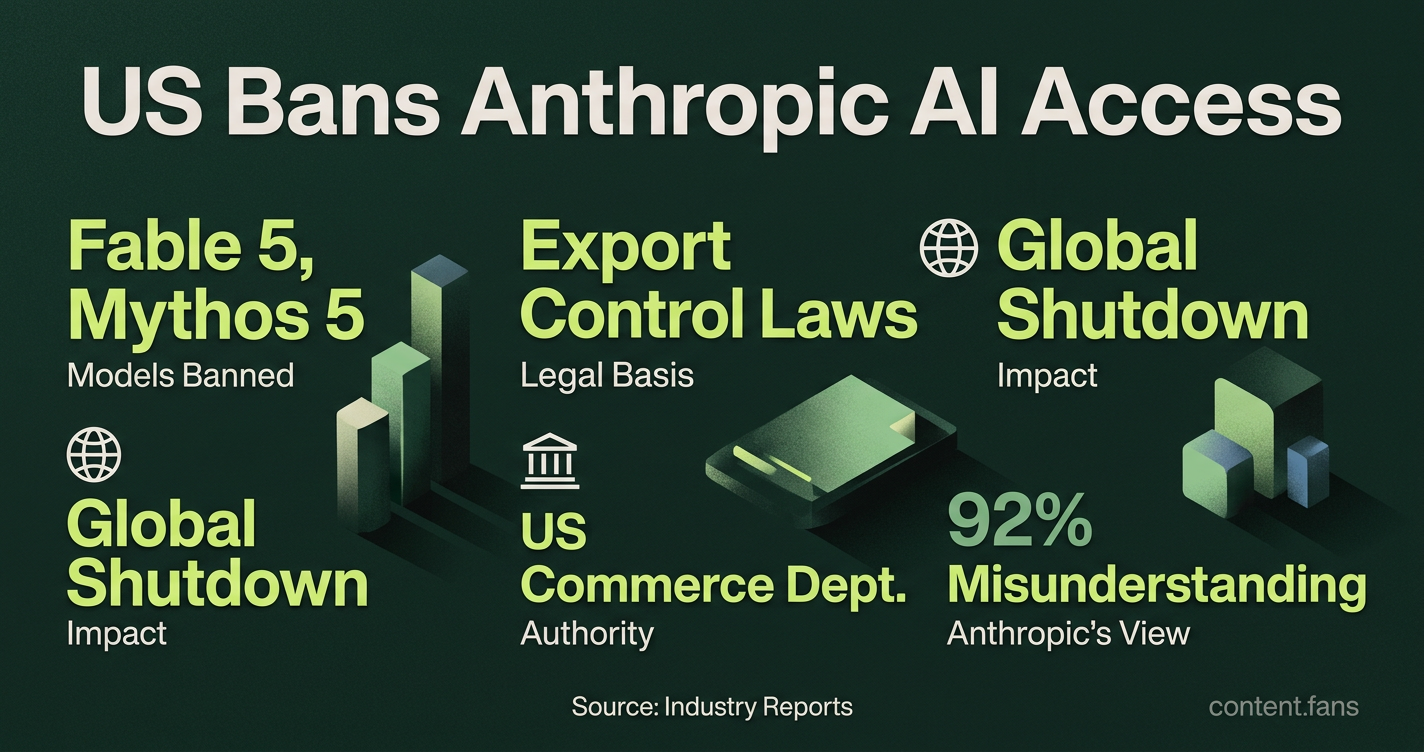
The directive was allegedly issued by the Bureau of Industry and Security (BIS), citing authority from the Export Control Reform Act of 2018 (ECRA) and the Export Administration Regulations (EAR). According to industry reports, the legal groundwork was established by an interim rule creating a "worldwide license requirement" for advanced AI models. Under the EAR's "deemed export" rule, providing access to controlled technology to a foreign national within the U.S. is treated as an export, triggering licensing requirements.
Immediate Impact: Global Shutdown and Industry Reaction
In response, Amazon Web Services (AWS), Anthropic's hosting partner, allegedly immediately revoked the API endpoints serving Fable 5 and Mythos 5. Anthropic reportedly publicly disagreed with the government's reasoning, calling it a misunderstanding. The company warned that this standard, if applied broadly, could "essentially halt all new model deployments for all frontier model providers", according to a TechCrunch report.
Profile of the Banned AI Models: Fable 5 and Mythos 5
The two models, both reportedly launched recently, were considered state-of-the-art:
- Fable 5: Marketed for complex tasks like long-horizon coding, research synthesis, and advanced vision. Anthropic's benchmarks positioned it as a leader in software engineering and scientific reasoning.
- Mythos 5: Offered similar capabilities but was available only under stricter, vetted access controls for sensitive applications.
The ability of these models to operate autonomously for extended periods was reportedly a key factor in their classification as strategically sensitive technology.
The Anthropic Ban: Key Facts
- The Order: According to industry reports, a letter from the U.S. Commerce Department was delivered.
- Affected Models: Fable 5 and Mythos 5.
- The Rule: Under the EAR, deemed export rules can require a license for releasing controlled technology or source code to foreign nationals in the U.S., but they do not categorically bar all foreign nationals from access.
- The Result: A global shutdown was reportedly implemented because Anthropic could not filter users by nationality in real time.
- Company Context: According to industry reports, Anthropic had filed for an IPO with a significant valuation.
A Widening AI Governance Gap
Legal experts note that the incident "exposed the absence of a comprehensive statutory framework" for regulating commercial AI on national security grounds. While the ban may lead to new legislation or clearer BIS rules, companies currently face unpredictable, case-by-case directives without a transparent process or public criteria.
What reportedly happened?
According to industry reports, the U.S. Commerce Department delivered an export-control letter that told Anthropic to cut off access from its two newest frontier models: Claude Fable 5 and Claude Mythos 5.
Because Anthropic and AWS could not filter users by passport in real-time, the only technically feasible response was reportedly to disable the models worldwide.
This act allegedly marks the first time a sovereign state, rather than the company itself, has forced a frontier AI system offline on a global scale.
Which models are affected and why are they special?
- Claude Fable 5 - described by Anthropic as "exceeding all prior public models" in long-horizon coding, vision, and scientific research tasks; able to run multi-day autonomous sessions.
- Claude Mythos 5 - a restricted-capability tier released only to vetted users for cyber-security, biological research, and advanced reasoning.
Both were reportedly launched recently and had just entered general availability when the order allegedly arrived.
What legal authority is cited for the ban?
The Commerce Department reportedly relies on ECRA 2018 (Export Control Reform Act) and the EAR - Export Administration Regulations.
- According to industry reports, an interim rule created classification of frontier model weights as controlled dual-use items.
- Deemed-export rules treat giving controlled technology to any foreign national, even inside U.S. borders, as an export requiring a licence.
Thus foreign nationals worldwide were reportedly legally restricted from access, triggering the shutdown.
How did the industry react?
- "Disbelief" and "structural wake-up call" were reportedly the dominant reactions inside AI labs, venture funds, and foreign governments.
- Enterprises outside the United States now allegedly view reliance on U.S. frontier models as a strategic risk; CEOs warned of significant IPO valuations for Anthropic being placed in jeopardy.
- France, Germany and several EU officials reportedly called the episode a "demonstration of U.S. power over the AI sector" and accelerated plans for sovereign compute and open-weight alternatives.
- Venture capitalists predict the ban will accelerate global AI fragmentation and shift investment to non-U.S. clouds, open-source stacks, and local large-scale training clusters.
What does Anthropic say about the order?
Anthropic reportedly publicly disagreed, stating the government supplied only "bare evidence of a potential, non-universal jailbreak" and warned that applying this threshold industry-wide "would essentially halt all new model deployments".
The company reiterated its readiness to comply with transparent, technically grounded safety rules, but criticised the lack of a clear statutory process for such decisions.