
Supreme Court Ruling Changes Pharma Patent Enforcement in 2026
Serge Bulaev
The Supreme Court's 2026 ruling in Hikma v. Amarin says that generic drug makers who remove patented uses from their labels cannot be sued for encouraging patent infringement unless they clearly promote the protected use. The FDA's approval process for generics is not changing, but brand and generic companies may need to change how they write and market drug labels. The ruling means that simply following FDA rules, staying silent on patented uses, or guessing about how doctors might prescribe does not count as promoting infringement. Experts suggest this may lower legal risk for generics and could lead to earlier generic drug launches, but actual savings or price changes depend on how many companies use this option. The FDA has not announced any new rules, and brand companies now focus more on specific marketing actions in lawsuits.

The Supreme Court ruling changes pharma patent enforcement in the landmark 2026 Hikma v. Amarin case, establishing a higher bar for brand-name drug companies to sue generic competitors for patent infringement. In a unanimous decision, the Court clarified that generic manufacturers using "skinny labels" - which omit patented uses - cannot be held liable for induced infringement without evidence of clear, affirmative actions promoting the patented use, as detailed in the official Supreme Court opinion. This decision significantly alters the litigation landscape, though the FDA's drug approval process remains unchanged.
A Higher Standard for Induced Infringement Claims
The Court's decision sets a new, more stringent standard for what constitutes induced infringement. Brand manufacturers must now prove that a generic company took specific, affirmative, and clear steps to encourage physicians or patients to use their product for a patented indication. Previously, lawsuits often relied on the existence of a skinny label itself as indirect evidence of inducement.
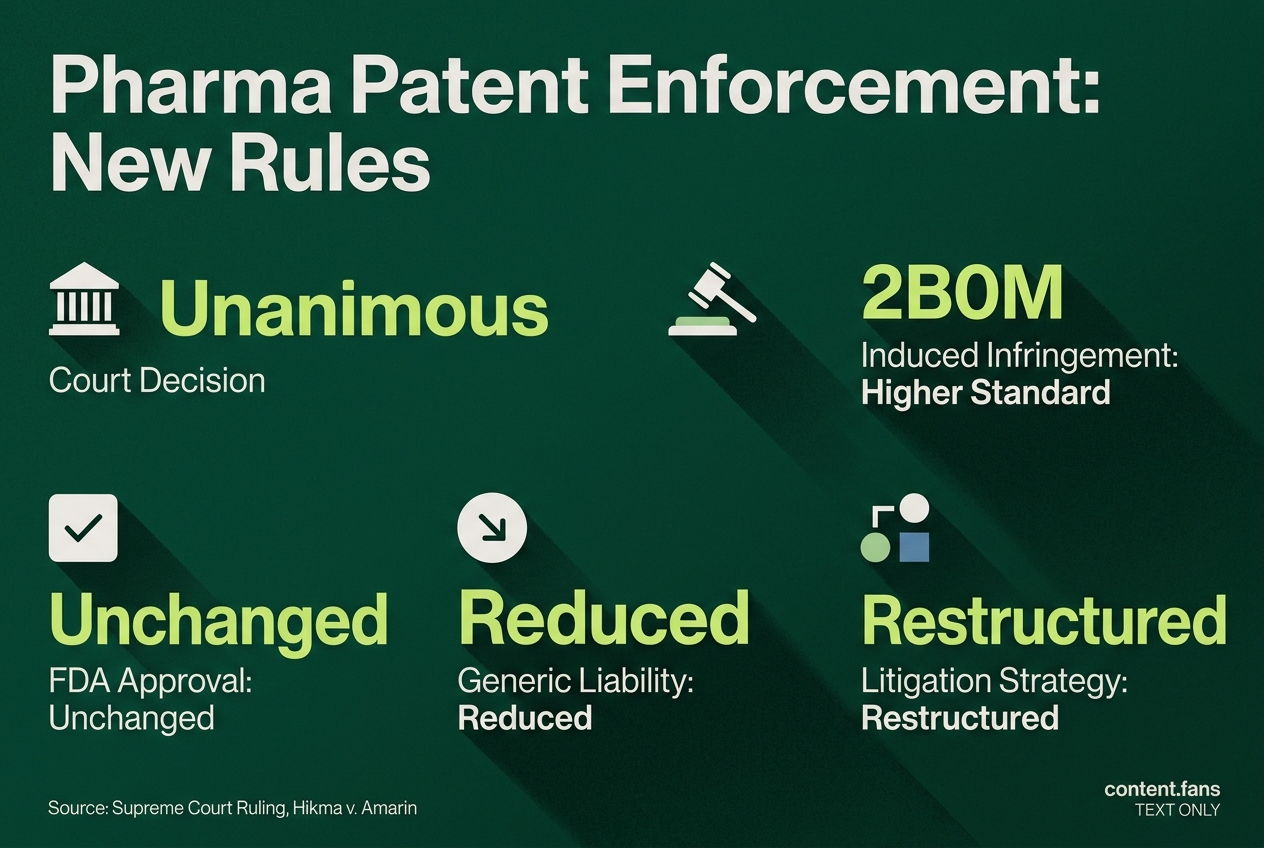
The ruling requires brand-name drug companies to prove a generic competitor took clear, affirmative steps to actively encourage doctors to prescribe a drug for a patented use. Merely using an FDA-approved "skinny label" that omits the patented use is no longer enough to support a lawsuit for induced infringement.
The Court explicitly outlined three categories of conduct that are now legally insufficient to support an inducement claim:
1. Routine statements made to comply with FDA rules, such as calling a product a "generic equivalent."
2. Silence or omission of the patented indication on the skinny label.
3. General speculation about the likelihood of physicians prescribing a drug off-label.
This higher pleading burden strengthens the "section viii carve-out" pathway, which allows generics to launch while omitting patented methods of use from their labels, as noted in expert legal commentary WilmerHale analysis.
FDA's Role and Labeling Rules Remain Unchanged
Despite the significant legal shift, the Food and Drug Administration's (FDA) approval pathway for generics is not affected. Agency officials reportedly view the decision as a litigation matter rather than a regulatory one, as approval standards for Abbreviated New Drug Applications (ANDAs) are unchanged. The ruling reinforces that a generic company's compliance with the FDA's "duty of sameness" is not, by itself, evidence of infringement.
New Litigation Playbook for Pharmaceutical Companies
In response to the Hikma ruling, brand-name pharmaceutical companies are fundamentally restructuring their litigation strategies. The focus has shifted from a generic's label omissions to gathering concrete evidence of intentional promotion.
| Pre-Decision Approach | Post-Hikma Strategy |
|---|---|
| Filed claims based on label omissions | Must allege specific, affirmative conduct |
| Relied on label gaps as evidence | Conduct pre-litigation audits of competitor marketing |
| Sought broad injunctions based on labels | Focus on method-of-use patents with active promotion |
Complaints filed after the decision now routinely include evidence like targeted sales materials, speaker program scripts, or screenshots from training documents to meet the "affirmative step" requirement. This forces brand plaintiffs to prove "purposeful encouragement" of the patented use Supreme Court Reverses Federal Circuit.
Impact on Generic Drug Pricing and Market Access
The clarified legal standard is expected to reduce litigation risk for generic manufacturers, potentially accelerating the launch of lower-cost alternatives. Industry advocates, including Hatch-Waxman Act co-author Henry Waxman, predict the ruling will encourage more generic competition. Wider use of skinny labels could preserve significant annual savings historically attributed to generic substitution. According to some analyses, a ruling against Hikma could have reduced the number of generic manufacturers and increased costs for programs like Medicare and Medicaid Reuters.
What Conduct Can Still Create Infringement Liability?
While the ruling provides significant protection for generics using skinny labels, the path for brand enforcement is not entirely closed. Generic manufacturers can still be held liable for induced infringement if they engage in conduct that explicitly or implicitly encourages a patented use. This includes:
- Distributing marketing materials that highlight the benefits of a patented use.
- Training sales teams to purposefully steer prescribers toward carved-out indications.
- Taking any other "clear and affirmative" action that promotes the infringing use.
Method-of-use patents remain fully enforceable, but the burden now falls squarely on the brand company to prove the generic competitor crossed the line from passive labeling to active promotion Supreme Court Reverses Federal Circuit.