
US adopts new AI strategy, controls chips, models, and rules
Serge Bulaev
The U.S. has released a new AI strategy that treats the entire AI technology stack - chips, models, and rules - as important assets to protect and control.

The US AI strategy, outlined in the 2025 America's AI Action Plan, presents a U.S. strategy to strengthen AI innovation, infrastructure, and international leadership, while using export controls and standards to support U.S. AI dominance. This policy, a core organizing principle for federal agencies, calls for new semiconductor controls and allied alignment via the Foreign Direct Product Rule (Policy Backgrounder).
By managing chips, model weights, and governance standards as interconnected points of leverage, Washington is actively shaping the global landscape, determining who can build frontier AI systems and under what conditions.
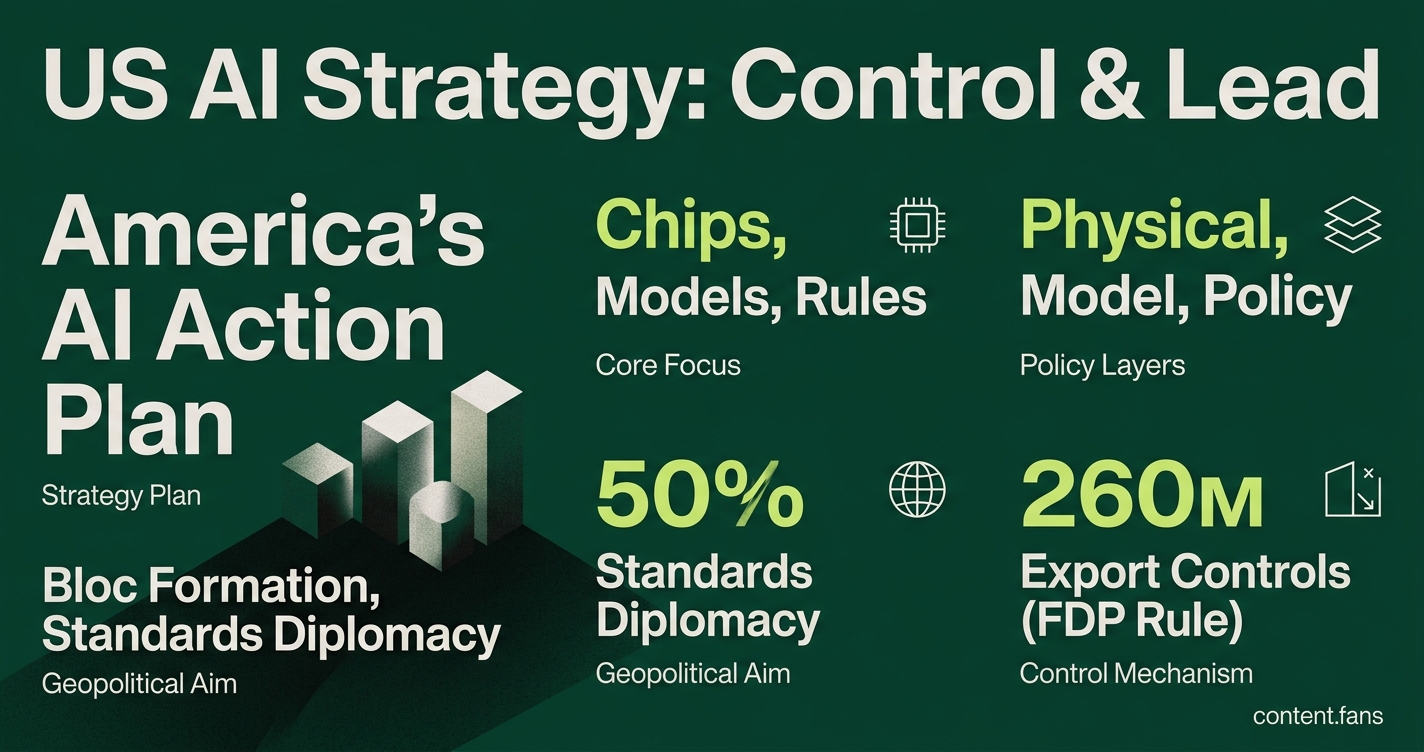
A layered approach to AI leadership
The plan promotes U.S. AI exports and includes export-control enforcement for advanced AI compute, focusing on maintaining American technological advantages through coordinated policy measures.
- Physical Layer: The plan prioritizes building U.S. AI infrastructure, encouraging compute access, and enforcing export controls on advanced AI compute to maintain competitive advantages in semiconductor technology and advanced GPUs.
- Model Layer: The plan references CAISI in AI evaluation and coordination, though specific details about pre-release review processes remain limited in public documentation.
- Policy Layer: The strategy pairs domestic deregulation with tighter external controls. A commentary on the plan outlines three pillars - accelerating innovation, expanding infrastructure, and leading international diplomacy - to deploy AI rapidly at home while maintaining export-control leverage (America's AI Action Plan PDF).
Geopolitical implications
- Bloc Formation: The plan promotes U.S. AI leadership through domestic infrastructure, American AI standards, and tighter export controls, which may encourage alignment among U.S. allies.
- Standards Diplomacy: The strategy aims to establish U.S. leadership in international AI governance forums, though specific details about forum participation remain general in scope.
- Export Incentives: The plan emphasizes exporting secure full-stack American AI technology packages to allies as part of broader diplomatic and economic objectives.
Industry pushback and enforcement limits
However, the strategy faces industry resistance and questions about its effectiveness. Industry reports suggest chip export controls have faced criticism from major technology companies, with concerns about revenue impacts and effectiveness in slowing competitor development. Research indicates that export controls face challenges as competitors adapt with memory optimizations and synthetic data approaches.
Despite this, hawkish analysts at the Hudson Institute argue that denying access to superior American chips remains 'critical' for slowing foreign military AI adoption. This fundamental disagreement highlights the uncertainty over how long hardware chokepoints can remain effective.
Observed outcomes include:
- Slower, but not halted, frontier model training for embargoed labs.
- An increased focus overseas on hardware-efficient algorithms and open-weight models.
- More fragmented global AI markets as nations explore sovereign cloud and chip development.
Washington's stack-wide strategy is a complex interplay of commercial interests, diplomatic pressures, and rapid technical adaptation, where each layer - equipment, models, and rules - continuously influences the others.
What exactly does the new US strategy aim to control across the AI stack?
The 2025 America's AI Action Plan supports exporting a secure full-stack American AI technology package to allies and emphasizes U.S. leadership. The strategy focuses on multiple areas:
- Physical layer - advanced semiconductor technology and manufacturing capabilities
- Model layer - coordination and evaluation of frontier AI systems through government agencies
- Rules layer - federal coordination of AI regulations and standards to ensure consistent national approaches
View the full text of the plan.
How are chip-making tools and model weights being restricted in practice?
Semiconductor controls: Updated rules extend licensing requirements to advanced semiconductor systems beyond finished GPUs, targeting memory, advanced packaging and related components.
Model access: Government agencies work with major AI laboratories on coordination and evaluation processes, though specific details about access requirements vary by arrangement.
For example, industry reports suggest some AI companies have faced contract changes related to government oversight requirements, though specific details remain limited in public reporting.
Are export controls slowing rival nations' AI progress?
Industry assessments show mixed effects:
- Marginal slowdown: Some reports suggest frontier training runs in certain regions face longer development timelines due to hardware restrictions.
- Efficiency gains: Labs such as DeepSeek released open-weight models with substantial efficiency improvements; DeepSeek V4 is described as using roughly 27% of the compute cost of V3 while maintaining comparable or better benchmark performance, and DeepSeek V3.2-Exp uses sparse attention for significant long-context efficiency gains.
- Adaptation: Industry reports suggest continued access to high-end computing resources through various channels despite export restrictions.
What do industry leaders say about the policy?
Industry criticism has been notable:
- Technology executives have expressed concerns about the effectiveness of export controls
- Revenue impact: Major chip companies have reported significant revenue impacts from China market restrictions
- Policy preference: Some industry leaders argue the US should focus on guaranteeing American firms preferential access to allied markets rather than implementing broad restrictions.
Could the strategy backfire by encouraging rival chip ecosystems?
Industry analysis suggests several potential risks:
1. Fragmented markets: US-aligned and competitor-centric technology stacks may split global markets, potentially raising infrastructure costs due to duplicated supply chains.
2. Acceleration of domestic development: Competitor nations have accelerated domestic semiconductor development programs and secured additional state support following new US restrictions.
3. Standards competition: US efforts to establish "trusted AI stack" recognition in international forums face challenges, with significant portions of the global market potentially remaining open to alternative standards.
Industry reports provide ongoing analysis of these technology diffusion dynamics and their implications for global AI development.