
Unilever scales influencer program to 300,000 creators with AI
Serge Bulaev
Unilever has expanded its influencer program to around 300,000 creators by using AI to help manage and automate much of the work. The company says AI speeds up finding, checking, and handling creators, but humans still make the final creative decisions and maintain personal relationships. Early results suggest AI may increase watch time and engagement on campaigns. Some challenges, like keeping the brand clear and measuring results across many markets, remain. It is not yet clear if having so many creators will help Unilever in the long run or make its message less strong.
Unilever is scaling its influencer program to 300,000 creators, using artificial intelligence to automate key workflows and maintain brand safety while preserving human-led creative relationships. The consumer goods group expanded its roster from 10,000 to 300,000 creators since 2023, leaning on AI to power the operation's global scale. The company's "Desire at Scale" framework treats creators as community-embedded co-authors rather than media channels, yet still targets efficiency through automation.
AI Shoulders the Volume
Unilever deploys AI agents for rapid creator discovery and vetting. According to a Digiday report, this technology generates brand-safe creator lists in minutes - a task that previously took days - by automatically monitoring for past controversies before briefs are issued.
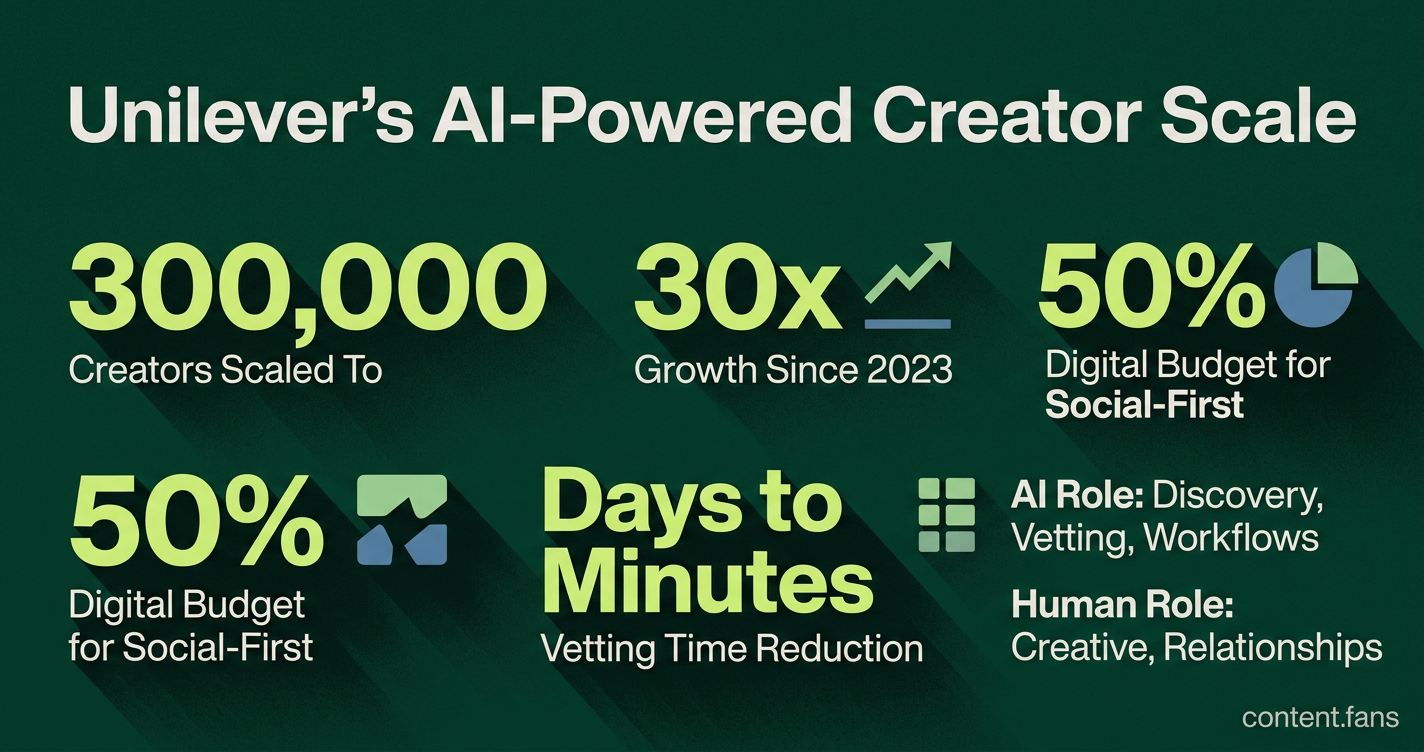
Unilever uses AI to automate high-volume operational tasks like creator discovery, vetting for brand safety, and managing workflows for briefs and contracts. This frees up human teams to focus on strategy and relationship building, while AI-powered optimization tools also help improve campaign performance and engagement metrics.
Workflow automation streamlines operations by moving briefs, contracts, and performance data through standardized pipelines, freeing marketers to focus on high-level strategy. Unilever committed 50% of its digital budget (not total global ad budget) to social-first, creator-driven content. Early results indicate this AI-driven approach shows significant improvements in campaign performance metrics.
Humans Guard the Creative Core
Crucially, creative judgment and relationship management remain human-led. Brand teams conduct a final "vibe check" on all creator shortlists and handle negotiations personally. Leadership states this prevents the "unimaginative" content that can result from over-automation. Dove, for example, continues to forbid AI-generated imagery in its Real Beauty work.
To ensure local relevance that algorithms cannot replicate, field marketers maintain direct contact with micro-influencers in markets like India, Brazil, and Nigeria. This hybrid AI-human model demonstrates how large advertisers can balance global consistency with local authenticity.
Operational Challenges at 300,000
Despite automation, managing a network of this size introduces significant operational challenges:
- Brand Dilution: Simultaneous campaigns from thousands of creators risk blurring brand identity and creating a "signal-to-noise" problem for consumers.
- ROI Measurement: Translating social media buzz into concrete sales data across dozens of international markets remains a complex and ongoing challenge.
- Legal & Financial Scalability: Templating standard contracts is necessary to handle mass payouts and usage rights while retaining the flexibility needed for different regions.
Why the Pivot Matters
Unilever leadership views creator content as "earned attention," arguing that brand stories shared organically within communities translate cultural credibility directly into sales. If the company successfully shifts half its digital spend to this channel, it could become the first multinational to run a majority social-led media strategy at a global scale.
While industry analysts observe competitors adopting similar AI-human hybrid models, Unilever's 300,000-strong creator network is the largest verified program to date. The key question remains whether this massive scale will build long-term brand equity or ultimately dilute the company's messaging.
How big is Unilever's creator network now?
Unilever has expanded its creator program 30-fold, growing from 10,000 to 300,000 creators. This massive scale-up supports the company's "Desire at Scale" strategy. The 'Desire at Scale' strategy aims to shift 50% of Unilever's digital budget to a social-first, creator-led model. The program targets hyper-local saturation - for example, deploying a micro-influencer in every postal code in India.
What specific tasks does AI handle in Unilever's creator program?
AI automates operational and vetting workflows while humans retain creative control. According to Digiday's analysis, Unilever uses AI for:
| AI Function | Purpose |
|---|---|
| Creator Vetting | Generates brand-safe creator lists in minutes and flags past controversies |
| Workflow Automation | Handles briefings, document standardization, data collection, and approvals |
| Content Optimization | Powers AI-assisted content that drives improved performance metrics |
| Brand Safety | Catches controversies and ensures compliance |
Notably, creative decisions and relationship management remain strictly human-controlled - Unilever explicitly avoids using generative AI for creative direction, with brands like Dove maintaining a no-AI-imagery rule.
Why does Unilever keep humans in control of creative decisions?
The company recognizes that over-automation risks producing "unimaginative" content and discouraging creator innovation. Strict creative briefs can lead to content getting flagged or requiring reshoots. By preserving human-led creative relationships, Unilever maintains brand-specific creative judgement and the personal relationships that drive authentic creator partnerships. This balance treats creators as co-authors of brands, not just distribution channels, embedding them in communities where trust and real conversations happen.
What operational challenges come with managing 300,000 creators?
Unilever faces several scale-related headaches:
- Signal-to-Noise Problem: With 300,000 creators producing content simultaneously, brand incoherence is a major risk - individual pieces may perform well but dilute overarching brand identity
- Innovation vs. Efficiency: Finding the right balance between streamlining operations and allowing creative freedom
- Measurement Complexity: Linking creator activity to sales and ROI rather than just "buzz"
- Infrastructure Gaps: Requiring a unified, AI-native infrastructure to manage creative quality at massive scale
- Contract Standardization: Demanding standardized contract structures and robust measurement systems
As noted in industry analysis, without proper infrastructure, the entire pivot to creator-led marketing fails.
How does this hybrid approach compare to broader industry best practices?
Unilever's model aligns with proven hybrid frameworks across the industry. According to industry reports, brands combining AI-driven efficiency with human-led relationship management achieve significant improvements in campaign performance and engagement metrics.
The most effective strategy follows an "AI for scale, humans for soul" approach: AI removes operational friction (vetting, tagging, budgeting) while humans retain the creative and strategic core. Dunkin' achieved a 57% increase in app downloads due to the Charli D'Amelio partnership and 'The Charli' drink launch, demonstrating the power of strategic creator partnerships. Other major brands have similarly found success with this balanced approach to creator marketing.