
LexisNexis Reports Misinformation as Top AI Risk for Consultants
Serge Bulaev
A recent LexisNexis report suggests that about half of consultants see misinformation as the biggest risk when using AI. Consultants may spend extra time checking AI results, since mistakes can happen in different ways, like factual errors, outdated data, model misuse, or bias. Firms often use a mix of automated tools and human checks to catch and fix these problems, but no single solution works for everything. The report notes that most clients manually verify AI outputs and expect clear plans for fixing mistakes. It also appears that many consultants use unapproved AI tools, so strong rules and regular checks are needed to lower risks and learn from errors.

A new LexisNexis report highlights misinformation as the top AI risk for consultants, with a significant portion ranking it as their primary concern. As consulting teams deploy generative AI, these hazards lead clients to spend extra time and resources validating AI-generated outputs to avoid costly errors.
Map the four primary misinformation vectors
Consulting firms manage AI misinformation by implementing a structured framework. This involves classifying risk into four types: factual errors, outdated data, model misuse, and bias. Each type triggers a specific validation process, blending automated detection tools with multi-layered human review to ensure accuracy and accountability.
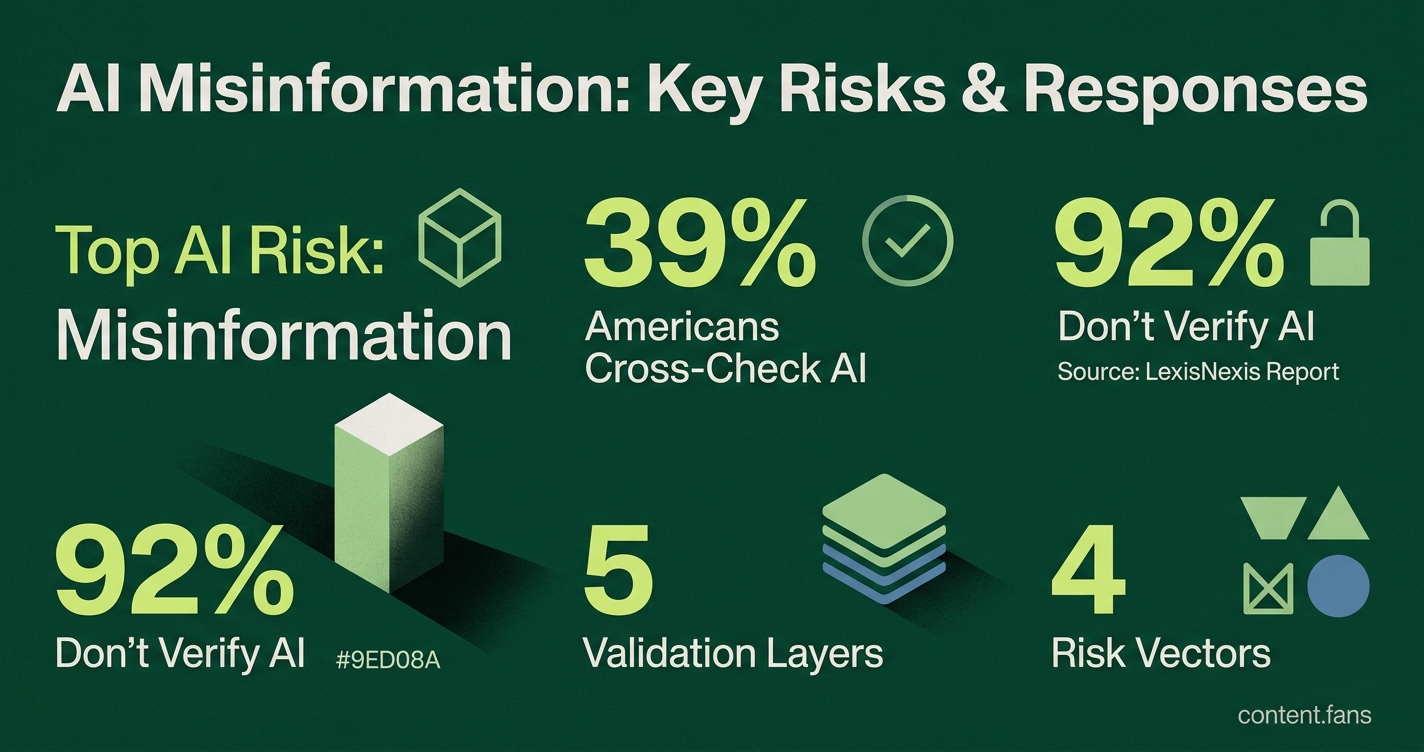
Risk teams classify questionable content into four primary vectors: factual errors, outdated data, model misuse, and bias. This categorization is crucial, as each vector requires a distinct validation path and response timeline to effectively mitigate harm.
Layer automated detection with human checkpoints
Since no single tool can catch every error, firms deploy a layered security stack combining internal and external solutions. Internally, tools like Perceptis AI and Perplexity ground outputs in approved sources and cited research. Externally, platforms like Meltwater and Blackbird.AI monitor for media shifts, deepfakes, and bots. This combined approach eliminates single points of failure.
Human-in-the-loop (HITL) research points to a five-layer validation process: 1) automated checks for formatting and keywords, 2) LLM-as-a-judge scoring, 3) expert review for high-risk content, 4) continuous human-on-the-loop (HOTL) auditing, and 5) a closed feedback loop for model fine-tuning. To comply with regulations like the EU AI Act, every intervention requires a timestamp and attribution.
Severity scoring ties to response speed
When an error is detected, teams use a severity rubric to connect the risk level to a required response time. A potential error in a regulatory filing demands faster action than a typo in an internal memo. With 39% of Americans cross-checking AI-generated information with Google or other sources while 92% of people do not verify AI answers, transparent and rapid remediation is non-negotiable.
A concise severity matrix may include:
- Critical: Potential legal or financial impact - fix inside 4 hours with executive review
- High: Client-visible factual mistake - fix inside 24 hours with partner sign-off
- Medium: Internal analysis inconsistency - fix inside 48 hours after analyst review
- Low: Stylistic or cosmetic issue - queue for next scheduled update
Communication and root-cause analysis
If misinformation reaches a client, the response framework provides pre-approved templates for transparent communication about the issue, its resolution, and preventive actions. A root-cause analysis follows to determine if the error stemmed from hallucination, data drift, or a process failure. Since many firms are unprepared for an AI governance audit, these detailed logs serve as critical evidence of due diligence.
Governance roles and shadow AI risks
The report identifies "shadow AI" as a major vulnerability, with a significant portion of consultants using unapproved tools. To counter this, strong governance structures must separate duties: a central office sets policy, practice leads select tools, and engagement managers approve deliverables. Continuous monitoring is essential to flag and validate content from unsanctioned tools, reducing exposure.
Building a resilient feedback loop
Every corrected error improves a dynamic knowledge base that links error types to better prompts and trusted data. This allows human reviewers to focus on complex edge cases rather than repetitive checks. Such a targeted feedback loop systematically reduces manual validation costs while maintaining low error rates.
This framework doesn't eliminate AI risk entirely but establishes a repeatable process to detect, contain, and learn from misinformation. It empowers consultants to leverage AI with greater, and more defensible, confidence.
What makes AI misinformation the top risk for consultants?
According to the LexisNexis Future of Work 2026 Management Consulting Industry Report, a significant portion of management consultants cite misinformation as their primary AI-related concern. This stems from "hallucinations" - confident but inaccurate outputs that can influence high-stakes client decisions. The risk is amplified by a "Validation Crisis": 39% of Americans cross-check AI-generated information with Google or other sources while 92% of people do not verify AI answers, because unverified data introduces noise that standard chatbots present as definitive fact, per Dow Jones analysis.
How do consulting firms classify different types of misinformation risks?
The framework identifies four critical vectors requiring distinct detection approaches:
| Vector | Description | Detection Priority |
|---|---|---|
| Factual errors | Incorrect data, statistics, or claims | High - cross-reference against primary sources |
| Outdated data | Superseded information presented as current | High - timestamp verification and source freshness scoring |
| Model misuse | Applying AI tools to inappropriate contexts | Medium - use-case classification protocols |
| Bias | Systematic skew in recommendations or analysis | Medium - demographic and outcome disparity testing |
What detection technologies should consulting firms deploy?
The 2026 industry standard is a layered workflow stack rather than any single tool. For external monitoring, platforms like Meltwater track narrative shifts across billions of data points, while Blackbird.AI identifies actors and networks driving disinformation campaigns. For internal deliverables, Perceptis AI grounds every claim in your own sources and generates structured arguments, directly mitigating hallucination risks. Perplexity provides cited live research with direct source links, reducing unverified data exposure.
Critically, standard chatbots often have low citation rates, whereas grounded, vetted data sources can maintain significantly higher citation rates - a gap that directly impacts reputational risk.
How does human-in-the-loop validation work in practice?
Consulting firms should implement a five-layer oversight stack:
- Automated checks - fast filters for formatting, policy keywords, citation presence
- LLM-as-a-Judge - scalable rubric scoring to flag low-confidence outputs
- HITL Review - subject matter experts approve high-risk outputs when uncertainty is high, sources are missing, or legal/financial risk exists
- HOTL Monitoring - continuous audits and drift monitoring with rollback protocols
- Feedback Loop - convert corrected outputs into training data via active learning
Reviewers must possess both domain expertise and AI literacy, with authority to override AI recommendations and operate within clear accountability structures. For consulting outputs that must be defensible in audit, human validation is mandatory when error downside is high.
What governance gaps are most dangerous right now?
Shadow AI presents the most immediate exposure: a significant portion of consultants use AI tools without approval, and many use personal tools for client work. This creates governance gaps where misinformation enters deliverables without oversight. Compounding this, many firms lack confidence in passing an AI governance audit within 90 days, and a significant portion of Corporate Affairs teams are unprepared for AI misinformation incidents.
The recommended response combines technical controls (approved tool provisioning, validation checkpoints) with organizational measures (clear escalation procedures, root-cause analysis requirements, and communication templates for notifying affected stakeholders when misinformation is discovered).