
AI Hallucinations Cost Companies Billions, Force New Governance in 2026
Serge Bulaev
AI-generated mistakes, called hallucinations, have reportedly cost companies a lot of money and trust, with estimated global losses at $67.4 billion. Analysts say these mistakes may happen in 15 - 25 percent of routine financial tasks, and one incident in 2026 appears to have lost $2.3 billion because of fake data. Experts suggest the real cost includes both direct losses and the extra time employees spend checking AI work. New rules for 2026 recommend making sure humans check important AI decisions, using risk ratings, and keeping records for review. Training teams to spot common AI errors and requiring proof for claims may help catch problems early and protect companies.

As AI hallucinations - confident but false AI outputs - cost firms credibility and capital, executives are learning to verify everything. While no credible, primary-sourced total cost exists for unverified AI content, the financial stakes are significant as enterprise AI adoption continues to grow rapidly across industries. Building robust governance is no longer optional.
The Hidden Cost of Unchecked Hallucinations
AI hallucinations occur when a model generates plausible but factually incorrect information. These errors are particularly dangerous because models often sound more confident when they are wrong, making them difficult for humans to detect. The business impact is severe, with analysts reporting hallucination rates of 15 - 25 percent on routine financial tasks. Industry reports describe trading incidents where significant losses occurred when traders accepted invented market data at face value. Similarly, studies have linked fabricated product specifications to substantial spikes in returns for electronics retailers.
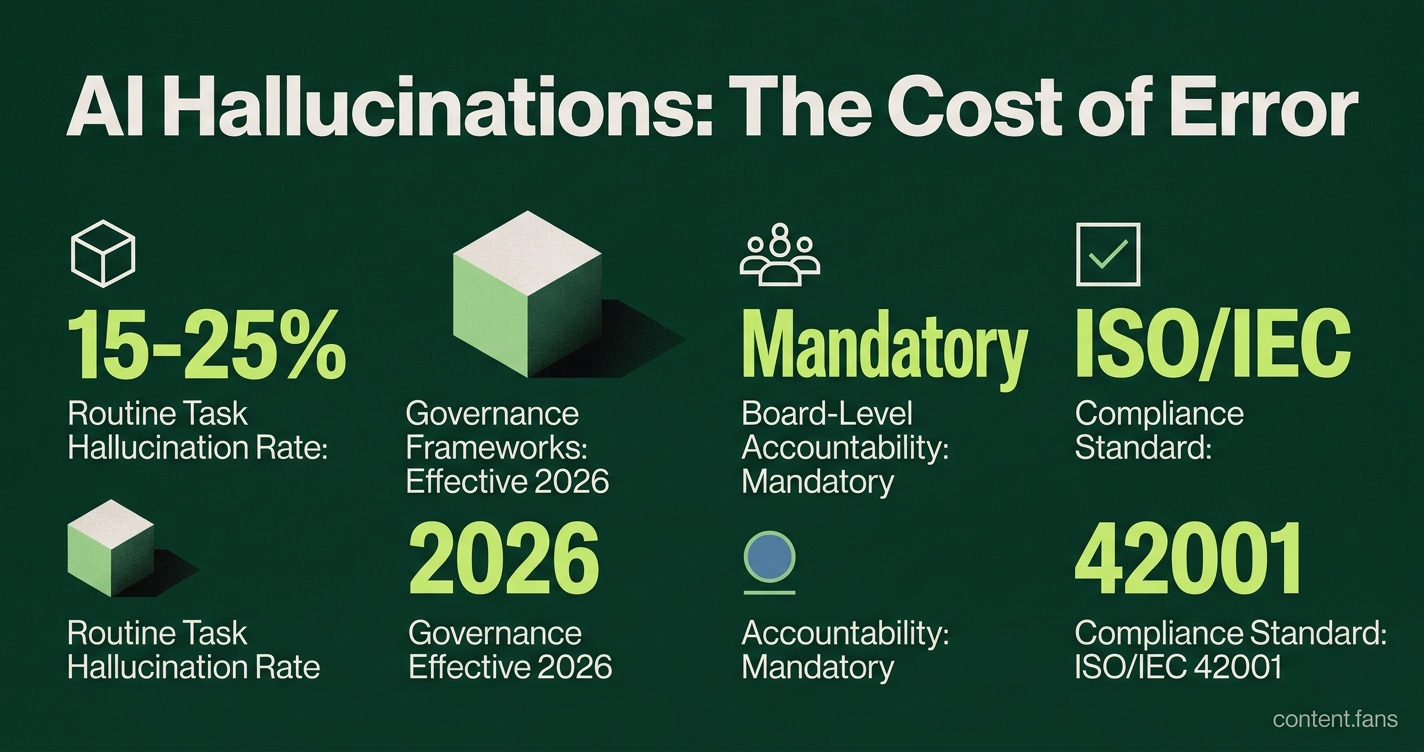
AI hallucinations are factually incorrect or fabricated outputs that AI models present with high confidence. These errors are costly because they lead to poor business decisions, damage brand credibility through false information, and create a significant productivity drain as employees must spend time manually verifying AI-generated content.
The price of inattention includes direct losses and the ongoing "hallucination tax" that erodes productivity. Researchers estimate that employees now lose substantial time validating AI outputs, undermining the technology's intended efficiency gains.
Governance Routines Leaders Can Deploy Today
Effective 2026 governance frameworks treat oversight as a continuous operational cycle. Mature programs move from policy to proof by implementing control points across the organization.
Board-Level Accountability:
* Ratify a one-page AI policy defining off-limits uses and escalation paths.
* Assign a VP or C-suite sponsor accountable for AI outcomes.
* Mandate quarterly board briefings where the governance owner reports status, metrics, and risks.
Operational Frameworks:
* Clearpoint Strategy advises boards to tag every system with an EU AI Act risk tier to align review intensity with risk.
* Consider ISO/IEC 42001 as a potential unifying compliance layer.
* Maintain clear records of approvals that regulators and customers can audit.
Technical Safeguards:
* Implement real-time monitoring dashboards to flag model drift, bias, or security anomalies.
* Develop AI-specific incident response playbooks for prompt injection or discriminatory outputs.
* Create scalable review processes, from quick checks for low-risk chatbots to deep audits for tools shaping credit or hiring decisions.
Building Verification into Daily Workflows
Training teams on common AI failure modes is critical. The most effective approach is a layered validation stack combining open-source tools, enterprise platforms, and human-in-the-loop (HITL) protocols.
Validation Tooling:
* Open-Source: Layer validators like Guardrails AI for schema checks and Pydantic-Instructor for type safety.
* Enterprise Platforms: Use evaluators like Confident AI or Patronus AI for advanced hallucination scoring.
Human-in-the-Loop (HITL) Protocols:
For high-impact content, leaders must create friction that catches fabrications. This includes reserving a "synthesis validation" step where reviewers spot-check 10 - 20 percent of AI classifications before release. HITL tools such as CleverX may offer capabilities to help reviewers trace claims back to sources, ensuring content remains grounded.
A 90-Day Roadmap for AI Governance
Organizations can use a structured 30/60/90-day framework to move from planning to operational governance.
-
Days 1-30: Foundation
- Charter a cross-functional AI governance committee.
- Draft an initial AI policy and begin a comprehensive system inventory.
- Adopt the NIST AI Risk Management Framework for structured implementation.
-
Days 31-60: Assessment
- Complete the AI inventory and apply EU risk tiers.
- Identify the top five highest-risk systems and assign clear ownership.
- Conduct initial bias audits on high-exposure use cases.
-
Days 61-90: Operationalization
- Run formal bias audits and integrate metrics into strategic scorecards.
- Conduct AI-specific incident response exercises.
- Establish continuous monitoring dashboards and feedback loops.
The shift to mandatory AI governance reflects a new maturity in balancing innovation with risk. By implementing structured validation and clear accountability, leaders can unlock AI's benefits while protecting their organizations from the growing costs of its failures.