
New AI Agent Checklist Validates Enterprise AI, Cuts Project Risk
Serge Bulaev
Enterprises may need a clear audit checklist to tell real AI agents apart from simple chatbots, as more rules and claims of 'agentwashing' appear. Analysts suggest that over 40 percent of AI agent projects might be canceled by 2027 if buyers can't trust what vendors offer. The checklist should test for things like clear tracking of all agents, strong controls to stop agents from doing too much, quick ways to stop risky actions, and secure audit records. It also appears important to have human checks for high-risk decisions and to make sure agents can recover from problems without making many mistakes. These steps may help companies pick trusted AI agents and lower the risk of project failure.

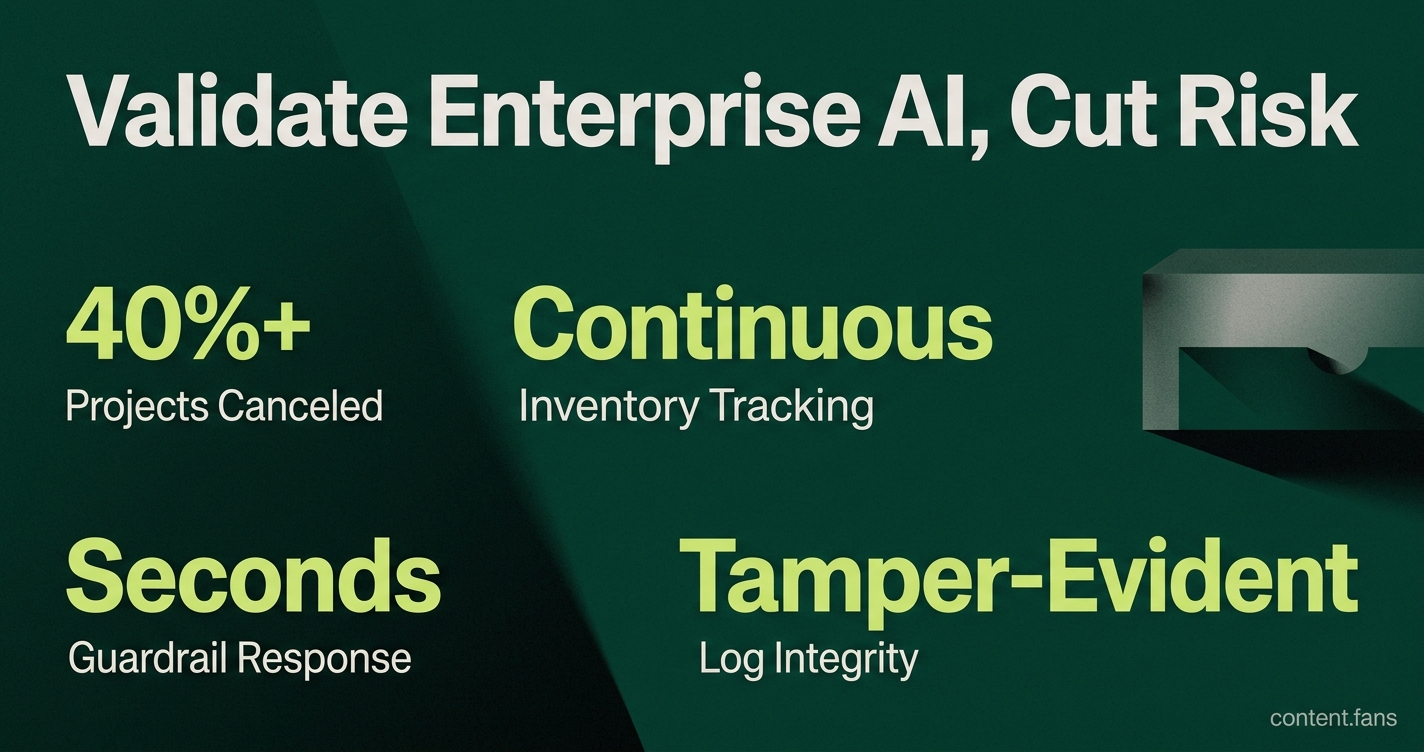
To combat rising "agentwashing" claims and comply with new regulations like the EU AI Act, enterprises require a comprehensive AI agent checklist to validate vendor capabilities. With analysts predicting that over 40% of agentic AI projects will be canceled by the end of 2027 due to escalating costs, unclear business value, or inadequate risk controls, an evidence-driven checklist is crucial for distinguishing genuine autonomous agents from rebranded chatbots before procurement.
The checklist must translate abstract policy language into concrete, runnable tests. This playbook aligns leading governance frameworks - including the Iternal security guide and Zenity's governance pillars - with reproducible acceptance criteria for vetting AI agents.
1. Visibility and Inventory
An enterprise AI agent checklist is a structured validation framework used to verify an AI vendor's claims. It translates governance policies into executable tests that confirm an agent's capabilities in areas like security, autonomy, and resilience, providing a data-driven method for risk mitigation before procurement.
The first step is establishing a complete, real-time inventory. The Iternal guide recommends a continuous, living inventory to track every agent, including shadow deployments, with clear ownership and data scope. The acceptance test involves running an automated crawler to ensure a significant portion of discovered agents are registered in a central repository.
2. Identity, Access, and Least Privilege
Enforcing least-privilege access is non-negotiable, as detailed in Zenity's AI Agent Governance Checklist. Auditors must verify that every API call is authenticated with an agent-specific identity tied to strict role-based access controls (RBAC). A valid test rejects over-scoped token requests and must demonstrate zero privilege escalations in sampled attempts.
3. Runtime Guardrails and Kill Switches
Robust runtime guardrails, including anomaly detection and instant kill switches, are essential for safety, as outlined in Atlan's EU AI Act guardrails template. An audit should test this by forcing a disallowed action, expecting the system to terminate the process within seconds and generate a logged alert visible in SOC dashboards with a unique event ID.
4. Tamper-Evident Audit Logging
To meet compliance mandates like the EU AI Act, agents must produce tamper-evident audit logs. Auditors should validate the immutability of these logs, which must include prompts, tool call sequences, and output hashes. A successful test verifies that checksums for all activity match the ledger without deviation, ensuring data integrity.
5. Human-in-the-Loop Checkpoints
For high-risk tasks, human-in-the-loop (HITL) checkpoints are mandatory. Verification requires simulating a high-risk action and confirming the agent pauses to seek approval from a designated human owner. The escalation must be time-stamped and logged, as failure at this stage disqualifies the agent for regulated use cases.
6. Resilience, Fallback, and Retry Behavior
Agents must demonstrate operational resilience. Chaos testing should be used to degrade dependencies and verify the agent's response. It must perform a limited number of retries before executing a defined fallback plan, avoiding infinite loops. Key metrics like error rate and mean time to restore should meet established benchmarks according to industry standards.
7. Post-Deployment KPIs
After passing the audit, continuous monitoring is key. Track post-deployment KPIs across four categories: resolution, quality, performance, and business impact. Industry reports suggest targeting high resolution rates while maintaining low hallucination rates. A structured monitoring cadence (daily, weekly, monthly) ensures ongoing governance and value delivery.
Contract Language Templates
Incorporate these acceptance criteria directly into vendor contracts. Master service agreements should include clauses that enforce compliance, such as requiring delivery of tamper-evident logs upon request or tying a portion of fees directly to the achievement of performance KPIs. This adds contractual weight to your technical validation.
A robust AI agent checklist, reinforced by automated testing and strong contractual clauses, empowers enterprises to cut through market hype, mitigate risk, and confidently deploy only verified, production-ready AI agents.
What is the New AI Agent Checklist and why does it matter in 2026?
The checklist is a runnable audit playbook that procurement and engineering teams can execute before signing a contract or turning on an agent in production. It forces vendors to prove - in real time - that their "agent" can orchestrate tasks, call tools, remember state, emit logs, survive failures, and escalate to humans when needed. Early adopters using similar validation routines have reported significant reductions in post-deployment incidents and faster buying cycles because buyers abandon over-hyped tools earlier in the process.
Which test areas must be covered to avoid "agent-washing"?
Insist on six concrete demonstrations:
- Orchestration - show the agent breaking a complex goal into sub-tasks and reordering them on the fly.
- Tool invocation - verify it can authenticate to at least two enterprise APIs and handle schema drift.
- State & context retention - restart the container mid-task and confirm it resumes exactly where it left off.
- Observability - expose a trace that links every prompt, tool call, and response to a single request-ID.
- Resilience - inject a 500 error on the third tool call and watch an automatic retry with exponential back-off.
- Human-in-the-loop - trigger a policy boundary and confirm a logged hand-off with a clear audit owner.
Contracts should withhold a portion of license fees until these acceptance tests pass in a customer-controlled environment.
How can enterprises operationalize the checklist without slowing delivery?
Embed the tests inside existing CI/CD gates. A Fortune-500 template now spins up a disposable test harness in under 12 minutes; if the agent fails any gate, the build is red and the vendor has 48 hours to patch. After three red builds the buyer may walk away penalty-free. This keeps pilots moving while transferring risk back to the supplier.
What post-deployment KPIs prove an agent is delivering value?
Track a four-tier dashboard:
- Resolution rate - First Contact Resolution (FCR) targets are typically 70 - 75% for human or hybrid support. AI-native resolution rates in year one are realistically 55 - 70%, reaching 70 - 85% only with deep backend integration.
- Hallucination rate - keep argument invention at low levels across all tool calls.
- Cost per resolved task - benchmark against the human average; agents often land significantly lower.
- CSAT delta - measure customer satisfaction at least monthly; a significant drop should force a design review.
Companies that publish these metrics internally see faster user adoption and board-level confidence in further scaling budgets.
Where can teams download starter scripts and contract language?
The Zenity CISO checklist and Sec-Ra compliance template both provide copy-ready Python test stubs and Word-format contract clauses that map each checklist item to an EU AI Act or ISO/IEC 42001 control. Adopters are encouraged to fork and extend the scripts to match their own API landscapes rather than building from scratch.